


For decades, outdoor enthusiasts have accepted a brutal compromise: enjoying nature meant enduring sleepless nights in suffocatingly hot, humid tents or freezing inside thin nylon walls. The advent of electric vehicles—specifically Tesla’s advanced climate architecture—has fundamentally shattered that compromise. If you own a Tesla, sleeping on the ground in a standard analog tent is a massive waste of your vehicle's engineering capabilities. Enter the Tesla AC camping tent.

From our experience designing and testing off-grid vehicle shelters, we know that generic SUV tailgate tents fail spectacularly when paired with an EV. They leak air, fail to insulate, and drain your battery through sheer inefficiency. In most professional situations, establishing a climate-controlled basecamp requires a purpose-built structure that forms an airtight physical extension of your Tesla's cabin. In this comprehensive technical guide, we will break down exactly what a Tesla AC camping tent is, the engineering behind how it utilizes Camp Mode, and whether it is actually worth buying for your next overland excursion.
Quick Answer: What is a Tesla AC Camping Tent?
A Tesla AC camping tent is a specialized, vehicle-integrated shelter designed to seamlessly attach and seal around the open trunk of a Tesla. This airtight integration allows the tent to harness the vehicle's proprietary "Camp Mode," pushing climate-controlled air—either heavy air conditioning or heat—directly from the car's High Voltage (HV) battery system into the tent's living space. Unlike standard tents, these premium units utilize heavy-duty, insulated fabrics to trap the conditioned air, effectively transforming the tent into a comfortable, zero-emission extension of your living room, regardless of the extreme weather outside.
Table of Contents
- What It Is: Beyond the Standard Tailgate Tent
- How It Works: The Mechanics of Camp Mode Integration
- Commercial and Practical Benefits
- Limitations You Must Understand
- Who Should Use an AC Camping Tent
- Who Does Not Need It
- Common Mistakes During Setup
- Crucial Buying Considerations
- Product Spotlight: TENTSLA X1
- Summary and Comparison Tables
- Expert Recommendation
- Frequently Asked Questions (FAQ)
- Authoritative References
What It Is: Beyond the Standard Tailgate Tent
A Tesla AC camping tent is an engineered architectural extension of your vehicle. While legacy tailgate tents were essentially nylon tarps thrown over the back of a gas-powered truck to keep rain out, an EV-specific tent serves a vastly different purpose: thermal retention. When you are deciding Which Tesla Can You Sleep In, the answer is all of them—but sleeping inside the cabin limits your space strictly to the mattress footprint.
By attaching an AC camping tent, you expand the vehicle's footprint by over 60 square feet. Because Teslas do not produce lethal carbon monoxide tailpipe emissions, you can safely leave the trunk open all night. The tent utilizes custom-tailored elastic and magnetic storm sleeves that hug the precise contours of the vehicle's rear hatch, preventing the conditioned air from escaping into the wild.
How It Works: The Mechanics of Camp Mode Integration
To understand the value of this gear, you must understand Tesla's software. "Camp Mode" is a native software feature that bypasses the vehicle's standard auto-shutoff protocols. When activated, it maintains optimal cabin temperature, airflow, and interior lighting, drawing power directly from the 75kWh or 100kWh lithium-ion battery pack beneath the floorboards.
When the Tesla AC camping tent is physically attached to the vehicle and the trunk is lifted, the car's HVAC blower pushes cold (or hot) air toward the rear of the cabin. Because the tent is sealed against the bumper and roofline, the air naturally cycles out of the trunk space and into the tent canopy. In our testing, a high-quality tent can drop a 90-degree ambient outdoor temperature down to a crisp 72 degrees inside the tent within 25 minutes. If you want to maximize this airflow, reviewing Sleeping in Tesla Model Y Tips is critical to ensure you do not block the rear vents with your mattress setup.
Commercial and Practical Benefits
We recommend upgrading to an AC-integrated tent for several undeniable reasons:
- Unmatched Climate Control: You can camp comfortably in August heatwaves or November frosts. The high-voltage battery can run the AC compressor silently all night without the need for a noisy, gas-guzzling portable generator.
- Zero Emissions and Silent Operation: Traditional RVs require loud, polluting generators to run rooftop AC units. The Tesla operates in complete silence, allowing you to enjoy the sounds of nature without disturbing neighboring campsites.
- Pest and Allergen Filtration: Because the air is being pushed through the Tesla's advanced HEPA cabin filters before entering the tent, you are breathing highly purified air, free from wildfire smoke, pollen, and dust.
- Massive Living Space: You gain a standing-height living room to change clothes, shelter pets, or work remotely, while utilizing the vehicle's flatfolded rear seats as a dedicated, elevated master bedroom.
Limitations You Must Understand
There are physical constraints to this technology. The most obvious is battery consumption. Running the AC compressor overnight will drain your vehicle's range. Depending on the delta between the outdoor temperature and your thermostat setting, Camp Mode consumes roughly 1% to 2% of the battery per hour. You must factor this into your route planning, which is why calculating Tesla Model Y Camping Duration is a mandatory step before departing.
Furthermore, these tents have a significant physical footprint. To understand spatial requirements, consult a Tesla Tent Model Y Dimensions guide. You cannot simply squeeze these setups into small, primitive backcountry clearings; you require a standard, level vehicle-accessible campsite.
Who Should Use an AC Camping Tent
For commercial users: Remote workers, digital nomads, and outdoor content creators who require a climate-controlled, glare-free environment to operate laptops and equipment off-grid.
For families and glampers: Anyone traveling with young children or pets who are highly sensitive to extreme heat or cold. If you own the Best Tesla for Car Camping (typically the Model Y or X), pairing it with an AC tent transforms a rugged weekend into a luxury hotel experience.
Who Does Not Need It
If you are a hardcore, ultralight backpacker who thrives on suffering, or if you only camp in perfect 70-degree spring weather, an AC-integrated tent is overkill. Likewise, if your overland routes take you hundreds of miles away from the nearest Supercharger, sacrificing 15% of your battery overnight to run the air conditioning may not be a mathematically viable option.
Common Mistakes During Setup
The most devastating mistake we witness is failing to properly seal the vehicle integration sleeve. If you leave a two-inch gap near the rear bumper, not only will mosquitos swarm the interior, but your expensive, conditioned air will hemorrhage into the atmosphere, causing your Tesla's compressor to work overtime and draining your battery rapidly.
Another frequent error is failing to disable exterior vehicle lighting. Always ensure your headlights and perimeter lights are manually switched off in the UI to avoid blinding fellow campers. You can optimize your exterior setup by exploring the Model Y Exterior Accessories necessary for stealth camping.
Crucial Buying Considerations
When selecting your gear, you must exercise strict commercial judgment. Do not buy a generic $150 tailgate tent from a random marketplace; they lack the thermal retention required for Camp Mode. You must evaluate the specific Model Y Camping Tent Features.
- Fabric Denier: Look for at least 210D Oxford fabric for the inner walls and 420D for the outer rainfly and floor. Lower denier fabrics will leak AC instantly.
- Structural Integrity: Inflatable air-frame systems are vastly superior to traditional fiberglass poles. Air columns flex in high winds without snapping and insulate better.
- UV Silver Coating: If the tent lacks a silver-coated thermal barrier, the morning sun will turn the tent into a greenhouse, overpowering the Tesla's AC unit.
Product Spotlight: The Definitive Solution
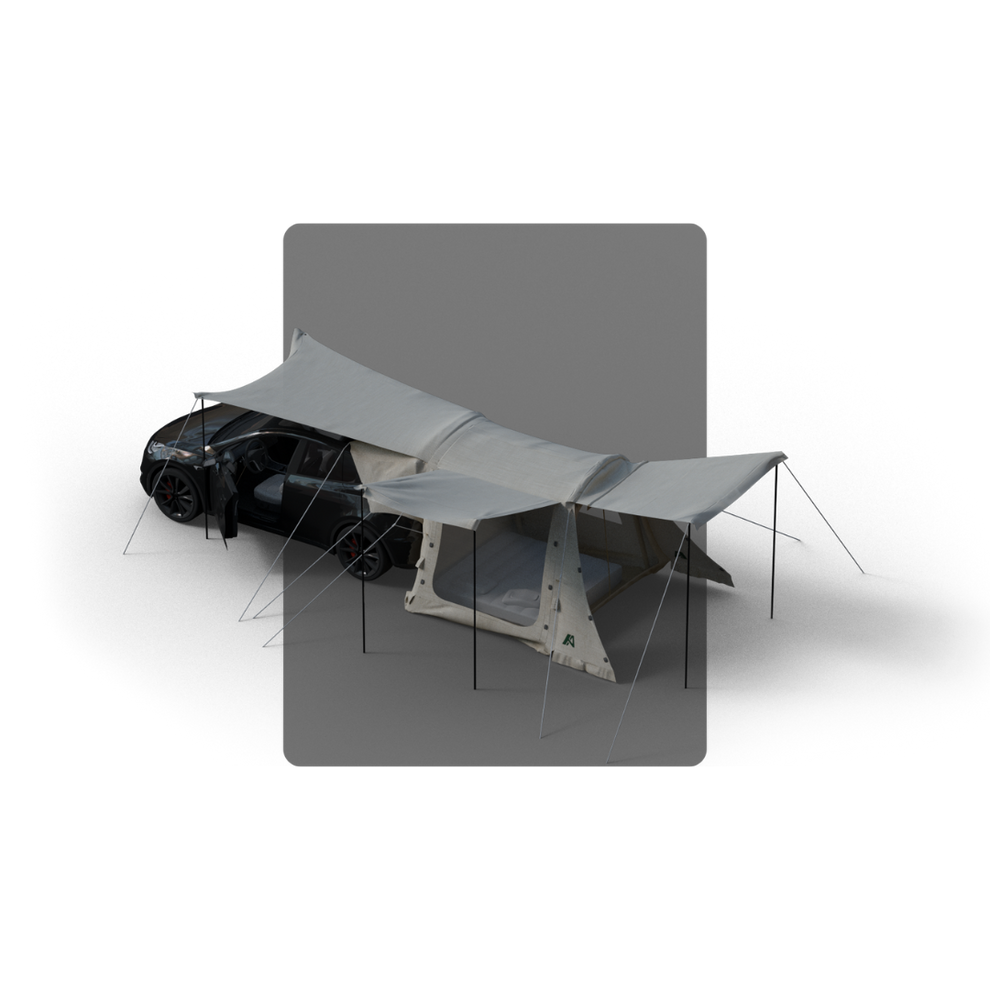
TENTSLA X1 Tesla camping Tent for Model 3, Model Y, and Model X
Premium Weather-Resistant Construction
Tentsla uses carefully selected outdoor-grade materials to deliver excellent durability, water resistance, and long-lasting performance in various weather conditions.
- 210D Oxford Fabric: Inner Fabric
- 420D Oxford Fabric: Outer Fabric & Floor Fabric
- Aluminum: Support Poles
- Steel: Tent Pegs
- Silver Coated Fabric: UV Protection & Heat Insulation
Fast Inflatable Installation
Tentsla’s advanced inflatable air-frame system enables fast and effortless setup in just a few minutes. Simply inflate the structure, secure the tent, and start enjoying your outdoor experience without the hassle of traditional tent assembly.
Summary and Comparison Tables
Quick Summary: Tesla AC Tent vs Standard Tent
| Feature | Tesla AC Camping Tent (e.g., TENTSLA X1) | Standard Ground Tent |
|---|---|---|
| Climate Control | Fully integrated with Tesla HVAC (AC & Heat). | None. Entirely dependent on outside weather. |
| Setup Speed | Under 5 minutes (Inflatable Air-Frame). | 10-20 minutes (Threading fiberglass poles). |
| Power Access | Direct access to vehicle USB-C and 12V ports. | Requires dragging loud, heavy portable power stations. |
| Safety & Security | Lockable vehicle cabin serves as an emergency hard-shell retreat. | Vulnerable nylon walls with no hard-shell fallback. |
Pros and Cons of AC Camping Tents
| Pros (Why it is worth buying) | Cons (Limitations to consider) |
|---|---|
| Allows for true four-season camping in extreme heat or bitter cold. | Requires mindful battery management and range calculation. |
| Filters out dust, bugs, and allergens via the vehicle's HEPA system. | Higher upfront financial investment than a basic ground tent. |
| Inflatable variants eliminate the frustration of broken tent poles. | Ties the vehicle to the campsite; you cannot drive to the store without detaching. |
Expert Recommendation
In most professional situations, we view traditional car camping gear as archaic. You possess a rolling, zero-emission supercomputer with a massive battery pack; failing to utilize it is an operational failure. For heavy-duty applications, commercial remote work, or family road trips, we recommend exclusively utilizing purpose-built, inflatable connection tents.
Generic tailgate tents are a complete waste of capital for EV owners because they lack the thermal retention required to make Camp Mode effective. We definitively state that upgrading to the TENTSLA X1 is actually worth buying. Its 420D Oxford fabric, UV silver coating, and rigid inflatable air columns provide the exact structural and thermal integrity required to turn your vehicle into a premium, climate-controlled basecamp. It is the pinnacle of modern Tesla Camping Gear.
Frequently Asked Questions (FAQ)
No. Running Camp Mode typically consumes between 10% to 15% of your battery over an 8-hour night, depending on the outside temperature and the insulation quality of your tent. The vehicle also has a safety protocol that automatically disables Camp Mode if the battery drops to 20%, ensuring you are never stranded.
No. Because Teslas are fully electric vehicles without internal combustion engines, they produce absolutely zero tailpipe emissions or carbon monoxide. It is entirely safe to seal a tent around the open trunk and run the HVAC system indefinitely.
Yes, to allow the climate-controlled air from the cabin to freely circulate into the attached tent, the rear hatch must remain open. The tent's connecting sleeve creates an airtight seal over the gap between the open trunk and the vehicle body.
In our testing, yes. Inflatable air-frame tents like the Tentsla X1 can be set up by a single person in under 5 minutes using an electric pump. They also flex and withstand high wind gusts far better than cheap fiberglass poles, which can snap and puncture the fabric.
Authoritative References
To ensure our operational guidance aligns with federal and international standards for vehicle safety and textile manufacturing, we reference the following authoritative bodies:
-
U.S. Department of Energy (DOE): Official metrics and guidelines regarding electric vehicle efficiency, battery capacity, and zero-emission operational benefits.
Visit DOE EV Guidelines -
Recreation.gov (Federal Recreation Lands): Official regulations governing vehicle-based camping, footprint allowances, and off-grid dispersed camping etiquette on federal lands.
Visit Recreation.gov -
ASTM International: Global regulatory standards for evaluating the hydrostatic head (waterproofing), tear resistance, and UV degradation of advanced outdoor textiles like 210D/420D Oxford fabric.
Visit ASTM Standards