


The internet is currently saturated with concept art, rumors, and speculative YouTube videos surrounding a dedicated Tesla motorhome. Enthusiasts and outdoor adventurers are actively pausing their purchasing decisions, asking: is Tesla coming out with a camper 2027? From our experience outfitting thousands of electric vehicles for overland adventures, banking on a dedicated, factory-built Tesla RV hitting the market by 2027 is a critical error in commercial judgment.

While the prospect of an aerodynamic, native-electric motorhome running on the Cybertruck or Semi architecture is undeniably appealing, the automotive reality is far more sobering. Tesla has a well-documented history of ambitious timelines that stretch into vaporware territory. Prioritizing a mythical future vehicle over utilizing the highly capable Tesla platforms that exist today means sacrificing years of irreplaceable outdoor experiences. In this comprehensive guide, we will dissect the realities of the rumored 2027 Tesla camper, analyze the physics of electric recreational vehicles, and explain why upgrading your current Model Y or Cybertruck with a premium tent ecosystem is the only logical choice for modern adventurers.
Quick Answer
No, there is zero official confirmation that Tesla coming out with a camper 2027 is a reality. While speculative renders of a "Cybervan" or Tesla RV circulate online, Tesla's current production roadmap is entirely consumed by scaling the Cybertruck, the upcoming next-generation compact car, and the Tesla Semi. In most professional situations, we recommend against waiting for an unannounced factory RV. Instead, you should convert your existing Tesla into a highly capable off-grid camper right now using aftermarket ecosystem integrations like the TENTSLA X1.
- What is the 2027 Tesla Camper Rumor?
- How it Works: The Physics of an Electric RV
- The Hypothetical Benefits of a Factory Camper
- Limitations of Waiting for 2027
- Who Should Wait and Who Should Act Now
- Common Mistakes Buyers Make
- Buying Considerations: Upfitting Your Current Tesla
- The Ultimate Solution: TENTSLA X1
- Expert Recommendation
- Data and Comparison Tables
- Frequently Asked Questions
What is the 2027 Tesla Camper Rumor?
The rumor that Tesla coming out with a camper 2027 stems from speculative interpretations of Elon Musk's previous comments regarding a high-passenger-density "Cybervan" and the inherent camping capabilities of the Cybertruck platform. The automotive community has essentially willed the concept of a Tesla Sprinter-van rival into existence. Enthusiasts envision a vehicle utilizing the 4680 structural battery pack, equipped with a native solar roof, integrated Starlink, and a built-in climate-controlled living space optimized entirely around Tesla's software ecosystem.
However, an objective look at Tesla's investor relations reports and quarterly production calls reveals a different priority matrix. The company is hyper-focused on autonomy, robotics, and mass-market vehicle scaling. Designing, testing, and crash-certifying a niche recreational vehicle simply does not align with their near-term fiscal objectives.
How it Works: The Physics of an Electric RV

Understanding why an official Tesla camper is unlikely to materialize by 2027 requires understanding the physics of electric propulsion. Range is the ultimate enemy of electric recreational vehicles. Traditional RVs are essentially rolling bricks; their drag coefficients are disastrous. In an internal combustion engine (ICE) vehicle, you simply accept abysmal gas mileage. In an electric vehicle, massive aerodynamic drag slashes your range exponentially.
To make an electric RV viable, the manufacturer must either pack it with an impossibly heavy battery (which compromises payload capacity and requires specialized commercial driver's licenses) or redesign the RV teardrop shape to slice through the air, which severely limits interior headroom. Currently, the most efficient way to camp electrically is not to build an oversized electric RV, but to utilize an aerodynamic passenger vehicle (like the Model Y) and attach a lightweight, collapsible external shelter at your destination.
The Hypothetical Benefits of a Factory Camper
If we play devil's advocate, a factory-built Tesla camper would present undeniable benefits. Native software integration means the vehicle's massive battery could seamlessly run an induction cooktop, a residential refrigerator, and a high-efficiency heat pump for weeks without requiring external shore power. It would offer a unified warranty, negating the need to patch together aftermarket inverters and lithium power stations.
Limitations of Waiting for 2027
The limitations of the "wait and see" approach are devastating to your lifestyle. First is the phenomenon colloquially known as "Elon Time." The Cybertruck was announced in 2019 and did not see meaningful customer deliveries until late 2023. If Tesla coming out with a camper 2027 was officially announced tomorrow, historical data suggests you would not take delivery until 2030.
Second is the opportunity cost. Every year spent waiting for a mythical vehicle is a year of memories lost. Your current Tesla is already a rolling climate-controlled battery pack. In our testing, the Model Y's native HVAC system consumes roughly 1% to 1.5% of battery per hour in Camp Mode, making it a near-perfect micro-camper today.
Who Should Wait and Who Should Act Now
Who does not need it (Who should act now): Practical outdoor enthusiasts, families, and overland adventurers should completely ignore the 2027 rumors. You should leverage the vehicle sitting in your driveway. By utilizing aftermarket solutions, you can achieve 90% of the functionality of a dedicated motorhome right now. If you are wondering about the interior logistics, read our guide to see if Sleep Two Adults in Tesla Model Y is viable for your setup.
Who should wait: The only consumers who should pause their camping plans are die-hard brand purists with unlimited budgets who possess secondary recreational vehicles and are willing to wait an indeterminate number of years for a factory-stamped product.
Common Mistakes Buyers Make
The most egregious mistake we see is consumers fundamentally misunderstanding the current capabilities of their Tesla. People assume that because their Model 3 or Model Y is a passenger sedan or crossover, it cannot support off-grid living. They fail to understand the power of Camp Mode. Another common error is buying generic, poorly fitting camping gear that damages the vehicle's weather stripping. Instead of purchasing generic air mattresses, users should invest in a tailored Tesla Camping Mattress designed specifically for the sub-trunk and wheel well dimensions of the vehicle.
Furthermore, owners often confuse the vehicle's pet-safety features with human comfort settings. Before heading into the wilderness, you must understand the Tesla Camp Mode vs Dog Mode functionality to ensure your 12V outlets remain active overnight for your accessories.
Buying Considerations: Upfitting Your Current Tesla
Instead of chasing rumors, commercial and practical judgment dictates upfitting your current rig. When building out your Tesla, consider modularity. A permanent camper van is useless for daily commuting. A modular setup allows your Model Y to be a grocery getter on Tuesday and an off-grid cabin on Saturday.
Look into Tesla Model Y Camper Kits that provide structured storage and cooking pull-outs. Combine these with Tesla Camping Accessories like custom window shades for privacy and insulation. If you are an early adopter of the Cybertruck, do not wait for a dedicated Cybertruck RV variant; research the Cybertruck Tent Price and integrate an external shelter immediately.
The Ultimate Solution: TENTSLA X1
In most professional situations, a vehicle's interior cabin is simply too restrictive for long-term habitation. You need a basecamp that seamlessly connects to your vehicle's climate control while expanding your living footprint. This is where Tentsla dominates the market.
TENTSLA X1 Tesla Camping Tent for Model 3, Model Y, and Model X
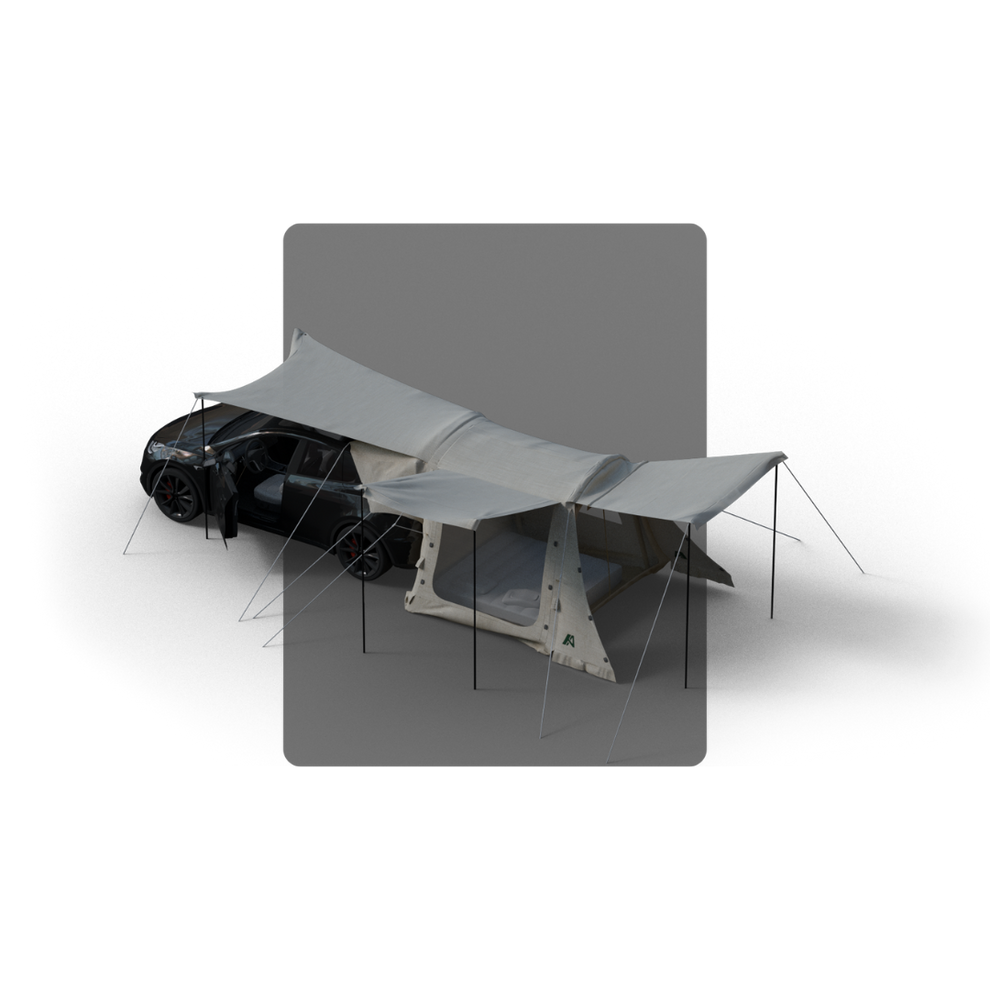
Premium Weather-Resistant Construction
Tentsla uses carefully selected outdoor-grade materials to deliver excellent durability, water resistance, and long-lasting performance in various weather conditions. Forget the vaporware of a 2027 camper; this is the reality of 2026 glamping.
| Material | Application |
|---|---|
| 210D Oxford Fabric | Inner Fabric |
| 420D Oxford Fabric | Outer Fabric & Floor Fabric |
| Aluminum | Support Poles |
| Steel | Tent Pegs |
| Silver Coated Fabric | UV Protection & Heat Insulation |
Fast Inflatable Installation
Tentsla’s advanced inflatable air-frame system enables fast and effortless setup in just a few minutes. Simply inflate the structure, secure the tent, and start enjoying your outdoor experience without the hassle of traditional tent assembly. By sealing the tent directly to the tailgate, you channel your Tesla's HEPA-filtered air conditioning directly into your massive, weather-proof living room.
Expert Recommendation
The Tentsla Verdict
From our experience engineering outdoor solutions specifically for electric vehicles, waiting to see if Tesla coming out with a camper 2027 is true is a fundamental waste of your time and resources. The EV architecture already exists in your driveway. Your Model Y or Model X has a battery pack capable of sustaining you off-grid for days. By installing a Tesla Model Y Camping Platform and attaching the Tentsla X1, you instantly create a highly aerodynamic, dual-room luxury camper at a fraction of the cost of a dedicated motorhome.
Data and Comparison Tables
| Criteria | Rumored 2027 Tesla RV | Current Model Y + Tentsla X1 |
|---|---|---|
| Availability | Unknown (Highly unlikely by 2027) | Available Now |
| Cost to Implement | Estimated $100,000 - $150,000+ | Vehicle cost + Sub-$2,000 for premium gear |
| Daily Drivability | Poor (Large footprint, hard to park) | Excellent (Standard passenger vehicle) |
| Climate Control | Native Integration | Native Camp Mode integration via trunk seal |
| Pros | Cons |
|---|---|
| Immediate access to off-grid adventures. | Requires setting up equipment at the campsite. |
| Fraction of the cost of a dedicated RV. | Less interior standing room inside the vehicle itself. |
| Maintains maximum aerodynamic efficiency on the highway. | No built-in gray/black water plumbing systems. |
| Vehicle remains fully practical for daily commuting. | Storage space must be carefully managed. |
| Component Needed | Why You Need It | Our Recommendation |
|---|---|---|
| External Shelter | Expands living space and creates a weather-proof vestibule. | Tentsla X1 Tailgate Tent |
| Sleeping Surface | Levels the cargo floor and provides insulation. | Memory foam mattress specifically cut for Model Y/3 contours. |
| Privacy | Blocks ambient light and insulates cabin glass. | Custom-fit blackout window shades. |
| Cooking Setup | Utilizes the 12V/16V system for safe, fire-free cooking. | Portable induction cooktop paired with a camp kitchen slide-out. |
Frequently Asked Questions
Has Elon Musk confirmed a Tesla Camper for 2027?
No. There has been no official confirmation, press release, or roadmap inclusion of a dedicated recreational vehicle or camper van from Tesla slated for 2027. All current images online are third-party concepts or AI-generated renders.
Can I use Camp Mode in a tent attached to my Tesla?
Yes. In our testing, using a premium tailgate tent like the Tentsla X1, which seals tightly around the rear hatch of the vehicle, allows the Tesla's robust HVAC system to effectively heat or cool both the vehicle cabin and the attached tent extension.
Is it bad for the battery to run Camp Mode all night?
No. Tesla's battery management system is specifically engineered to handle continuous low-draw loads like climate control. Running Camp Mode overnight typically consumes only 10% to 15% of the total battery capacity, depending on the external temperature differential, causing zero long-term degradation.
How can I sleep comfortably in a Model 3?
While smaller than the Model Y, the Model 3 can accommodate two adults. You must fold the rear seats flat and remove the rear seat bench cushion for a perfectly level surface. For a complete breakdown, review our guide on Sleep in Tesla Model 3.
Authoritative References & Industry Standards
To ensure our analysis of EV capabilities and automotive roadmaps is grounded in fact, we reference the following authoritative organizations regarding electric vehicle architecture and manufacturing timelines:
- National Highway Traffic Safety Administration (NHTSA) - For safety standards and crash testing compliance timelines that dictate new vehicle rollouts.
- RV Industry Association (RVIA) - For industry standards regarding recreational vehicle classifications and the integration of electric powertrains into motorhomes.
- Car and Driver - For verified automotive journalism and tracking of official manufacturer production roadmaps and concept vehicle reality checks.