


As electric vehicles revolutionize off-grid travel, the most persistent question we receive from new owners and prospective buyers is highly specific: Can two adults sleep in a Tesla Model Y? It is a question born of a desire to eliminate expensive hotel bills, bypass crowded airport terminals, and wake up directly at the trailhead.

From our experience at TENTSLA, engineering premium outdoor gear specifically for EV ecosystems, the short answer is absolutely yes. However, in most professional situations, simply knowing the dimensions is not enough. Sleeping comfortably inside a crossover SUV requires a strategic understanding of the vehicle's unique physical architecture, battery management, and climate control software. If you simply throw a cheap sleeping bag into the trunk, you will wake up miserable, dehydrated, and sore. In this definitive guide, we will break down the exact interior measurements, analyze the battery drain of Camp Mode, and provide our uncompromising recommendations on how to turn your Model Y into a luxury mobile hotel room.
Quick Answer: The Reality of Model Y Camping
Yes, two adults can sleep very comfortably in a Tesla Model Y. In fact, it is widely considered the undisputed champion of the EV car-camping lifestyle. Here are the core facts you need to know:
- Space Capacity: With the rear seats folded down and the front seats pushed fully forward, the cargo floor provides roughly 78 inches of length and 54 inches of shoulder width. This easily accommodates two adults up to 6'4" tall.
- Battery Drain: Utilizing Tesla's built-in Camp Mode overnight in mild weather will drain roughly 10% to 15% of your total battery capacity (approximately 7 to 10 kWh).
- The Catch: The folded rear seats do not lie perfectly flat; they rest at a 7 to 10-degree incline. To sleep comfortably, you must use a custom-contoured mattress designed specifically for the Model Y to neutralize this slope.
We recommend prioritizing a high-quality mattress and complete blackout window shades before taking your first overnight trip. Without them, you are merely surviving the night, not enjoying it.
Table of Contents
- What It Is: The Interior Architecture of the Model Y
- How It Works: The Magic of Camp Mode
- The Tangible Benefits of Model Y Glamping
- Limitations: The "Model Y Step" and Other Realities
- Who Should Use It & Who Does Not Need It
- Common Mistakes That Ruin the Night
- Summary & Comparison Tables
- Strategic Buying Considerations for the Perfect Setup
- Expert Recommendation from TENTSLA
- The Bottom Line
- Frequently Asked Questions
What It Is: The Interior Architecture of the Model Y
To truly understand why the Model Y is the premier vehicle for a Tesla Camping Experience, we must look at the geometry. Unlike the Model 3, which suffers from a rigid parcel shelf that blocks vertical movement in the trunk, the Model Y is a crossover liftback. When you fold down the 60/40 split rear seats, you open up a massive, cavernous space totaling 71.4 cubic feet of volume behind the front row.
By moving the driver and passenger seats to their furthest forward position, you create a sleeping surface that is approximately 78 inches long. The width between the wheel wells is roughly 41 inches, expanding to over 54 inches at the shoulders. Because of the domed glass roof, vertical headroom is exceptional. You can easily sit up cross-legged, read a book, or eat a meal without striking your head against the glass. Furthermore, the Model Y features a massive hidden sub-trunk beneath the floorboards. This allows you to store all your luggage, charging cables, and shoes completely out of the way, keeping your primary sleeping surface immaculate and uncluttered.
How It Works: The Magic of Camp Mode
The physical space is only half the equation. What transforms the Model Y from an ordinary car into a climate-controlled sanctuary is software. Tesla's Camp Mode is a specialized software setting that maintains cabin temperature, keeps the central touchscreen active, and provides continuous power to the USB-C ports, all while putting the vehicle's drivetrain into a low-power state. Crucially, it disables the Sentry Mode alarm system, ensuring that tossing and turning in your sleep will not trigger blaring horns and flashing lights.
In our testing, battery consumption is highly predictable but heavily dependent on ambient temperature. If the outside temperature is a mild 65°F (18°C), Camp Mode will quietly sip power, using about 10% to 15% of your battery over an 8-hour night. However, for heavy-duty applications like winter camping in sub-freezing temperatures, the vehicle's heat pump will work overtime. In temperatures below 20°F (-6°C), you should expect a battery drain closer to 20% to 25%. The system is remarkably safe; if your battery drops to 20% state of charge (SoC), Camp Mode will automatically disable itself to ensure you have enough range to reach a Supercharger the next morning.
The Tangible Benefits of Model Y Glamping

In most professional situations, we advise clients to view their Model Y as a mobile real estate asset. The financial benefits are immediate. Replacing a $200-a-night hotel room with a scenic, free boondocking spot fundamentally changes the economics of road-tripping. Over a single two-week cross-country journey, a proper camping setup pays for itself.
Beyond economics, the comfort is unparalleled. Traditional tent camping requires enduring oppressive humidity or freezing nighttime temperatures. Inside a Model Y, you have precision climate control. You can set the thermostat to a perfect 68°F, run HEPA-filtered air through the cabin, and fall asleep under a massive panoramic glass roof staring directly at the Milky Way. It offers the security of a locked metal chassis with the immersive nature experience of a high-end glamping resort. You can elevate the coziness even further by incorporating a premium Camping Blanket for Outdoor Trips designed to trap heat without adding bulk.
Limitations: The "Model Y Step" and Other Realities
We must use commercial and practical judgment here: the setup is not completely flawless straight from the factory. The most significant limitation is what the community refers to as the "Model Y Step." When you fold the rear seats forward, they do not lie 100% flat. They sit at a 7 to 10-degree incline, and where the seatbacks meet the trunk floor, there is a minor drop-off or "step." If you simply throw a cheap, thin yoga mat onto the floor, you will feel this ledge digging directly into your lower back all night.
Additionally, while the massive windows are beautiful, they offer zero privacy and turn the cabin into a greenhouse the moment the sun rises. Without heavy-duty blackout shades tailored specifically for the Model Y windows, you will be violently awoken at dawn by blinding sunlight and rapidly rising cabin temperatures.
Who Should Use It & Who Does Not Need It
For commercial users and avid road trippers: The Model Y camping setup is an absolute necessity. If you are a landscape photographer, a traveling salesperson, a festival-goer, or an avid hiker who wants to beat the crowds to the national park gates at sunrise, the Model Y is the ultimate tool for strategic, comfortable overnight staging.
Who does not need it: If you own the rare 6-seater configuration of the Model X, do not attempt to sleep in the cabin, as the motorized captain's chairs do not fold flat. Furthermore, if you are a family of four, squeezing two adults and two growing children into the back of a Model Y is a recipe for extreme claustrophobia. In these scenarios, you cannot rely solely on the cabin; you must expand your footprint outward.
Common Mistakes That Ruin the Night
Over years of managing the Tesla Camping Blog, we have identified several critical errors that beginners consistently make:
- Parking on a Slope: Because the mattress materials are often slick, parking on even a 3-degree incline will cause you to slowly slide down into the trunk hatch all night. Always carry RV leveling blocks or use a phone app to ensure your parking pad is dead level.
- Failing to Manage Moisture: Human respiration generates immense moisture. Even with the AC running, if your climate control is set to "Recirculate," the windows will drip with heavy condensation by morning. You must manually set the climate control to pull fresh air from the outside to mitigate moisture and CO2 buildup.
- Buying a Generic Air Mattress: A standard twin air mattress from a big-box store will not fit around the Model Y wheel wells, and it will not counteract the slope of the folded seats. You must invest in a purpose-built contour mattress.
Summary & Comparison Tables
Quick Summary Table: Model Y Sleeping Capacity
| Specification | Measurement / Detail |
|---|---|
| Maximum Occupants | 2 Adults (up to roughly 6'4" or 193cm) |
| Usable Floor Length | Approx. 78 inches (with front seats pushed forward) |
| Usable Floor Width | 41 inches at wheel wells, 54 inches at shoulders |
| Average Battery Drain | 10% - 15% per 8-hour night (Mild weather) |
Pros and Cons of Sleeping in a Model Y
| Pros of Model Y Camping | Cons of Model Y Camping |
|---|---|
| Eliminates expensive hotel and lodging costs. | Rear seats do not fold perfectly flat (slight slope). |
| Zero tailpipe emissions and silent operation all night. | Requires purchasing custom-cut privacy window shades. |
| Precision, HEPA-filtered climate control via Camp Mode. | Heavy battery drain in extreme sub-freezing weather. |
| Massive sub-trunk allows luggage storage beneath the bed. | Limited vertical height compared to a traditional RV. |
Comparison Table: Model Y vs. Model 3 for Camping
| Feature | Tesla Model Y | Tesla Model 3 |
|---|---|---|
| Body Style | Crossover Hatchback | Traditional Sedan |
| Vertical Headroom | Excellent (Easy to sit completely upright) | Poor (Blocked by rigid rear parcel shelf) |
| Cargo Volume | 71.4 cubic feet | 43.6 cubic feet |
| Sleeping Verdict | Ideal for 2 adults. Highly recommended. | Passable for 1 adult. Claustrophobic for 2. |
Strategic Buying Considerations for the Perfect Setup
To maximize your return on investment and ensure a flawless night of sleep, you must view the interior of the car as a blank canvas that requires specific outfitting. First, the mattress. Do not compromise here. Look for multi-density memory foam or highly structured inflatable mattresses that feature a built-in thicker section at the top. This built-in wedge naturally counteracts the 7-degree slope of the folded seats, leveling out your spine.
Second, light discipline. Invest in a complete set of reflective window covers. These covers not only provide total blackout privacy in crowded campsites but also reflect radiant heat during the day and insulate the glass against freezing temperatures at night.
Finally, what happens when you have more than two people, or you want a dedicated living space to stand up and change clothes? The interior of the Model Y is incredible for sleeping, but it lacks a "living room." If you are planning extended trips, you need to expand your footprint beyond the tailgate.
Expert Recommendation from TENTSLA
The Ultimate EV Glamping Architecture
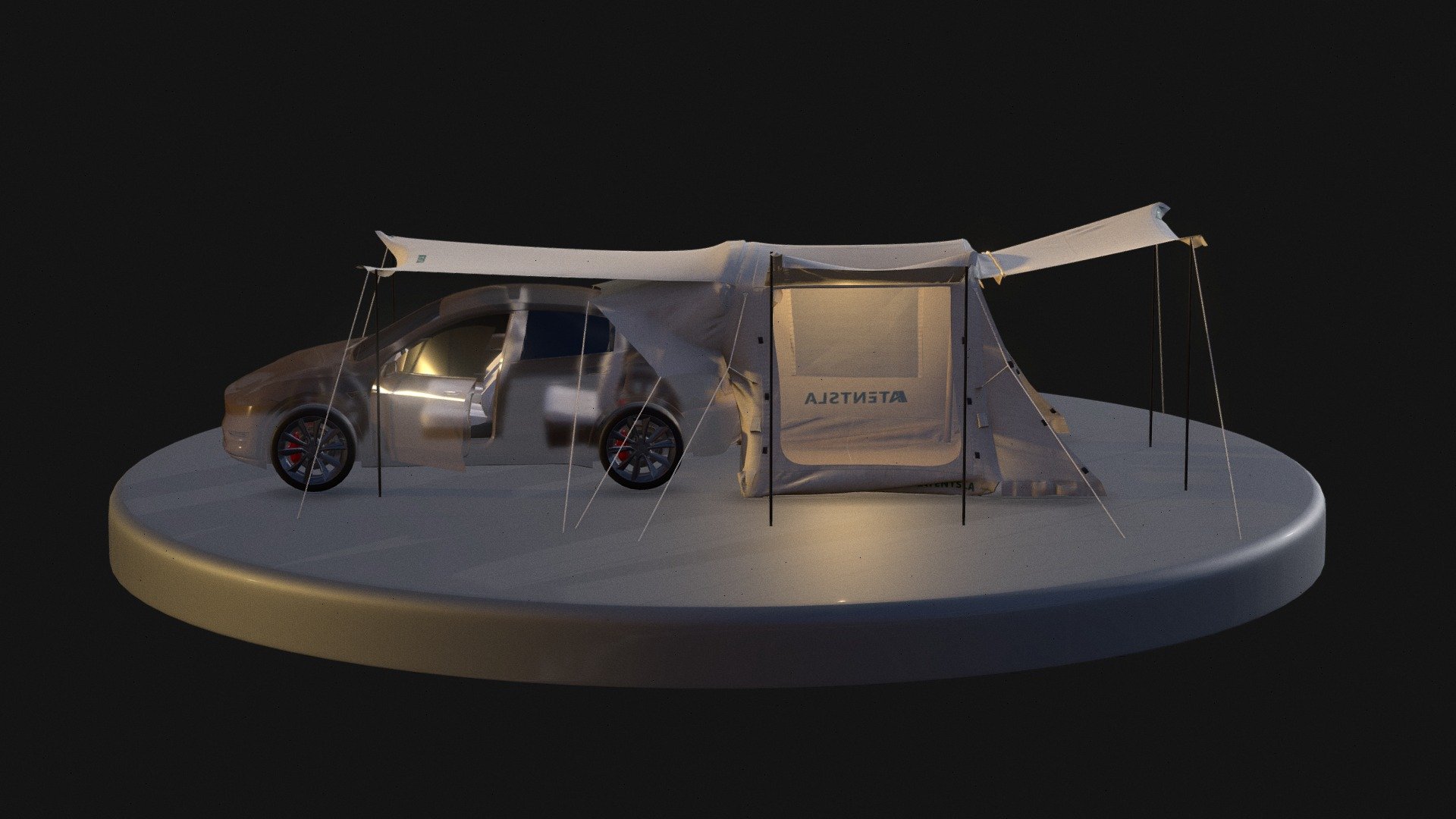
In our testing, relying solely on the cabin of the Model Y limits you to short weekend trips. If you want to transform your Tesla into a true basecamp capable of sustaining a multi-week overland journey, we recommend integrating the TENTSLA X1 Tesla camping Tent.
The TENTSLA X1 is an inflatable, standalone glamping tent engineered specifically to interface perfectly with the rear hatch of the Model Y, Model 3, and Model X. By sealing the tent directly to the open trunk, you effectively double your livable square footage. You can sleep comfortably in the climate-controlled cabin of the Model Y while using the spacious, weather-resistant interior of the TENTSLA X1 as a lounge, dining room, or a separate bedroom for kids and large pets. Because it features fast inflatable installation in minutes, it eliminates the frustration of traditional fiberglass poles. It is the definitive upgrade for anyone serious about the EV outdoor lifestyle. Explore our full range of solutions in the Tesla Camping Collection.
The Bottom Line
Unrivaled Comfort With the Right Equipment
Can two adults sleep in a Tesla Model Y? Emphatically, yes. The Model Y offers a massive 71.4 cubic feet of cargo space, brilliant Camp Mode software, and the structural length to comfortably fit individuals up to 6'4" tall. However, the experience is only as good as your preparation. By acknowledging the minor physical slope of the seats and proactively solving it with a contour mattress, blackout shades, and an expandable tailgate tent like the TENTSLA X1, you bypass the friction of traditional camping and unlock a luxurious, zero-emission travel experience. Stop paying for mediocre hotels and start waking up at the destination.
Frequently Asked Questions
In mild conditions (around 65°F or 18°C), Camp Mode consumes approximately 10% to 15% of your battery over an 8-hour period. In extreme cold where the heat pump must work continuously to maintain cabin warmth, expect the consumption to rise to 20% to 25% per night. Always ensure you begin the night with at least a 40% charge to ensure ample driving range the next morning.
No, for safety reasons, activating Camp Mode disables the automatic walk-away door locks and shuts off the Sentry Mode alarm system. To secure the vehicle while you sleep inside, you must manually tap the lock icon on the central touchscreen or use the Tesla mobile app to lock the doors.
No, they do not. While they fold down smoothly to create a massive cargo area, the backrests sit at a slight 7 to 10-degree incline relative to the trunk floor. To achieve a perfectly flat, ergonomic sleeping surface, you must use a mattress specifically engineered with thicker foam at the head to neutralize the slope.
If you have further technical questions about vehicle integration or tent compatibility, please visit our Tesla Camping FAQ or Contact Tentsla directly.
Authoritative Industry References
- Tesla Motors Official Documentation - Model Y Owner's Manual: Interior Dimensions, Cargo Volume Specifications, and Camp Mode operational parameters.
- Car and Driver - Independent automotive testing metrics detailing interior cargo packaging, wheelbase dimensions, and crossover SUV utility context.
- U.S. Environmental Protection Agency (EPA) - Data regarding zero tailpipe emissions and the environmental benefits of utilizing battery-electric HVAC systems in off-grid environments over traditional idling combustion engines.