


The electric vehicle revolution has completely redefined the boundaries of outdoor recreation and car camping. Historically, overlanding and dispersed wilderness stays required specialized combustion vehicles fitted with complex auxiliary deep-cycle dual-battery setups, noisy gas generators, or high-draw propane space heaters. The rise of modern electric platforms, particularly the Tesla Model Y, has disrupted this framework. By leveraging massive high-voltage lithium traction packs alongside intelligent climate management software, the car transforms from a simple passenger commuter into a fully climate-controlled, mobile micro-living space. However, planning a successful off-grid multi-day stay requires analyzing real-world power parameters rather than relying on idealized assumptions.

At TENTSLA, we are dedicated to designing and manufacturing high-performance overland gear, advanced glamping enclosures, and premium portable sleep setups engineered specifically for the electric vehicle ecosystem. We understand how thermodynamic variables, ambient wind layers, and electronic system loads directly impact a vehicle's range depletion. From our experience, many early EV adventurers make the critical error of treating their car's battery pack as an infinite energy reservoir, failing to understand how aggressive heating in freezing temperatures shifts the hourly energy depletion curve. This technical manual delivers a comprehensive engineering breakdown of exactly how long you can camp in a Tesla Model Y, detailing software management profiles, climate electrical loads, and structural equipment configurations required to scale your off-grid endurance.
- 1. Sourcing Matrix: Model Y Trim Specifications and Camping Endurance
- 2. Electrochemical Engineering: The Mechanics of Camp Mode
- 3. Thermodynamic Factors: Temperature Loads and Power Drain Rates
- 4. Space Optimization: Expanding the Living Footprint via Inflatable Shields
- 5. Frequently Asked Questions (FAQs)
- 6. Regulatory and Industrial Automotive References
1. Sourcing Matrix: Model Y Trim Specifications and Camping Endurance
Before plotting out a multi-day route into remote federal lands or national parks, you must understand your vehicle's specific usable energy capacity. The table below profiles the baseline power metrics observed when you plan to camp in a Tesla Model Y across various factory configurations.
| Tesla Model Y Trim Classification | Battery Pack Chemistry | Usable Pack Capacity (kWh) | Average Camp Mode Loss (Per 8 Hours) | Theoretical Off-Grid Limit (Static Camping) |
|---|---|---|---|---|
| Standard Range / Rear-Wheel Drive | Lithium Iron Phosphate (LFP) | Approximately 60 kWh | 6% to 12% (3.6 - 7.2 kWh) | 4 to 7 Days (Leaving a 20% driving safety buffer) |
| Long Range / Dual-Motor AWD | Nickel Manganese Cobalt (NMC) | Approximately 75 kWh | 5% to 10% (3.7 - 7.5 kWh) | 5 to 9 Days (Leaving a 20% driving safety buffer) |
| Performance / Dual-Motor AWD | Nickel Manganese Cobalt (NMC) | Approximately 75 kWh | 5% to 10% (3.7 - 7.5 kWh) | 5 to 9 Days (Leaving a 20% driving safety buffer) |
2. Electrochemical Engineering: The Mechanics of Camp Mode
To maximize your off-grid timeline when you camp in a Tesla Model Y, you must first understand the software-controlled power distribution occurring inside the vehicle. Unlike traditional combustion cars that run off a fragile 12-volt lead-acid battery and require the engine to idle continuously to run the air conditioning, a Tesla manages its interior environment using its high-voltage main battery pack. When you activate the integrated Camp Mode software profile through the central touchscreen interface, the vehicle executes several critical power-saving routines:
- Continuous Climate Regulation: The car engages the highly efficient cabin heat pump or air conditioning compressor to lock in your precise target temperature indefinitely.
- Low-Voltage Auxiliary Maintenance: The DC-to-DC converter remains active, safely stepping down energy from the high-voltage pack to run the 12V/16V accessory outlets, low-noise USB charging ports, and internal audio sub-systems.
- Security and Visual Dimming: The car automatically disables the high-power ultrasonic security sensors and perimeter alarm grids to prevent midnight false alarms caused by occupant movement. Additionally, the main 15.4-inch display shifts to a dimmed, low-energy ambient interface after 10 minutes of non-interaction.
From our experience, the vehicle's internal computer management enforces a strict safety floor. If your main battery charge drops down to 20% state of charge (SoC), Camp Mode will automatically shut down to preserve your remaining energy for driving, alerting you instantly via a smartphone push notification. Therefore, we recommend arriving at your wilderness campsite with at least a 60% to 80% charge to ensure ample headroom for long multi-day stays.
We recommend strictly disabling Sentry Mode while running Camp Mode at your campsite. Sentry Mode forces the car's multi-camera array and onboard Autopilot processing computer to remain fully active, processing continuous raw video streams to detect nearby movement. This processing overhead adds an unnecessary 200 to 300 Watts of continuous electrical draw, which can waste an extra 3% to 5% of your main battery pack every single night for no reason.
3. Thermodynamic Factors: Temperature Loads and Power Drain Rates
The real-world question of exactly how long you can camp in a Tesla Model Y depends heavily on basic laws of thermodynamics. The energy consumed by the vehicle's climate control system is directly proportional to the temperature delta between the cabin interior and the outside environment.
Mild and Moderate Climates (15°C to 22°C / 60°F to 72°F)
When the outside weather is mild and comfortable, the cabin requires minimal heating or cooling. The primary electrical draw shifts to running the low-power ventilation fans, internal computer loops, and low-voltage phone chargers. Under these optimal conditions, the continuous power drain floats between a low 400 to 600 Watts. Over an 8-hour sleep period, this consumes less than 4 to 5 kWh of energy, resulting in a minimal 5% to 7% drop on a Long Range battery pack. In this mild zone, a fully charged car could theoretically handle static camping for over a week cleanly.
Sub-Zero Extreme Winter Environments (Below 0°C / 32°F)
When camping in sub-zero winter environments or alpine snow zones, the energy consumption dynamics shift drastically. To keep the cabin interior at a cozy 20°C, the vehicle's cabin heat pump must work significantly harder, and the system may engage resistive auxiliary cabin heaters to fight the freezing air outside. This intense thermal work can cause your continuous power draw to spike up to 1.5 kW or 2.0 kW per hour. Consequently, a cold 8-hour night can easily consume 12 to 16 kWh of energy, leading to a substantial 15% to 22% drop in your battery capacity. This high winter consumption compresses your absolute off-grid static camping timeline down to roughly 2 or 3 days.
4. Space Optimization: Expanding the Living Footprint via Inflatable Shields
While the interior cabin of the Model Y delivers exceptional headroom and cargo versatility when the second-row seats are folded flat, long overlanding trips can feel cramped if you are forced to store all your luggage, coolers, and camping gear directly on the front seats every night.
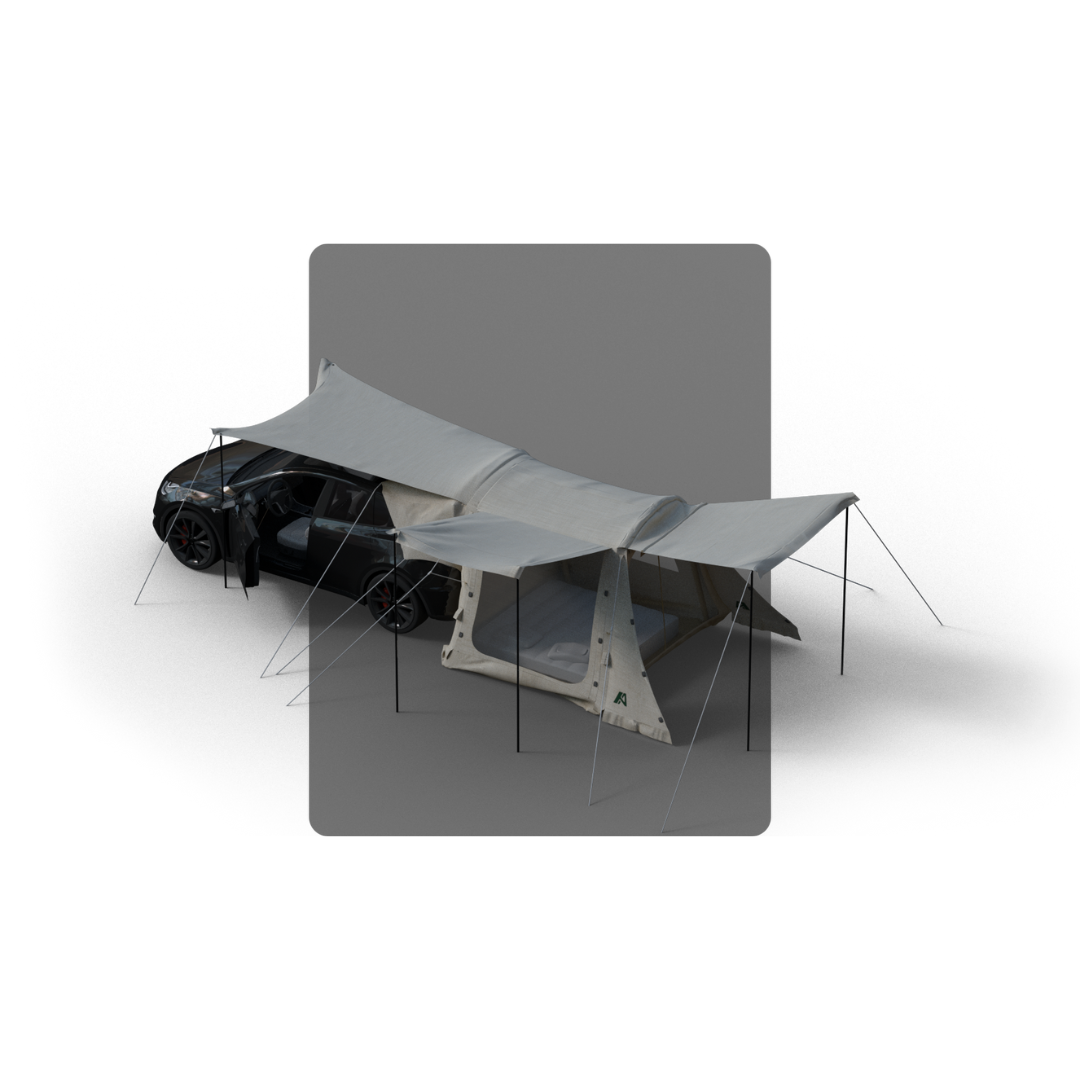
To overcome this spatial bottleneck, we engineered the innovative Tentsla X1 inflatable camping tent. This premium, standalone glamping system uses a high-pressure inflatable beam structure that sets up in minutes using an automatic pump, avoiding the hassle of traditional fiberglass poles. Designed to connect seamlessly around the open rear hatch of the Model 3, Model Y, and Model X, it expands your usable living space significantly. This smart layout allows you to leave your rear hatch fully open under the shelter of the weather-resistant, multi-layer fabric shroud, extending the car's Camp Mode climate control straight into the spacious tent interior to create a comfortable multi-zone living environment.
| Essential Camping Accessory Class | Primary Engineering Function | Operational Advantage for EV Overlanding | Sourcing Platform Resource Link |
|---|---|---|---|
| Tailored Mattress Pad Array | Fills the rear floor gap completely to ensure an even, level sleeping surface | Prevents hip and shoulder pressure points across long trips | Tesla Camping Mattress |
| Advanced Inflatable Enclosure | Connects around the rear hatch to double your usable living and storage space | Extends cabin climate control straight into the tent area safely | Tentsla X1 Tent |
| High-Insulation Self-Inflating Mat | Provides an extra layer of thermal isolation over the cold rear battery floor | Blocks cold air from sapping your body heat during winter stays | Self Inflating Camping Mattress |
| Custom Blackout Shade Assemblies | Blocks exterior light and adds privacy across all glass panels | Lowers daytime solar heat buildup, reducing A/C battery drain | Tesla Car Camping Accessories |
By upgrading your vehicle with purpose-built gear, you can transform your EV into a highly capable overlanding platform. Equipping your vehicle with a contoured Tesla Camping Mattress forms an even, comfortable sleeping deck over the folded rear seats, while incorporating high-density thermal insulation through a premium Self Inflating Camping Mattress layout stops cold battery floor panels from stealing your body heat. Finally, snapping custom multi-layer blackout blocks from our Tesla Car Camping Accessories collection into your side windows stops morning solar rays from overheating the interior, drastically reducing your A/C compressor's workload and saving significant battery capacity for the drive home.
5. Frequently Asked Questions (FAQs)
6. Regulatory and Industrial Automotive References
For official electric vehicle safety directives, battery performance tracking studies, and international overlanding code guidelines, consult these authoritative organizations:
- Society of Automotive Engineers (SAE). SAE J2907_202211: Performance Testing Standards for Electric Vehicle Battery and Auxiliary Drivetrain Energy Consumption.
- Federal Highway Administration (FHWA). National Electric Vehicle Infrastructure (NEVI) Dispersed Campsite Power Connectivity Frameworks. U.S. Department of Transportation.
- Journal of Power Sources. Thermal Management and Low-Temperature Performance Testing of Lithium Iron Phosphate (LFP) vs. NMC Traction Cell Configurations.