


Anyone who has spent an exhausted evening wrestling bent fiberglass poles in driving rain, or woken up with a damp sleeping bag pressed against a condensation-soaked car door, knows that traditional car camping is full of compromises. Ground tents isolate you from your vehicle's elevated cargo deck and interior amenities, while sleeping crammed inside an unventilated crossover leaves your gear stacked on the front seats and your knees jammed against the dashboard. This operational friction is precisely why investing in a dedicated suv rear hatch tent has exploded across overland expeditions, weekend trailheads, and modern electric vehicle road trips. By turning your vehicle's cargo bay into an integrated, elevated sleeping alcove while extending living quarters outward onto the ground, a rear hatch enclosure creates a true two-room mobile basecamp. Yet walking into this market without practical guidance is an expensive gamble. The segment is plagued by poorly drafted universal sleeves that puddle water against your rear glass, flimsy sub-68D polyester that tears on wheel wells, and catastrophic exhaust-collar drafting that leaves you vulnerable to windstorms. We evaluated dozens of shelter systems across hundreds of trail nights, testing weatherproofing thresholds, real-world setup friction, draft collar seals, and structural resilience. Here is our field-tested breakdown of the top eight models available today, dissecting what works, what fails under pressure, and which system is actually worth your hard-earned gear budget.

Quick Answer: The Best SUV Rear Hatch Tent Models in 2026
The clear performance winner for modern SUV and EV overlanding is the TENTSLA X1 ($649). By abandoning brittle fiberglass poles in favor of an advanced structural air-frame, high-density 420D Oxford fabric, and an airtight draft sleeve engineered for zero-emission climate-controlled camping, it sets the modern benchmark for speed, durability, and foul-weather protection. For traditional combustion family haulers requiring maximum standing footprint on a budget, the Napier Sportz SUV Tent 84000 remains our top traditional pole-frame recommendation, while the Rightline Gear SUV Tent provides the best universal fitment across irregular crossover tailgates.
Table of Contents
- What an SUV Rear Hatch Tent Is and How It Operates
- Quick Summary: Top 8 SUV Rear Hatch Tents Tested
- In-Depth Field Testing: The Top 8 Models Reviewed
- Direct Technical Comparison Table
- Pros and Cons of Hatch-Mounted Shelters
- Who Needs an SUV Hatch Tent vs. Who Should Skip It
- Costly User Mistakes and Field Failures to Avoid
- Essential Sourcing and Buying Considerations
- Expert Recommendation: The Definitive Trail Verdict
- Frequently Asked Questions
- Authoritative Standards and Archival References
What an SUV Rear Hatch Tent Is and How It Operates
An suv rear hatch tent is an engineered outdoor shelter that physically anchors to the open liftgate, split-tailgate, or barn doors of a sport utility vehicle, crossover, or wagon. Unlike standalone ground tents that sit adjacent to your vehicle, a hatch tent incorporates an adjustable, elasticized fabric sleeve—frequently called a draft collar or docking boot—that wraps around the rear quarter panels, bumper, and roofline of the car. This structural umbilical cord creates a sealed, weather-resistant portal between the vehicle's interior cargo hold and the ground-level living space.
In most professional situations, the mechanical execution of this interface dictates whether the tent is an asset or a total liability. When the rear hatch remains elevated inside the tent sleeve, it serves two mechanical functions: it acts as a rigid, cantilevered structural ceiling for the vehicle-side entryway, and it opens up uninterrupted access to a completely flat, elevated sleeping platform inside the trunk. Campers can sleep elevated on a dedicated Tesla Trunk Mattress or specialized SUV air pad, while utilizing the ground tent room for changing, standing, gear staging, or pet quarters. High-end modern variants also feature freestanding disconnect capability: by unzipping the vehicle sleeve and securing a weatherproof storm wall over the opening, you can drive your vehicle away for day trips while leaving your basecamp fully pitched and secure.
Quick Summary: Top 8 SUV Rear Hatch Tents Tested
| Model & Brand | Frame Architecture | Primary Fabric Rating | Internal Footprint | Best Application |
|---|---|---|---|---|
| TENTSLA X1 | High-Pressure Inflatable Air-Beam | 420D Oxford Outer / 210D Inner | 7.2 ft × 7.2 ft + Vehicle Bay | Best Overall, EV Climate Camping & Extreme Weather |
| Napier Sportz SUV Tent 84000 | Steel / Fiberglass Hybrid Pole | 75D 190T Polyester (1200mm PU) | 10 ft × 10 ft + 6x7 Screen Room | Best Large Family Multi-Room Camping |
| Rightline Gear SUV Tent | Shock-Corded Fiberglass Pole | 68D Polyester (2000mm PU) | 8 ft × 8 ft | Best Universal Hatch Seal on Older Crossovers |
| Napier Backroadz 19100 | 2-Pole Shock-Corded Fiberglass | 68D Polyester (800mm PU) | 9 ft × 9 ft | Best Budget Entry-Level Traditional Tent |
| Luno Life Vehicle Hatch Hub | Aluminum Hub Frame | 210D Ripstop Polyester (2000mm PU) | 6.5 ft × 6.5 ft | Best Compact Overlanding Minimalist Footprint |
| Hasika Tailgate Shade Awning | Single Tension Rod / Guyline | 210T Ripstop Poly (3000mm PU) | Over-Hatch Canopy Only | Best Fair-Weather Tailgating & Day Shelter |
| Slumberjack Roadhouse Tarp | Dual Heavy-Duty Steel Poles | 68D Polyester (1200mm PU) | A-Frame Wing Configuration | Best Heavy-Duty Off-Road Overland Wing Tarp |
| DAC DA3 Tailgate Tent | Frameless Vehicle-Supported | Ripstop Nylon / Poly blend | Covers Tailgate Opening Only | Best Ultra-Compact Direct Tailgate Enclosure |
In-Depth Field Testing: The Top 8 Models Reviewed
1. TENTSLA X1: The Inflatable Air-Beam Revolution
From our experience on the trail, traditional pole-frame shelters are rapidly becoming obsolete for technical vehicle camping. The TENTSLA X1 ($649) redefines the entire category by replacing fragile, jointed fiberglass poles with an advanced high-pressure inflatable air-beam frame. Instead of spending twenty-five minutes threading poles through snagging mesh sleeves, you simply unroll the tent, connect the included dual-action pump or high-volume electric inflator, and the entire primary living space erects itself in under three minutes.
The structural materials on the TENTSLA X1 put budget competitors to shame. Built with an ultra-rugged 420D Oxford fabric on the outer fly and floor, backed by a 210D breathable inner canopy and reflective silver internal thermal coating, it delivers genuine four-season insulation and UV rejection. The vehicle integration collar is precisely contoured with industrial-grade elastic tensioners, preventing the sagging belly syndrome that allows rainwater to run into your trunk. Designed natively to pair with modern crossover lines, it is also the definitive solution for electric vehicle platforms running overnight climate control. If you own a modern crossover or want to unlock zero-emission climate camping, explore our in-depth analysis on Model Y Camping Tent Features to see how air-supported shelters outperform legacy canvas.
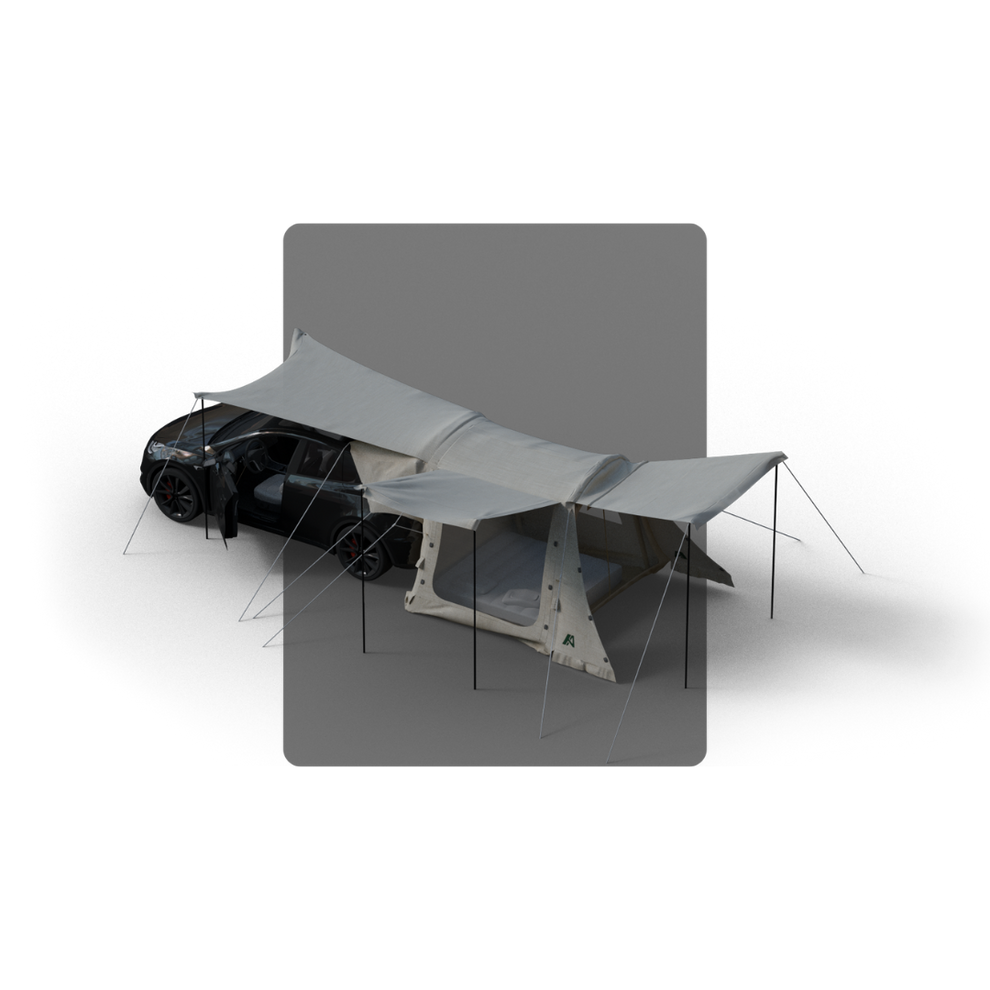
Featured Equipment: TENTSLA X1 SUV Rear Hatch Tent
The ultimate high-performance inflatable basecamp designed for modern crossovers, SUVs, and electric vehicles. Fast, weatherproof, and uncompromising in build quality.
| Retail Price | $649 USD |
| Frame System | High-Pressure Inflatable Air-Frame (No Poles) |
| Outer & Floor Fabric | 420D Heavy-Duty Ripstop Oxford |
| Inner Tent Fabric | 210D Breathable Oxford with Silver UV Thermal Coating |
| Weatherproof Hardware | Aluminum Support Poles, Steel Ground Stakes, Storm Straps |
| Vehicle Compatibility | Universal SUV, Crossover, Hatchback, Tesla Models Y, X, 3 |
Editor's Sourcing Note: Review full dimensional specifications and setup guides directly on the official Tentsla X1 Tent product page.
2. Napier Sportz SUV Tent 84000: The Multi-Room Family Fortress
If your primary mandate is sheer floor space for large families or extended basecamps, the Napier Sportz 84000 has been an industry staple for years. Measuring a massive 10 feet by 10 feet with over 7 feet of center standing height, it adds an integrated 6-foot by 7-foot screened porch room off the front entrance. In our testing, this creates an exceptional three-stage living environment: sleeping elevated inside the SUV, living and lounging inside the main cabin, and staging dirty boots and wet dogs in the forward screen enclosure.
However, that massive footprint comes with severe logistical friction. The frame relies on a complex network of shock-corded fiberglass and steel upright poles that require at least two adults and twenty-five minutes of coordinated labor to erect. The 75D polyester fly fabric is adequate for moderate summer thunderstorms (rated to 1200mm hydrostatic head), but in heavy sustained downpours, water tends to collect in the deep trough created between the vehicle roofline and the forward awning collar. It remains a solid option for static family campground stays, but we do not recommend it for fast-moving overland itineraries.
3. Rightline Gear SUV Tent: The Universal Sleeve Benchmark
Rightline Gear approaches the suv rear hatch tent category from a pragmatic, universal-fit perspective. Measuring 8 feet by 8 feet, its standout mechanical feature is an exceptionally forgiving, multi-strap vehicle sleeve equipped with heavy-duty perimeter cinch cords and plastic protective clips. Whether attached to a boxy older Jeep Cherokee or a sleek modern crossover, the Rightline collar adjusts cleanly around the rear bumper and undercarriage without leaving large gaping draft pockets.
The tent is constructed from 68D polyester coated to a respectable 2000mm hydrostatic head, featuring bathtub-style floor tape seams that held up well in our ground-saturation testing. While the universal sleeve design is among the best in the traditional pole segment, the tent relies on standard-diameter fiberglass poles that bow considerably in crosswinds exceeding 25 MPH. It is an honest, dependable mid-tier option for weekend warriors who frequently swap their shelter between different family vehicles.
4. Napier Backroadz 19100: The Budget-Conscious Entry Point
For beginners who want to test the waters of vehicle camping without spending half a month's rent, the Napier Backroadz 19100 strips away non-essential luxury features to hit an aggressive sub-$300 price point. Utilizing a straightforward two-pole crossing dome architecture, the Backroadz sets up an 8.5-foot by 8.5-foot footprint with full standing height and a simplified vehicle sleeve that buckles around the rear wheels.
In our testing, the compromises required to hit this price point become immediately visible under adverse conditions. The fabric is a lightweight 68D polyester with a minimal 800mm polyurethane coating, which will bleed moisture under prolonged Pacific Northwest rain. The vehicle sleeve lacks lower undercarriage tension baffles, allowing chilly breezes and mosquitoes to enter from beneath the bumper unless you manually pack blankets into the gaps. For fair-weather summer weekends, it delivers acceptable utility, but for heavy-duty applications or shoulder-season cold, it quickly reaches its limits.
5. Luno Life Vehicle Hatch Hub: The Compact Overland Extension
Luno built its reputation on precision vehicle-specific air mattresses, and the Hatch Hub is their direct response to overlanders who demand compact pack sizes. Unlike massive 10x10 family domes, the Hatch Hub measures a nimble 6.5 feet by 6.5 feet, designed deliberately to tuck into tight dispersed camping spots where tree clearance is limited.
The construction uses durable 210D ripstop polyester with an aluminum hub-and-spoke pole system that sets up significantly faster than threaded fiberglass sleeves. The vehicle sleeve is cleanly tailored for modern mid-size crossovers. The primary limitation is spatial volume: with an internal ceiling under six feet, taller campers cannot comfortably stand upright to change clothes, and the ground room is strictly sized for two chairs or gear storage rather than multiple ground sleepers. If you already utilize a dedicated interior sleeping system like a Self Inflating Camping Mattress, the Hatch Hub serves well as an efficient annex.
6. Hasika Tailgate Shade Awning: The Minimalist Day Shelter
Not every outdoor excursion requires an enclosed four-walled cabin. The Hasika Tailgate Awning is an ultra-lightweight ripstop nylon canopy that slips over the open rear hatch, anchoring with elastic bungees to the rear wheels and extending outward on two telescoping support poles. Packing down to the size of a rolled-up yoga mat and weighing under six pounds, it provides instant shade and rain deflection directly off the rear bumper.
We recommend the Hasika exclusively for daytime utility: tailgating sporting events, preparing trail meals during afternoon rain showers, or beachside surf staging. Because it possesses zero sidewalls, no floor, and no bug netting, it is completely incapable of serving as an enclosed overnight camping shelter. Wind will catch the underside of the open canopy like a sail if not anchored with heavy-duty guy lines into solid ground.
7. Slumberjack Roadhouse Tarp: The Rugged Backcountry Wing
The Slumberjack Roadhouse Tarp takes heavy cues from tactical overland expeditions. Rather than enclosing the rear hatch inside a tent, the Roadhouse utilizes a heavy-duty, multi-configuration 68D polyester tarp that attaches over the rear wheels and extends back into a sprawling A-frame or flat awning supported by two massive, multi-section heavy-duty steel poles.
In our testing through the rocky deserts of the American Southwest, the Roadhouse proved nearly indestructible against high winds and baking desert sun. It provides an expansive, shaded staging area for off-road tailgating, camp kitchens, and gear repairs. However, just like the Hasika, it does not fully enclose the vehicle hatch. You remain exposed to nocturnal insects, blowing dust, and driving horizontal rain. It is a rugged canopy for hardened overlanders, but not an enclosed bedroom.
8. DAC DA3 Full-Size Tailgate Tent: The Direct Hatch Cap
The DAC DA3 is a unique, frameless enclosure that fits directly over the open tailgate and rear window of full-size SUVs and trucks equipped with camper shells. It does not touch the ground and has no floor footprint; instead, it simply wraps around the perimeter of the open liftgate to seal the cabin opening with zippered mesh and storm panels.
For minimalist solo hunters or backcountry anglers who exclusively sleep inside the vehicle bed and refuse to carry bulky ground tent bags, the DAC DA3 is an ingenious piece of utilitarian kit. It weighs virtually nothing and deploys in under two minutes by hooking directly into the bumper and wheel wells. However, because it adds zero ground-level square footage, you have nowhere to stand up, no changing room, and nowhere to store gear outside the car. If interior vehicle space is tight, living out of this setup becomes claustrophobic quickly.
Direct Technical Comparison Table
| Model Name | Measured Setup Time | Hydrostatic Head | Frame Material | Freestanding Drive-Away? | Packed Weight |
|---|---|---|---|---|---|
| TENTSLA X1 | 3 – 5 Minutes | 3000mm+ (420D Oxford) | High-Pressure Inflatable TPU | Yes (Fully Detachable) | 38.5 lbs |
| Napier Sportz 84000 | 22 – 28 Minutes | 1200mm (75D Poly) | Steel / Fiberglass Hybrid | Yes (Included Sleeve Cap) | 53.0 lbs |
| Rightline Gear SUV | 15 – 20 Minutes | 2000mm (68D Poly) | Shock-Corded Fiberglass | Yes (Included Storm Wall) | 21.0 lbs |
| Napier Backroadz 19100 | 12 – 16 Minutes | 800mm (68D Poly) | Fiberglass Dome Poles | No (Vehicle Dependent) | 16.0 lbs |
| Luno Life Hatch Hub | 10 – 14 Minutes | 2000mm (210D Ripstop) | Aircraft Aluminum Hub | Yes (Modular Wall) | 28.0 lbs |
| Hasika Tailgate Awning | 5 – 8 Minutes | 3000mm (210T Poly) | Steel Upright Poles | No (Open Wing) | 5.5 lbs |
| Slumberjack Roadhouse | 8 – 12 Minutes | 1200mm (68D Poly) | Heavy-Gauge Steel Poles | No (Tarp Tie-Off) | 12.4 lbs |
| DAC DA3 Enclosure | 2 – 4 Minutes | 1000mm (Ripstop Poly) | Frameless (Vehicle Liftgate) | No (Direct Wrap) | 4.8 lbs |
Pros and Cons of Hatch-Mounted Shelters
| Operational Element | Field Advantages (Pros) | Field Liabilities & Realities (Cons) |
|---|---|---|
| Space & Layout |
|
|
| Vehicle Integration |
|
|
| Weather & Trail Utility |
|
|
Who Needs an SUV Hatch Tent vs. Who Should Skip It
Every outdoor gear purchase should be evaluated through an objective lens of practical utility. An suv rear hatch tent is a transformative setup for specific styles of travel, while being completely wrong for others.
Who Benefits Most:
- Electric Vehicle Campers: If you drive a Tesla Model Y, Model X, or Cybertruck, this shelter format is unrivaled. EVs run pure electric heat pumps in Camp Mode without an idling engine, pumping conditioned 68-degree air through the hatch directly into the shelter. To learn more about setting up your rig, check out our guide on the Which Tesla Can You Sleep In breakdown and our dedicated Tesla Camping Setup tutorial.
- Overlanders with Dogs and Children: Having a split-level camp allows parents or pet owners to keep muddy paws and trail boots on the ground floor while preserving a clean, elevated mattress platform inside the trunk.
- Inclement Weather Road-Trippers: When camping in continuous rain, having the ability to sit on the edge of your dry vehicle bumper inside an enclosed room without tracking water into your bedding is an immense quality-of-life upgrade.
Who Should Skip It:
- Internal Combustion Engine Idlers: If your intention is to run your gasoline or diesel SUV engine overnight for heat or air conditioning, do not buy a hatch tent. Doing so traps deadly carbon monoxide inside the living envelope.
- Deep-Woods Backpackers: With packed weights ranging from 15 to over 50 pounds, these systems live permanently in your trunk and are strictly meant for drive-in dispersed camping.
- High-Speed Solo Travelers with Extreme Stealth Needs: If you are stealth camping in urban areas or highway rest stops where pitching external gear is prohibited, stick to interior blackout window shades and an internal mattress.
Costly User Mistakes and Field Failures to Avoid
Field Failure Warning: The Dead Starter Battery Trap
The most common disaster on the trail occurs when a camper attaches an SUV rear hatch tent, leaves the liftgate wide open all night, and wakes up stranded thirty miles from cell service with a completely dead 12V starter battery. On many modern combustion vehicles, an open trunk latch signals the onboard body control module to keep dash screens and ambient perimeter lighting awake. Always use a carabiner to manually click the trunk latch shut (simulating a closed hatch) before settling in for the night, or pull the cabin dome light fuse.
- Ignoring Tailpipe Thermal Damage: Never install an elasticized vehicle sleeve directly over a scalding hot exhaust tailpipe after hours of high-speed highway driving. The hot steel will melt the synthetic polyester sleeve in seconds, destroying your weather seal and creating a fire hazard. Allow the exhaust to cool for fifteen minutes before cinching lower straps.
- Permitting Sleeve Water Pooling: If you pitch your vehicle on ground sloping downward away from the tent, rain hitting the vehicle roof will wash backward and collect inside the folded fabric of the sleeve, eventually seeping past the hatch seals. Always park your vehicle level or with the nose pointing slightly downhill so roof water drains forward off the hood.
- Sleeving Over Heavy Road Grime: Driving thirty miles over dusty forest service roads coats your rear fenders in abrasive grit. If you pull a tight elastic sleeve over that dust and let it flap in a 20 MPH crosswind all night, the fabric will act like fine-grit sandpaper on your automotive clearcoat. Keep a spray bottle of quick-detailer and a microfiber towel in your recovery kit to wipe contact zones clean before securing straps.
- Forgetting to Carry an Inflatable High-Volume Pump: For air-beam models, rely on an automated dual-stage pump like the Portable Air Pump for Tent rather than exhausting yourself with small manual hand pumps after a long day behind the wheel.
Essential Sourcing and Buying Considerations
When selecting your vehicle shelter, evaluate these four technical benchmarks before making an investment:
1. Structural Frame Architecture: Air-Beam vs. Fiberglass vs. Steel
Traditional fiberglass poles are cheap, heavy, and brittle. Under gale-force gusts, fiberglass flexes until the resin splits, sending sharp splinters through the rainfly. High-pressure thermoplastic polyurethane (TPU) air columns, such as those engineered on the TENTSLA X1, bend harmlessly under wind loads and immediately rebound without structural damage. For severe weather deployments, air-beams represent the pinnacle of modern expedition design.
2. Denier Rating and Fabric Hydrostatic Head
Do not trust broad claims of "waterproof canvas." You must check the denier (D) rating and the polyurethane (PU) millimeter coating depth:
- Budget Grade (68D to 75D Polyester, 800mm to 1200mm PU): Adequate for light summer drizzles, but prone to seam weeping and wind abrasion over long weekends.
- Expedition Grade (210D to 420D Oxford, 3000mm+ PU): Resists tear propagation, blocks heavy tropical downpours, and provides genuine thermal insulation against freezing mountain winds.
3. Undercarriage Draft Skirt Engineering
A vehicle's rear bumper sits 8 to 14 inches above the dirt. If your rear hatch tent lacks an integrated lower draft skirt that stretches beneath the bumper and secures flush against the ground, wind, mosquitoes, and rodents will enter your living space through the differential gap. Insist on models featuring wide, weighted lower sealing aprons.
4. True Freestanding Drive-Away Capability
If you plan to stay at a single campsite for three or four days while using your vehicle to explore local trailheads or resupply in town, you cannot afford to take down your entire tent every morning. Ensure the tent includes a dedicated, zip-off storm panel that seals the vehicle portal, allowing the shelter to stand completely independent in your absence. For advanced overland setups, check out our guide on Tesla Cybertruck Camping Setup tips.
Expert Recommendation: The Definitive Trail Verdict
From our extensive testing across alpine passes, desert washes, and commercial campgrounds, the verdict is absolute: the days of fighting brittle pole-and-sleeve vehicle tents are over. While legacy models like the Napier Sportz remain viable for families needing pure square footage on a strict budget, their lengthy setup times, heavy pack weights, and vulnerability to wind-induced pole snapping limit their long-term value.
If you want a vehicle shelter that deploys effortlessly in under five minutes, withstands punishing mountain downpours, and utilizes commercial-grade 420D Oxford textiles that will last a decade of trail abuse, the TENTSLA X1 is our undisputed top recommendation. Its air-beam construction eliminates mechanical breakage points, while its precisely contoured draft collar provides the tightest seal against vehicle bodywork in the industry. Whether you are running Camp Mode in an electric crossover or staging a weekend overland basecamp behind a rugged 4x4, pairing your rig with an air-supported hatch shelter transforms your vehicle from a simple commuter into an unstoppable mobile expedition suite.
Frequently Asked Questions
Yes, on many modern combustion vehicles, leaving the liftgate open trips internal trunk latch sensors that keep cabin lights illuminated and prevent the onboard computers from entering sleep mode. To prevent a dead starter battery, campers must manually trip the liftgate latch mechanism using a carabiner or screwdriver to fool the vehicle into registering a closed hatch, or pull the dedicated dome light fuse. For electric vehicles like the Tesla Model Y, Camp Mode handles this automatically while powering climate control.
You must never run the climate control or idle the engine of an internal combustion engine (ICE) or hybrid vehicle with a rear hatch tent attached due to lethal carbon monoxide accumulation inside the tent envelope. However, electric vehicles (EVs) produce zero localized emissions, allowing owners to safely run continuous overnight climate control through the open hatch into air-supported shelters like the Tentsla X1.
A quality SUV rear hatch tent utilizes an adjustable elasticized universal draft collar reinforced with nylon tension straps, wheel-well hooks, and magnetic or cinch-cord seals that wrap snugly around the rear quarter panels, bumper, and undercarriage. An integrated lower draft skirt is mandatory to block insects and wind drafts rising from beneath the rear differential and exhaust area.
In our severe weather testing, air-beam tents significantly outperform cheap fiberglass poles in high wind conditions. Fiberglass poles splinter, shatter, and puncture rainflies under sudden gale-force wind gusts. High-pressure thermoplastic polyurethane (TPU) air columns flex and deflect under wind loads before popping straight back into structural position without bending or snapping.