


Every long-distance road tripper, outdoor explorer, remote worker, and mobile adventurer eventually confronts the same critical question: is sleeping in the car healthy, or are you slowly wrecking your spine, suffocating in stale air, and destroying your circadian rhythm for the sake of saving on hotel bills? The internet is overflowing with romanticized social media reels showing minimalist travelers curled up effortlessly inside compact crossovers, watching sunrises through panoramic glass roofs. Yet anyone who has ever pulled into a highway rest stop, cranked the driver seat back forty-five degrees, and tried to sleep for eight hours knows the brutal reality: you wake up with a stiff neck, throbbing lower back pain, a dry throat, and heavy mental fog. The debate over whether is sleeping in the car healthy is often polluted by polarized extremes: medical purists claim sleeping in any vehicle is fundamentally dangerous, while hardcore overland campers claim you can live out of a hatchback indefinitely. From our experience designing automotive shelter systems and spending hundreds of nights testing sleep ergonomics in sub-zero and desert climates, the truth is neither black nor white. The answer depends entirely on mechanical physics, respiratory chemistry, and whether you are sleeping in an outdated combustion trap or an engineered electric sanctuary.

Quick Answer: Is Sleeping in the Car Healthy?
The definitive answer to whether is sleeping in the car healthy comes down to two distinct scenarios: sleeping reclined in a traditional combustion car seat is profoundly unhealthy, while sleeping on a completely flat, ventilated platform inside an electric vehicle with active climate control is just as restorative and healthy as sleeping in a luxury bedroom. When you sleep in a standard car seat, your lumbar spine is subjected to unnatural lateral shearing forces, deep tissue compression restricts venous return, and in a sealed gas car, rising carbon dioxide ($CO_2$) and particulate buildup ruin sleep architecture. Conversely, when you configure a vehicle with a horizontal orthopedic mattress, maintain an optimal 65-degree Fahrenheit ambient micro-climate via continuous HEPA-filtered airflow, and expand your living space with an integrated automotive shelter, your body achieves full rapid eye movement (REM) and deep slow-wave physical recovery without musculoskeletal stress.
Article Directory
- The Biological Reality: What Happens to Your Body Inside a Vehicle?
- Quick Summary Table: Vehicle Sleep Health & Ergonomics Matrix
- The 4 Hidden Health Hazards of Sleeping in a Traditional Vehicle
- Combustion Engines vs. Electric Vehicles: Why the Powertrain Dictates Sleep Safety
- Architectural Shelter Spotlight: TENTSLA X1 Tailgate Camping System
- Direct Technical Comparison: Vehicle Sleep Configurations vs. Biological Needs
- Pros and Cons Table: Evaluating Vehicle Sleeping Health
- Who Should Sleep in Their Car vs. Who Should Book a Hotel
- Costly Mistakes That Make Sleeping in the Car Dangerous
- Essential Buying Considerations for a Restorative Mobile Bedroom
- Expert Outdoor Practitioner's Final Recommendation
- Frequently Asked Questions
- Authoritative Medical & Engineering References
The Biological Reality: What Happens to Your Body Inside a Vehicle?
To accurately determine if is sleeping in the car healthy, we must step away from lifestyle marketing and inspect human physiology under rest. During a normal 8-hour sleep cycle, your body alternates between non-rapid eye movement (NREM) and rapid eye movement (REM) sleep. During deep stage-3 NREM sleep, your blood pressure drops, breathing slows, muscles fully relax, tissue growth and repair occur, and human growth hormone (HGH) is released. For this physiological repair cascade to function, three environmental baselines must be met: zero musculoskeletal contact stress, uninterrupted respiratory oxygenation, and stable core body thermoregulation.
When you attempt to sleep inside an unmodified vehicle, you disrupt all three baselines simultaneously:
- Spinal Distortion and Intervertebral Pressure: The human spine has an organic S-curve supported by the cervical, thoracic, and lumbar regions. When you lie down on a flat bed, intervertebral disc pressure drops to its lowest daily level, allowing the discs to rehydrate through osmotic fluid absorption. If you sleep in a contoured bucket seat, your lumbar curve is flattened or unnaturally hyper-extended, keeping disc pressures elevated and preventing restorative spinal decompression.
- Respiratory Gas Exchange Restrictions: A modern vehicle cabin is an airtight volume of roughly 90 to 120 cubic feet. Two adults resting inside consume oxygen and exhale moisture and carbon dioxide ($CO_2$). Within two hours in an unventilated vehicle, $CO_2$ concentrations surge past 2,500 parts per million (ppm), inducing micro-arousals, morning headaches, and elevated heart rates.
- Thermoregulatory Stress: Steel and glass have virtually zero insulating value. A vehicle cabin tracks external ambient temperature rapidly, turning into a freezing refrigerator in winter or a humid sauna in summer, pulling your autonomic nervous system out of restorative sleep.
From our experience on multi-week expedition routes, sleeping in a vehicle is not inherently harmful; what harms you is the physical configuration you choose. Transitioning from an amateur setup to a scientifically sound sleeping environment is what makes is sleeping in the car healthy a resounding reality.
Quick Summary Table: Vehicle Sleep Health & Ergonomics Matrix
| Sleep Setup Configuration | Spinal & Musculoskeletal Health | Air Exchange & Respiratory Safety | Thermoregulation Stability | Long-Term Health Verdict |
|---|---|---|---|---|
| Reclined Front Driver/Passenger Seat | Severe lumbar compression, cervical strain, pelvic tilt | Poor; localized stale air pockets around headrest | Poor; zero thermal shielding from windshield glass | Unhealthy: Causes chronic disc pain and fatigue |
| Folded Rear Seats (Unleveled / No Pad) | Moderate-to-severe hip bruising, spinal curvature drop-off | Poor; condensation builds on unventilated windows | Poor; cold transfer through metal trunk floorpan | Unhealthy: High pressure points trigger joint soreness |
| Folded Rear Seats + Ergonomic Mattress | Good; even pressure distribution, neutral spine | Moderate; requires cracked windows or rain guards | Moderate; relies entirely on sleeping bag thermal ratings | Acceptable: Fine for weekend getaways in mild weather |
| EV Camp Mode + Mattress + Leveling Base | Excellent; full 180-degree flat orthopedic support | Superior; continuous HEPA-filtered fresh air intake | Superior; digital climate control locked at 65°F–68°F | Healthy: Matches luxury residential bed restoration |
| EV Platform + Tailgate Tent Expansion | Maximum; full stretch-out living and sleeping volume | Maximum; vast cubic airflow, zero moisture trapping | Superior; multi-layer thermal barrier and active HVAC | Peak Health: Zero claustrophobia, ideal for expedition living |
The 4 Hidden Health Hazards of Sleeping in a Traditional Vehicle
When evaluating whether is sleeping in the car healthy, one must understand the specific medical and physiological failure modes of unoptimized car camping. In most professional situations, travelers who report feeling drained after sleeping in their vehicle are suffering from one of four physical hazards.
1. Musculoskeletal Compression and Blood Flow Restriction
Car seats are ergonomically engineered to support an upright human body resisting vehicular gravitational vectors (acceleration, braking, cornering). They are not beds. When you recline a driver seat to sleep, your hips remain lower than your knees, creating an acute angle at the pelvis. This position shortens the psoas muscles, rotates the sacroiliac (SI) joint, and places continuous tension on the sciatic nerve. Over eight hours, this posture restricts femoral venous return, leading to swollen feet, leg cramps, and deep muscular spasms. To achieve restorative sleep, the human body must lie horizontal with spinal pressure evenly distributed across an anatomical sleep surface.
2. Toxic Air Accumulation, Hypoxia, and Moisture Condensation
Each breath an adult exhales introduces roughly 40 milliliters of water vapor into the air, alongside approximately 4% to 5% carbon dioxide. In an enclosed passenger car with sealed windows, two occupants produce nearly a liter of liquid water overnight. This water condenses against the coldest surfaces: the interior glass and steel door frames. Within hours, high relative humidity creates a breeding ground for fungal spores and mold behind interior fabric headliners. Worse, elevated carbon dioxide levels prevent your red blood cells from releasing oxygen efficiently, leading to shallow breathing, elevated morning blood pressure, and grogginess.
3. Thermoregulation Failure and Sleep Fragmentation
According to clinical sleep research, your core body temperature must decrease by approximately 1 to 2 degrees Fahrenheit to trigger melatonin release and maintain deep slow-wave sleep. A traditional combustion car without climate control is an environmental conductor. In hot weather, radiating heat through the glass causes excessive sweating and dehydration; in cold weather, thermal bridging through the floor pan leaches warmth from your body, causing involuntary muscle shivering that jerks your brain out of REM sleep cycles.
4. Acoustic and Psychological Stress (Claustrophobia & Sensory Guarding)
Sleeping with your nose twelve inches from a low automotive headliner triggers subconscious micro-stress responses. In psychology, this is known as sensory guarding: your brain remains in a vigilant, low-level survival state because of the cramped space, exterior street noises, and fear of being discovered or disturbed. Fragmented sleep elevates systemic cortisol levels, accelerating physical exhaustion.
Combustion Engines vs. Electric Vehicles: Why the Powertrain Dictates Sleep Safety
The conversation around whether is sleeping in the car healthy underwent a complete revolution with the arrival of modern electric vehicles. In a legacy internal combustion engine (ICE) vehicle, sleeping is fundamentally limited by a deadly chemical reality: carbon monoxide ($CO$).
Leaving an engine idling overnight to run the heater or air conditioner is extremely dangerous. If an exhaust manifold develops a hairline fracture, or if falling snow, mud, or debris partially obstructs the tailpipe underneath the chassis, odorless, colorless carbon monoxide seeps through floor grommets into the cabin. Carbon monoxide binds to hemoglobin with an affinity over 200 times greater than oxygen, causing fatal carboxyhemoglobinemia in sleeping occupants. For this reason, medical authorities strictly warn against running an engine while sleeping in a car.
Electric vehicles eliminate combustion risks entirely. In a platform like the Model Y or Cybertruck, there is no tailpipe, no exhaust manifold, and no carbon monoxide. Furthermore, software suites like Camp Mode maintain continuous, thermostatically controlled cabin airflow indefinitely. Reviewing our technical breakdown of Tesla Model Y Sleeping Safety reveals that an EV functions as a self-contained climate shelter, drawing outside air through hospital-grade HEPA filters that eliminate 99.97% of airborne mold spores, pollen, and fine particulate matter (PM2.5). When you learn how to use camp in Tesla Model Y like a pro, the car actively circulates fresh air, monitors thermal gradients, and uses only 1% to 2% of battery capacity per hour, transforming mobile overnighting from a survival test into a restorative wellness routine.
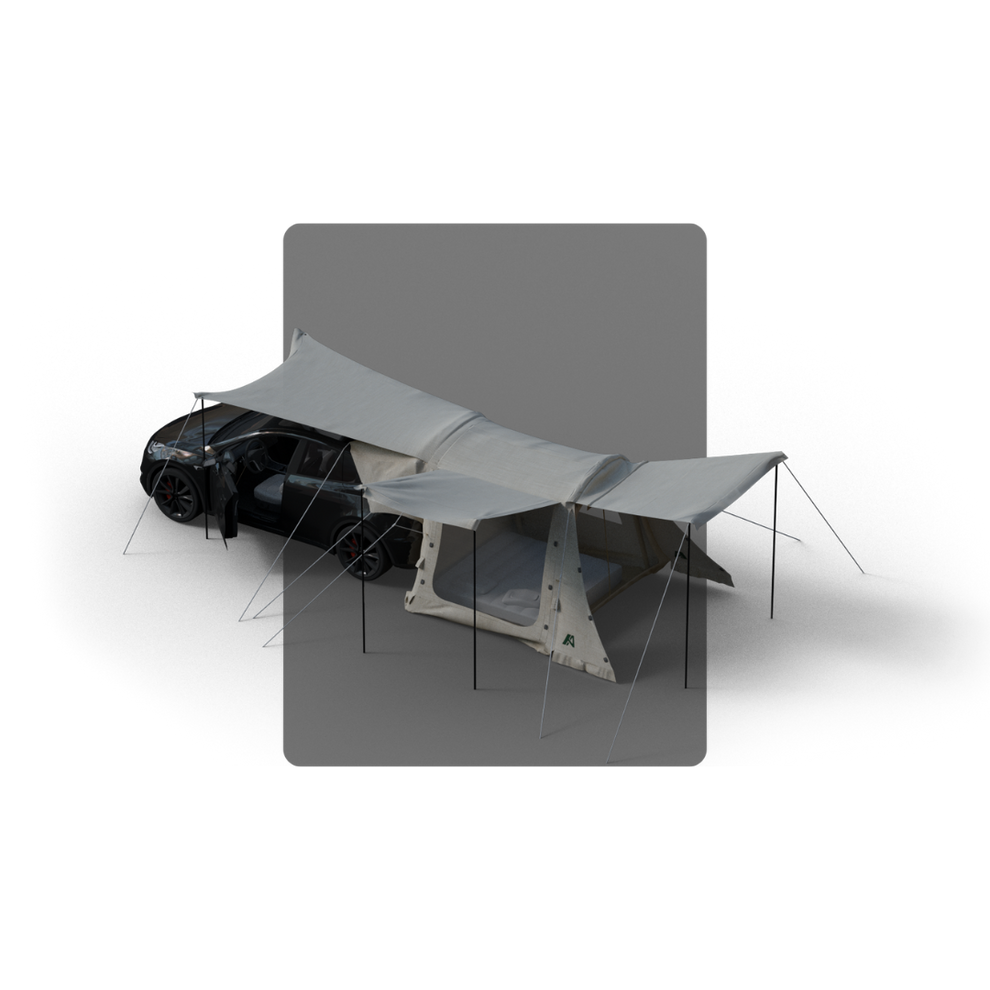
Architectural Solution: TENTSLA X1 Tesla Tailgate Camping System
Eliminating cabin claustrophobia, expanding interior volume, and turning an EV into a genuine multi-room mobile master suite is the fastest way to make is sleeping in the car healthy an absolute reality. The TENTSLA X1 integrates seamlessly with the open liftgate of your vehicle, channeling continuous climate-controlled air into a spacious, weather-resistant shelter.
| Outer Fabric & Floor | Heavy-duty 420D Oxford Fabric with high-grade waterproof polyurethane barrier |
| Inner Fabric | Breathable, high-density 210D Oxford Fabric engineered to eliminate condensation |
| Frame Architecture | Fast inflatable air-frame system (Sets up in under 5 minutes without rigid pole assembly) |
| Thermal & Solar Protection | Silver-coated exterior fabric providing superior UV reflection and radiant heat insulation |
| Hardware Integration | Solid aluminum support poles, high-tensile steel pegs, and custom vehicle seal gaskets |
| Platform Compatibility | Engineered specifically for Tesla Model Y, Model 3, and Model X tailgates |
Expedition Recommendation: Upgrade your mobile sleep ecosystem by checking out the official TENTSLA X1 portal, or evaluate broader vehicle integration across our review of Popular Tesla Camping Tents.
Direct Technical Comparison: Vehicle Sleep Configurations vs. Biological Needs
| Sleep Parameter | Reclined Driver Seat (Standard Car) | Folded Rear Seats (Unmodified) | Flat Mattress System (Dedicated EV) | EV Cabin + TENTSLA Tailgate Tent |
|---|---|---|---|---|
| Spinal Axis Alignment | Severe pelvic flexion; cervical spine unsupported | Rough, uneven drop-offs across seat hinge joints | 100% horizontal neutral spine; zero joint pressure | Orthopedic flat sleep plane + standing vertical clearance |
| Air Quality & Ventilation | Stale air; $CO_2$ spikes past 2,500 ppm in 2 hours | Heavy window condensation; humidity > 80% | Continuous HEPA air exchange; $CO_2$ < 800 ppm | Vast air volume exchange; zero moisture stagnation |
| Thermal Climate Control | None (Engine off) or Deadly $CO$ risk (Engine idling) | None; rapid thermal tracking of outdoor ambient | Digital HVAC locked at ideal sleep temp (66°F) | Climate channeled across dual-room insulated zones |
| Circulatory Health | Venous blood pooling in lower extremities | Localized capillary occlusion on bony prominences | Unobstructed venous return; healthy arterial flow | Full stretching room; zero vascular constriction |
| Deep & REM Sleep Quality | Fragmented; frequent micro-awakenings from pain | Poor; wakefulness triggered by stiffness and cold | High; sustained slow-wave deep sleep cycles | Optimal; complete psychological and physical rest |
Pros and Cons Table: Evaluating Vehicle Sleeping Health
| Aspect | Health & Wellness Benefits (Pros) | Physiological Risks & Realities (Cons) |
|---|---|---|
| Physical Health & Sleep Ergonomics |
|
|
| Respiratory & Mental Wellbeing |
|
|
Who Should Sleep in Their Car vs. Who Should Book a Hotel
Every dollar allocated to travel and outdoor equipment should support practical wellness. Answering whether is sleeping in the car healthy depends entirely on the traveler's physical condition, vehicle platform, and sleep equipment.
Who Benefits from Sleeping in Their Vehicle:
- Overland Explorers & Trailhead Athletes: Hikers, mountaineers, and endurance runners aiming for early alpine starts benefit immensely from vehicle camping. Sleeping directly at the trailhead eliminates early-morning driving fatigue. When outfitted with an orthopedic Tesla Camping Mattress, athletes wake up rested and ready to perform.
- Long-Distance Electric Vehicle Commuters: Road-trippers who drive modern EVs equipped with specialized climate features can safely bypass roadside motels. Verifying that you can comfortably Sleep Two Adults in Tesla Model Y allows couples to tour national parks in complete comfort.
- Digital Nomads & Remote Professionals: Travelers moving between destinations can transform their vehicle into an ergonomic basecamp. Pairing their setup with specialized Tesla Camping Accessories provides mobile charging, work surfaces, and climate-controlled resting spaces wherever they roam.
Who Should Stay Away and Book a Traditional Hotel:
- Individuals with Severe Spinal Stenosis or Acute Disc Herniations: If you suffer from active spinal nerve impingement, sleeping on anything less than an expansive orthopedic mattress with easy standing access can aggravate your condition. Crawling in and out of a vehicle cargo deck places torsional stress on damaged lumbar vertebrae.
- Travelers in Sub-Compact Gas Cars in Extreme Weather: If you drive a small gasoline sedan without fold-flat rear seats and the outside temperature is 15°F or 95°F, sleeping in that car is not healthy; it is dangerous. Without an active EV climate system or dedicated fuel heater, the cabin will expose you to hypothermia or heat exhaustion.
- Individuals with Severe Claustrophobia: If enclosed small spaces trigger panic attacks, sleeping inside a closed vehicle will cause restless sleep and elevated cortisol. If you must sleep near your vehicle, an expansive shelter setup like a Tesla Model 3 Camping Tent is essential to provide open, full-height headroom.
Costly Mistakes That Make Sleeping in the Car Dangerous
Medical & Operational Warning: The most dangerous mistake in vehicle camping is running an internal combustion engine overnight while sleeping. A slight shift in wind direction can blow tailpipe exhaust directly underneath the vehicle body, drawing fatal carbon monoxide through floor vents and firewall seals. Never idle a gas car while sleeping.
- Sleeping Directly on Folded Seats Without a Leveling Base: Many SUV and crossover rear seats do not fold completely flat, resting at a 5-degree to 12-degree upward incline. Sleeping with your head or feet elevated at an unnatural angle forces blood pressure shifts and strains the pelvic girdle. Always utilize an engineered Tesla Model Y Camping Platform to bridge footwell gaps and create a true 180-degree flat sleep plane.
- Leaving Windows Completely Sealed in Traditional Vehicles: If you sleep in a vehicle without electric climate control, sealing all four windows traps exhaled moisture against cold steel surfaces. Within hours, window condensation drips into door electronics and soaks seat cushions, promoting hidden mold growth. Always crack at least two windows an inch, utilizing exterior window rain visors to allow fresh cross-ventilation while keeping rain out.
- Failing to Monitor Battery Consumption in Cold Climates: When utilizing electric vehicle HVAC systems in winter, running heating elements against sub-freezing exterior air consumes power. Reviewing our analysis on Tesla Camping Mode Battery Drain ensures you calculate your energy reserves properly, leaving at least 20% to 30% battery buffer to reach the nearest fast-charging station the next morning.
- Using Thin Inflatable Pool Rafts Instead of High-Density Foam: Inexpensive PVC pool floats lose air pressure as cabin temperatures drop overnight, leaving your hips resting directly on hard metal seat latches. A healthy setup demands high-density memory foam or dual-layer drop-stitch mattresses that maintain structural support across varying temperatures.
Essential Buying Considerations for a Restorative Mobile Bedroom
Before purchasing equipment to transform your vehicle into a sleep platform, audit prospective gear against these four practical engineering benchmarks:
1. True Flat-Plane Orthopedic Mattress Design
Never buy a generic rectangular camping pad and expect it to fit around custom wheel-well contours. Sourcing a contoured mattress designed specifically for your vehicle floorpan ensures full edge-to-edge support, preventing gaps where pillows and limbs slip into footwells. High-density CertiPUR-US memory foam provides the pressure-point relief required to keep blood circulating freely through the hips and shoulders.
2. Active Climate Compatibility and Thermal Insulation
If you camp in an EV, verify that your gear does not obstruct rear HVAC vents. Ensure your window coverings use multi-layer reflective bubble foil: silver reflective facing outward to deflect daytime solar gain, and insulating black felt facing inward to absorb cabin warmth at night. For larger platforms, explore options for the Best Tesla for Car Camping to match your vehicle's thermal capacity to your travel style.
3. Breathable Multi-Ply Weather Resistance
If expanding your vehicle living footprint with an integrated tailgate tent, material science is paramount. Cheap nylon tents trap moisture and tear in heavy winds. Demand 420D high-density Oxford fabric for exterior weather shells and tent floors to withstand sharp gravel, paired with breathable 210D inner linings that prevent condensation from dripping onto your face. Sourcing gear featuring fast-inflatable air-frame technology allows you to set up camp in five minutes without fighting complex aluminum pole assemblies in the dark.
4. Comprehensive Storage and Gear Management
A vehicle cabin cluttered with loose luggage, coolers, and hiking shoes creates mental clutter and forces you to sleep in awkward, curled-up postures. Utilize rooftop cargo boxes, front trunks (frunks), or dedicated tent annexes so your primary sleeping mattress remains completely clear and dedicated to rest.
Expert Outdoor Practitioner's Final Recommendation
In our professional assessment across thousands of miles of expedition testing, the question is sleeping in the car healthy is no longer a matter of opinion; it is a matter of equipment and execution. Reclining in a driver seat with an idling combustion engine is an orthopedic disaster and a respiratory risk that should be avoided by any health-conscious traveler.
However, when executed with modern automotive engineering, vehicle sleeping transforms into one of the most regenerative, health-promoting ways to travel:
- Deploy an Orthopedic Flat Sleep Foundation: Level the cargo floor, eliminate seat gap drop-offs, and lay down a custom-fit, high-density memory foam mattress that supports neutral spinal alignment.
- Harness Electric Climate and Fresh Air Filtration: If you drive an electric vehicle, engage Camp Mode locked at 66°F with active HEPA filtration, guaranteeing continuous fresh air exchange, zero carbon monoxide risk, and deep sleep phase maintenance.
- Expand Your Volumetric Footprint: Eliminate sensory guarding and cabin claustrophobia by attaching a premium inflatable shelter like the TENTSLA X1. Extending your living space past the rear bumper gives you room to stand, change clothes, organize equipment, and enjoy the outdoors while resting in complete comfort.
Equip your vehicle properly, prioritize spinal alignment, protect your respiratory air quality, and enjoy deep, restorative sleep beneath the stars wherever your journey takes you.
Frequently Asked Questions
Sleeping in a reclined car seat causes severe lumbar compression, unnatural thoracic kyphosis, and pelvic tilt that restricts blood circulation and strains back muscles. However, sleeping in a vehicle is completely healthy for your spine if you sleep on a 100% flat, level surface supported by a high-density memory foam or dual-layer drop-stitch mattress that preserves the natural S-curve of the spine.
Yes, in a traditional internal combustion engine (ICE) vehicle, leaving the engine idling overnight for heat or air conditioning creates a deadly risk of carbon monoxide (CO) entering the cabin, particularly if snow, mud, or debris obstructs the exhaust pipe. Additionally, sleeping in a completely sealed, non-ventilated cabin causes carbon dioxide levels to climb and creates heavy moisture condensation. In electric vehicles, there is zero carbon monoxide risk, and active climate modes maintain continuous fresh air circulation.
Human thermoregulation requires core body temperature to drop by roughly 1 to 2 degrees Fahrenheit to initiate and sustain deep slow-wave sleep and REM phases. A metal car cabin acts as a thermal conductor, quickly becoming freezing cold in winter or dangerously hot in summer. Without active climate control or proper thermal insulation, sleep becomes fragmented, elevating cortisol levels and causing severe next-day cognitive fatigue.
To make vehicle sleep restorative and clinically safe, you need three non-negotiable items: a flat leveling platform or custom-fit camping mattress to prevent spinal misalignment, active ventilation or an EV climate system with HEPA filtration to maintain clean oxygen exchange, and an exterior expansion system such as a tailgate tent to eliminate cabin claustrophobia and manage gear storage.
Authoritative Medical & Engineering References
- Centers for Disease Control and Prevention (CDC): Clinical Guidance on Carbon Monoxide Poisoning Hazards in Enclosed Spaces
- National Center for Biotechnology Information (NCBI / PMC): The Influence of Sleep Surfaces and Spinal Posture on Sleep Quality and Spinal Alignment
- Sleep Foundation: Environmental Temperature, Core Thermoregulation, and Restorative Human Sleep Architecture