

8 Tips to Choose a Car Camping Location: The Field Guide to Campsite Selection and EV Overlanding
Oct 20, 2026

Every road-tripper, overlander, and electric vehicle camper remembers the bitter sting of a poorly chosen campsite. You pull off a remote logging road in pitch darkness, kill the headlights, throw down your bedding, and wake up at 3:00 AM sliding into the trunk footwell because your car is pitched on a punishing seven-degree downhill slope. By dawn, your vehicle is covered in fine dust from passing logging trucks, cold morning wind is howling through your unsealed weather flaps, and you realize you parked in a natural drainage depression right as a flash storm rolls in over the ridgeline. Selecting an overnight campsite is not an exercise in romantic spontaneity. It is an applied tactical assessment where topography, vehicle approach angles, localized meteorological vectors, and legal land boundaries intersect. When you make the deliberate effort to choose a car camping location using systematic criteria, you protect your vehicle undercarriage, eliminate miserable sleepless nights, and turn your mobile rig into a functional outdoor basecamp. As seasoned backcountry overlanders, EV road-trippers, and outdoor gear engineers who test inflatable air-frame shelters, trunk sleeping platforms, and battery drain rates across extreme terrains at TENTSLA, we approach site selection with zero compromise. Here is our practitioner-grade evaluation of the eight essential tips you must master to choose a car camping location that delivers safety, privacy, and deep, restorative sleep.

Quick Answer: How to Choose a Car Camping Location
To successfully choose a car camping location, evaluate the site across eight non-negotiable physical and regulatory parameters: (1) Grade and Leveling Topography (never sleep on an unmitigated slope greater than 2 degrees); (2) Approach Clearance and Undercarriage Safety (assess breakover angles and rock obstacles to protect low-slung chassis components and EV battery packs); (3) Energy Management and Charging Proximity (secure a verified 20% to 30% battery buffer above the energy required to reach the next charging station, accounting for climate control draws); (4) Microclimate and Wind Vector Analysis (position your vehicle as a windward deflection shield while avoiding low-lying frost pockets); (5) Public Land Jurisdictions (distinguish BLM and USFS dispersed corridors from restricted private property); (6) Hydrological Flash-Flood and Drainage Mapping (avoid dry washes, alluvial fans, and saturated soils); (7) Rear Liftgate and Tent Annex Clearances (ensure a clean 10-to-12-foot footprint directly behind your bumper to deploy an airtight shelter like the TENTSLA X1); and (8) Leave No Trace Surface Durability (park strictly on hardened, established mineral soil). Master these eight variables, and you will never spend another night sliding across your mattress.
Article Directory
- What It Is: The Structural Mechanics of Car Camping Site Selection
- Quick Summary Table: The 8 Tips for Choosing a Site
- The 8 Tips to Choose a Car Camping Location Analyzed in Depth
- Basecamp Spotlight: TENTSLA X1 Inflatable Air-Frame Tesla Camping Tent
- Direct Technical Comparison: Dispersed Public Lands vs. Developed Frontcountry
- Pros and Cons: Rigorous Site Selection vs. Spontaneous Pull-Offs
- EV Power Dynamics: Managing Kilowatt-Hours in the Backcountry
- Who Needs Methodical Site Selection vs. Who Can Camp Anywhere
- Costly Mistakes Campers Make When Picking a Camp Spot
- Essential Gear Considerations to Adapt to Imperfect Terrain
- Expert Overlanding Verdict: The Final Site Selection Blueprint
- Frequently Asked Questions
- Authoritative Land Management & Safety References
What It Is: The Structural Mechanics of Car Camping Site Selection
When you transition from traditional backpacking to vehicle-supported camping, the rules of outdoor accommodation fundamentally shift. In backpacking, your shelter footprint is flexible: a tiny, two-person nylon wedge can nestle between trees on uneven ground with minimal footprint impact. In car camping, your primary shelter anchor is a multi-thousand-pound steel and aluminum vehicle with fixed mechanical dimensions, rigid axles, and zero tolerance for severe approach errors.
Learning how to choose a car camping location requires viewing the natural landscape through an engineer's lens. You are positioning a physical shelter, a high-capacity power bank, and a sleeping room simultaneously. How your tires interact with the soil, how ambient air currents flow across your vehicle cowl, and how level your suspension sits will dictate your physical comfort. In modern electric vehicle overland travel, the car is an active habitat. When running a dedicated climate management system like Tesla Camp Mode, the vehicle continuously draws power from its high-voltage traction pack to maintain target cabin temperature, purify air through HEPA filtration, and keep low-voltage auxiliary systems powered.
From our experience on multi-week expeditions, choosing the wrong location turns these technological advantages into liabilities. A site without adequate rear clearance prevents you from deploying an interconnected vehicular shelter. A site on loose sand or uncompacted silt can trap an all-wheel-drive EV weighing over 4,400 pounds. Systematic site selection is the discipline of validating terrain, weather exposure, legal access, and logistics before shifting the gear selector into park.
Quick Summary Table: The 8 Tips for Choosing a Site
| Selection Vector | Primary Field Metric | Target Benchmark | Critical Failure Prevented | Operational Impact |
|---|---|---|---|---|
| 1. Grade & Leveling | Caliper pitch angle (degrees) | ≤ 1.5° grade (Dead-level preferred) | Cervical blood pooling, body sliding | Guarantees uninterrupted REM sleep |
| 2. Approach & Clearance | Ground clearance & departure angles | Minimum 6.6" clearance (Model Y) | Battery armor punctures, rocker crushing | Protects multi-thousand-dollar battery trays |
| 3. Energy Proximity | Kilowatt-hour reserve buffer | ≥ 25% battery buffer above return trip | Stranded dead-battery recovery calls | Maintains overnight heating and cooling |
| 4. Microclimate Vectors | Wind direction & cold air pooling | Nose-in to wind; avoid valley sinks | Buffeting noise, excessive thermal HVAC drain | Saves 3% to 6% battery capacity per night |
| 5. Land Jurisdiction | Cadastral property boundaries | Verified BLM/USFS motor corridors | Trespassing citations, 2:00 AM evictions | Ensures lawful, peaceful multi-night stays |
| 6. Hydrology & Drainage | Soil permeability & alluvial channels | Elevated mineral gravel; zero dry washes | Flash flood inundation, vehicle mud sinking | Critical life-safety and emergency egress |
| 7. Tailgate Clearance | Unobstructed rear linear footprint | 10 to 12 feet of flat rear clearance | Crushed liftgates, compromised tent seals | Enables integrated inflatable living annexes |
| 8. Surface Durability | Substrate load-bearing capacity | Hardened gravel, rock, or dry dirt | Tire rutting, environmental destruction | Complies with Leave No Trace ethics |
The 8 Tips to Choose a Car Camping Location Analyzed in Depth
1. Grade and Leveling Physics: The 1.5-Degree Rule

In our testing across hundreds of vehicle camp setups, sleeping on an unmitigated slope is the number-one cause of camper misery. The human vestibular system is acutely sensitive to gravitational tilt. If you park on an incline where your head rests lower than your feet, blood pools in your cranial vessels, triggering severe morning sinus pressure and throbbing tension headaches. Conversely, if you park on a lateral tilt where the driver's side is four inches higher than the passenger side, your body will continuously roll toward the low side throughout the night, compressing your spine and waking you up every time you shift position.
When you evaluate a prospective spot to choose a car camping location, check your vehicle leveling display or place a small circular bubble level on your center console. Never settle for a pitch greater than 1.5 to 2 degrees. If an uneven surface is your only option, always park with the front bumper pointed slightly downhill so that your head (resting behind the front seats) is naturally elevated above your feet. For persistent backcountry unevenness, carry dedicated multi-tiered polymer leveling ramps to drive your low-side wheels up until the vehicle platform sits dead-level. Pairing a flat chassis with a custom-engineered Tesla Trunk Mattress transforms the rear cargo area into a residential-grade sleeping sanctuary.
2. Ground Clearance and Undercarriage Safety Audits
Unlike body-on-frame 4x4 trucks with solid live axles and ten inches of clearance, modern crossover electric vehicles have tight underbody packaging. A standard Tesla Model Y features roughly 6.6 inches (167 mm) of ground clearance; a Model 3 sits lower at approximately 5.5 inches (140 mm). More importantly, the entire structural floor pan houses a high-voltage lithium-ion traction battery encased in an aluminum or structural steel ballistic shield.
When scouting a spur road to your chosen camp spot:
- Audit the Center Crown: Backcountry dirt roads frequently have deep tire ruts carved by lifted pickup trucks, leaving a raised center ridge packed with embedded river rocks and hard roots. Straddling a tall center crown can high-center your vehicle or drag sharp rocks directly across your battery protection skid plates.
- Watch Approach and Departure Angles: Low aerodynamic front splitters and long rear overhangs will scrape when entering steep creek crossings or climbing over roadside drainage berms. Always get out of the vehicle and physically walk an unpaved access spur before committing your tires to it.
- Avoid Loose Silt and Deep Mud: Modern EVs carry substantial curb weight (4,000 to 4,500+ lbs). What looks like dry crust can easily give way to bottomless mud beneath. Sinking an EV down to its battery plate turns an enjoyable weekend into a multi-thousand-dollar off-road recovery bill.
3. Energy Management and Charging Hub Proximity
Traditional internal combustion campers worry about finding a gas station within fifty miles. In an electric vehicle, your car is both your locomotive engine and your primary environmental life-support system. Running climate control throughout the night consumes electrical energy, and you cannot simply walk down the road with a plastic jerrycan if you drain your battery to zero percent.
In most professional situations, we enforce the Rule of Thirty: never set up camp at a remote location unless your projected battery reserve upon returning to the nearest high-speed Supercharger or level-2 charging station is at least 20% to 30%.
- Under standard conditions (ambient temperatures between 45°F and 75°F), Tesla Camp Mode consumes approximately 1% to 1.5% of battery capacity per hour (roughly 1.0 to 1.5 kWh/hour). Over an eight-hour night, that equals an 8% to 12% total battery draw.
- In sub-freezing winter conditions (temperatures below 25°F), thermal heat-pump draw spikes. The vehicle must heat both the cabin and the high-voltage battery pack, consuming 2.5% to 3.5% capacity per hour.
4. Microclimate Vectors: Wind Shields and Thermal Inversion
Novice campers look only at the scenic view. Experienced overlanders analyze the microclimate. A breathtaking campsite perched on the razor edge of an exposed canyon rim looks stunning at 4:00 PM; by 11:00 PM, sustained forty-mile-per-hour gusts will violently buffet your car, flap your tent fabric, and make sleep impossible.
When you scout the terrain to choose a car camping location, evaluate two critical atmospheric behaviors:
- Prevailing Wind Deflection: Always position the aerodynamic front nose of your vehicle directly into the prevailing wind direction. Modern vehicles are engineered to channel air cleanly over the hood and windshield with minimal drag. If you park broadside to severe crosswinds, the flat side panels act like a sail, rocking the suspension and howling against the window seals.
- Cold Air Drainage (Thermal Inversion): Cold air is denser than warm air; at night, it behaves like water, flowing downhill and settling into the lowest geographical depressions—such as valley floors, dry lakebeds, and dry creek bottoms. Temperatures at the bottom of a ravine can be 10°F to 15°F colder than on a gentle bench elevated fifty feet above the valley floor. Avoid low-lying cold sinks to minimize your vehicle's heating power consumption.
5. Land Jurisdiction and Legal Dispersed Corridors
Few experiences ruin a wilderness trip faster than being awoken at 2:00 AM by high-powered spotlights and an armed landowner or forest ranger demanding you vacate the premises immediately. Public land access in North America is a complex patchwork of overlapping federal, state, and private jurisdictions.
To camp legally without paid reservations, target verified federal public lands:
- Bureau of Land Management (BLM): Millions of acres of public land across the western United States permit free, dispersed camping for up to 14 consecutive days. Review regional guidelines directly through the Bureau of Land Management.
- United States Forest Service (USFS): National Forests generally permit dispersed car camping along designated forest service roads. However, regulations typically mandate that your vehicle remain within one car-length (or 100 to 300 feet) of the established roadway. Check official travel management maps via the US Forest Service.
- Private Property Infiltration: Never rely on guesswork. High-resolution GPS mapping applications (such as OnX Offroad or Gaia GPS) provide offline cadastral land-ownership overlays that show precise parcel boundaries in green (public) versus red/yellow (private ranch or mineral leases). If a gate is closed, or if signs mark private timberland, respect the boundary.
6. Hydrological Flash Flood and Drainage Mapping
A dry desert wash or canyon floor looks like the ultimate flat, sandy campsite. Pitching camp inside an alluvial wash is one of the most fatal errors in outdoor recreation. Arid soils in desert regions have near-zero water infiltration rates. A localized thunderstorm occurring ten miles upstream can send a wall of churning mud, boulders, and debris rushing down a bone-dry wash in minutes, sweeping parked vehicles away with terrifying force.
Always inspect the physical ground before you park:
- Look for Driftwood and Wash Lines: If you see dried twigs wrapped around the base of desert shrubs, piles of smoothed river cobbles, or vertical undercut dirt banks, water moves through that channel with high energy. Park well outside the high-water line.
- Avoid Clay Slicks and Salt Flats: Playa beds and alkaline clay pans dry into smooth, hard-packed surfaces that look like concrete runways. However, a light rain shower transforms dried clay into slick, greasy gumbo that sticks to tire treads, eliminates traction, and immobilizes heavy vehicles for days. Camp on elevated benches composed of well-drained, coarse mineral gravel.
7. Rear Liftgate Clearance and Tent Annex Footprint
Traditional tent campers pack a standalone nylon tent, carry it thirty yards into the woods, and leave their car parked by the road. In modern EV camping, your vehicle is the core architectural component of your shelter. High-efficiency setups merge the vehicle cabin with an integrated outdoor living room using an airtight tailgate connection.
When you pull into a potential spot to choose a car camping location, you must audit the immediate perimeter:
- Vertical Overhead Hatch Clearance: Modern crossover liftgates swing upward to a height of seven to eight feet. Check for low-hanging pine branches, sharp rock overhangs, or overhead utility wires that could scratch your paint or damage your power-liftgate motor.
- Linear Rear Footprint: To deploy an advanced aerodynamic shelter like the TENTSLA X1, you require a clean, level footprint extending 10 to 12 feet directly behind your rear bumper. Ensure the ground behind your car is free of cactus spines, sharp bedrock outcroppings, and deep depressions so that your living room floor sits flat and secure.
8. Surface Durability and Leave No Trace Ethics
The explosive popularity of overlanding and dispersed vehicle camping has placed immense pressure on fragile public ecosystems. Irresponsible drivers carving new tracks across pristine meadows or crushing alpine tundra lead federal land managers to permanently bulldoze spur roads and close dispersed access for everyone.
Practice uncompromising stewardship governed by the Leave No Trace Center for Outdoor Ethics:
- Camp on Durable Surfaces: Park strictly on established, compacted turnouts, existing gravel pull-offs, or bare mineral earth. Never crush native sagebrush, desert biological soil crusts (cryptobiotic soil), or high-altitude subalpine vegetation.
- Human Waste Management: If your dispersed location lacks a vault toilet, carry a portable chemical toilet or pack a trowel to dig a cathole 6 to 8 inches deep, positioned at least 200 feet away from lakes, streams, and dry riverbeds. Pack out all used hygiene products and toilet paper in sealed waste bags.
- Campfire Restrictions: Never build raw stone fire rings during summer fire bans. High winds carry embers into dry grass with catastrophic speed. Carry a self-contained portable propane fire pit or rely entirely on your vehicle's electric heating systems.
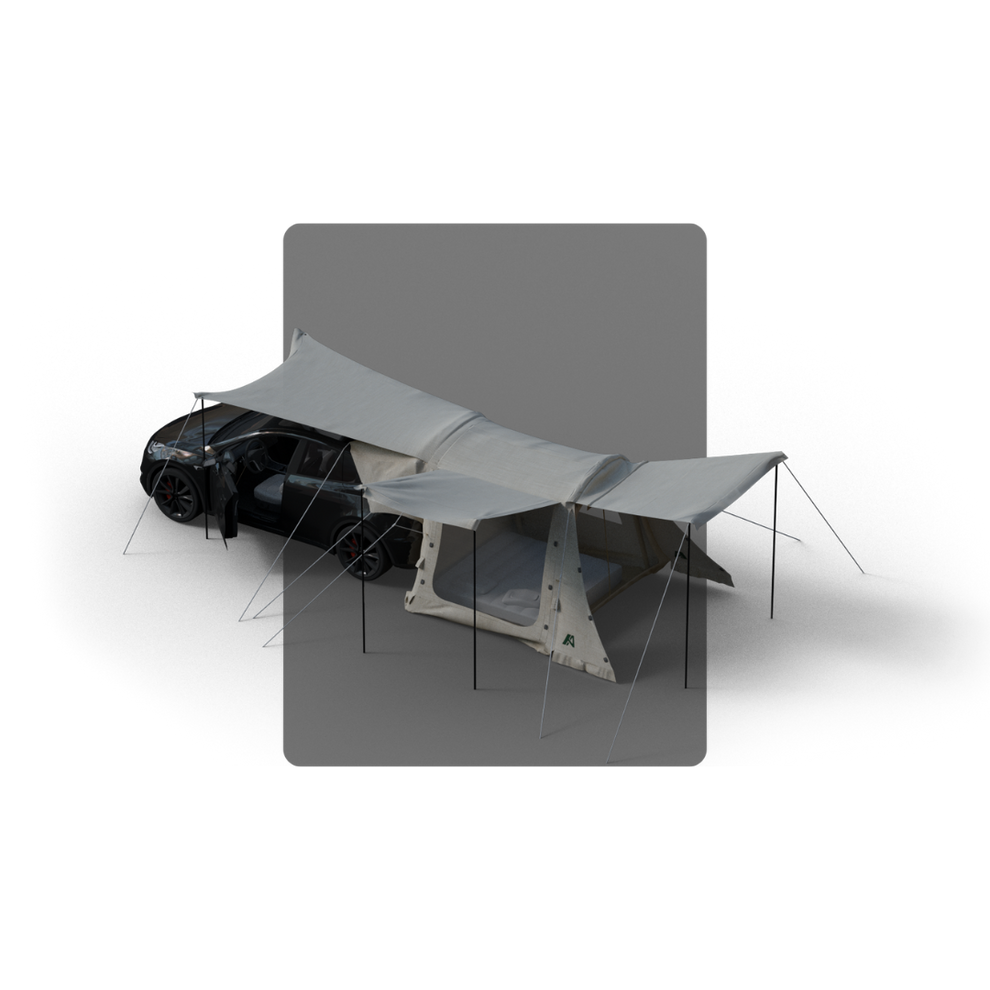
Basecamp Engineering: TENTSLA X1 Tesla Camping Tent ($649)
Engineered specifically to solve the spatial limitations of vehicle sleeping, the TENTSLA X1 integrates seamlessly with the rear tailgate of your Tesla Model Y, Model 3, or Model X, expanding your interior cabin into an expansive, weather-tight multi-room basecamp.
| Airframe System | Rapid-inflation high-pressure structural air-beams (Sets up in under 5 minutes with zero rigid poles) |
| Fabric Architecture | Rugged 420D Oxford Outer Shell & Floor paired with breathable 210D Oxford Interior |
| Thermal & UV Defense | Silver-coated internal canopy for maximum solar heat reflection and UV insulation |
| Vehicular Integration | Airtight tailored elastic sleeve that seals around the open trunk hatch to share vehicle Camp Mode climate |
| Hardware Package | High-tensile aluminum support awning poles, heavy-duty steel ground stakes, and manual pump included |
Overlander's Sourcing Advice: Eliminate the claustrophobia of sleeping inside a cramped trunk. Order the complete system on the official Tesla Camping Tent product portal, accelerate your inflation time with our Portable Air Pump for Tent, or explore premium sleep surfaces in our Self Inflating Camping Mattress lineup.
Direct Technical Comparison: Dispersed Public Lands vs. Developed Frontcountry
| Operational Feature | Dispersed BLM / USFS Public Lands | Developed Frontcountry State/National Parks | Commercial RV Resort / Private Campgrounds |
|---|---|---|---|
| Cost per Night | $0 (Free public access) | $20 to $45 per night + booking fees | $45 to $110 per night |
| Reservation Window | Zero reservations (First-come, first-served) | Strict (Booked 6 months in advance on Recreation.gov) | Online reservation system |
| Power Infrastructure | Zero (Off-grid vehicle traction pack only) | Rarely available at standard tent/car sites | Continuous 120V / 240V NEMA 14-50 hookups |
| Leveling Predictability | Variable (Requires scouting and leveling ramps) | Engineered flat asphalt or packed gravel pads | Poured concrete or precision gravel pads |
| Privacy and Solitude | Exceptional (100 yards to miles between neighbors) | Low (Campsites spaced 15 to 30 feet apart) | Very Low (High-density vehicle parking) |
| Sanitation & Water | Zero (Must pack in water; pack out all waste) | Vault toilets, seasonal potable water spigots | Full utility: hot showers, flush toilets, laundry |
Pros and Cons: Rigorous Site Selection vs. Spontaneous Pull-Offs
| Selection Approach | Authentic Practical Strengths (Pros) | Real-World Operational Liabilities (Cons) |
|---|---|---|
|
Methodical Site Selection (Satellite mapping, slope auditing, wind checks) |
|
|
|
Spontaneous "Park & Sleep" (Pulling onto the first roadside turnout at dusk) |
|
|
EV Power Dynamics: Managing Kilowatt-Hours in the Backcountry
Car camping in an electric vehicle is fundamentally different from car camping in a gas-powered SUV. An internal combustion vehicle is dead weight at night: you cannot run the engine overnight without suffocating inside a cloud of carbon monoxide, draining the small 12-volt starter battery, or disturbing wilderness silence with a rattling exhaust. An EV, by contrast, is a silent, high-density residential energy storage system on wheels.
However, that massive energy reserve must be monitored with mathematical discipline. The primary drain is thermal management. Tesla Camp Mode maintains active airflow, runs cabin heat or air conditioning, powers interior USB ports, and keeps the touchscreen operational. In moderate temperatures (55°F to 65°F), thermal loads are minimal because the heat pump runs at low compressor speeds. But when you camp in high-altitude desert environments—such as the Colorado Plateau or high Sierra—temperatures swing dramatically from 85°F during the day to 28°F at 4:00 AM.
Consider the energy ledger across an active overnight session:
- Base Parasitic Load: Simply keeping the vehicle's onboard computers, sensor suite, and low-voltage DC-DC converters awake draws approximately 200 to 300 Watts of continuous power, regardless of climate settings (roughly 2.4 kWh over an eight-hour night).
- Thermal Heating Consumption: Heating a cold cabin against near-freezing ambient air consumes between 1,200 and 2,000 Watts. If your campsite is exposed to high winds, convective heat loss accelerates through the panoramic glass roof, forcing the heat pump to run continuously.
- The Wind Mitigation Savings: Positioning your vehicle nose-in behind a natural rock bluff or dense tree line cuts wind-chill convective cooling across the cabin glass, reducing overnight thermal battery draw by up to 30% (saving 3 to 5 kWh of energy). That saved energy can provide an extra 15 to 20 miles of highway driving range the following morning.
For colder expeditions, smart overlanders pair vehicle climate with high-efficiency localized heating gear, such as low-wattage 12V heated blankets or insulated thermal window covers. Review our field-tested recommendations across the Tesla Camping Gear catalog to maximize your off-grid battery efficiency.
Who Needs Methodical Site Selection vs. Who Can Camp Anywhere
Every dollar and hour allocated to your overland preparation should match your vehicle setup, travel tempo, and comfort expectations. Methodical site selection is non-negotiable for specific travel profiles, while simple quick-stops suffice for others.
Campers Who Must Use Methodical Site Selection:
- EV Overlanders and Road-Trippers: If you are relying on battery power to sleep comfortably in Camp Mode and still reach a distant Supercharger the following day, disciplined site selection is a life-safety requirement. Running out of kilowatt-hours in a remote national forest is a severe logistical emergency.
- Campers with Tailgate-Connected Tent Annexes: If you travel with an interconnected vehicle shelter like the TENTSLA X1, you cannot simply park on an arbitrary roadside shoulder. You require adequate linear space behind your vehicle, a level footprint for your tent floor, and zero overhead obstructions that could interfere with your open liftgate.
- Families and Light Sleepers: Adults and children who require uninterrupted, quiet sleep to stay energized during long multi-day road trips cannot tolerate highway noise, tilted mattresses, or buffeting winds.
Campers Who Can Tolerate Basic "Park & Sleep" Stops:
- High-Clearance 4x4 Rigs with Self-Leveling Air Suspension: If you drive a modified off-road rig equipped with independent four-corner onboard air suspension that can level out a five-degree slope at the touch of a button, you can park on uneven terrain without manual ramp staging.
- Interstate Transit Drivers Napping for 3 Hours: If your goal is simply to pull off the highway at 1:00 AM, recline your driver's seat for a three-hour nap, and resume driving at dawn, stopping in a well-lit interstate rest stop or approved travel center parking bay is practical and efficient.
Costly Mistakes Campers Make When Picking a Camp Spot
Overlander's Field Warning: The "Dead Tree Fall" Hazard (Widow-Makers)
The most lethal hazard in backcountry camping is parking beneath dead, diseased, or drought-stressed trees. Known among foresters as "widow-makers," large dead branches or rotted pine trees snap without warning under moderate wind gusts. A two-hundred-pound pine limb falling from forty feet will crush a vehicle cabin, smash through panoramic glass roofs, and cause fatal injuries. Always look up before you park. Never position your vehicle or tent beneath dead overhead branches, standing dead snags, or trees with rotted roots.
- Arriving After Astronomical Dusk: Sourcing a dispersed campsite in complete darkness is a recipe for disaster. Headlights provide a narrow, high-contrast tunnel of vision that hides steep drop-offs, deep ruts, mud bogs, and overhead branches. You cannot assess slope, drainage, or cleanliness. Always plan your travel schedule to arrive at your prospective camp zone at least 60 to 90 minutes before sunset so you can walk the terrain and inspect the ground thoroughly.
- Parking on Vegetated Meadow Turf: Driving onto lush green grass or soft meadows destroys the root structure of fragile native vegetation and leaves deep tire ruts that accelerate soil erosion. In wet conditions, heavy vehicles break through turf crusts instantly, sinking axles into mud. Always park on durable, bare mineral earth, compacted gravel, or established hard-packed dirt.
- Forgetting to Lock Down Food Storage in Bear Country: Keeping aromatic food, coolers, and cooking gear inside a thin tent or in an unlocked vehicle cargo area in active bear habitats. Black bears and grizzly bears have an acute sense of smell and can peel open vehicle doors like tin cans. In designated bear management zones across national parks, all food, trash, and scented toiletries must be locked inside permanent bear-proof metal food lockers or certified bear-resistant canisters stored away from your sleeping quarters. Review safety protocols via the National Park Service.
- Failing to Cache Offline Digital Topographic Maps: Relying on live cellular data to navigate remote public lands. Backcountry valleys and forest canyons rarely have reliable 5G or LTE reception. If you fail to download your mapping areas, satellite imagery, and trail routing for offline use prior to leaving highway corridors, you will be unable to verify property boundaries, topography, or return routes.
Essential Gear Considerations to Adapt to Imperfect Terrain
Even with the most disciplined scouting, the natural world rarely provides perfectly flat, paved, four-star campsites. Equipping your vehicle with the right hardware allows you to adapt to challenging landscapes safely and comfortably.
1. High-Density Multi-Tiered Leveling Ramps
Never rely on random rocks or scrap wood found on the trail to level your vehicle; loose stones can slide out under tire torque, damaging your wheels or dropping the suspension abruptly. Carry a pair of commercial high-impact polymer leveling blocks or curved drive-on leveling ramps rated for at least 5,000 pounds per wheel. A good set allows you to raise one or two low wheels by one to four inches in thirty seconds, neutralizing stubborn ground pitches.
2. Vehicle-Specific High-Density Foam Mattresses
Standard household inflatable air mattresses are terrible for car camping: they leak air as ambient temperatures drop overnight, transfer cold air from the trunk floor into your back, and bow inward at the edges. Invest in a custom-tailored, multi-layer memory foam or self-inflating mattress contoured to the exact interior wheel-arch dimensions of your vehicle. A high-performance mattress bridges the gap over folded seat hinges and provides a flat, thermally insulated sleeping deck. If you drive a compact EV sedan, review dedicated configurations in our guide to the Tesla Model 3 Sleeping Pad.
3. High-Output Electric Air Pumps for Rapid Shelter Deployment
If your basecamp setup involves an inflatable structural tent like the TENTSLA X1, relying on a small manual hand pump after a ten-hour driving day is exhausting. Carry a dedicated, high-pressure 12-volt electric SUP/tent inflator that plugs directly into your vehicle's 12V auxiliary power socket. Setting your target PSI and pressing start lets your living annex erect itself automatically while you prep dinner or organize your bedding.
4. Comprehensive Road Trip Recovery Gear
Venturing down unpaved public land corridors requires self-recovery capability. Pack a portable 12-volt digital tire inflator, a heavy-duty tire puncture repair kit, a set of high-traction recovery boards, and an emergency jump starter. Having the capability to air down your tire pressures to 25 PSI for soft sand and air back up to 42 PSI for highway transit transforms your vehicle's off-road stability. Browse our complete equipment collection on the Tesla Road Trip Essentials portal.
Expert Overlanding Verdict: The Final Site Selection Blueprint
In our professional assessment across thousands of miles of backcountry trail scouting and EV overland testing, learning how to choose a car camping location is the single most valuable outdoor skill you can develop. High-end camping gear, high-capacity lithium batteries, and custom memory foam mattresses cannot rescue a night spent sliding down a rocky, wind-blasted hillside or dealing with a midnight eviction on private land.
Here is your definitive, field-tested site selection checklist:
- Arrive in Daylight: Plan your route to arrive at your target area at least one hour before dusk. Never attempt to validate an unpaved dispersed campsite in the dark.
- Check the Bubble Level: Park your vehicle, inspect your leveling display, and verify that your pitch angle is under 1.5 degrees. If a mild slope is unavoidable, point the nose downhill so your head remains elevated.
- Audit the Wind and Canopy: Point your front bumper into the wind, verify that you are not parked in a freezing cold-air drainage sink, and look directly upward to ensure zero dead "widow-maker" branches threaten your vehicle roof.
- Lock in Your 30% Energy Buffer: Calculate your return route to the nearest high-speed charging hub. Ensure you hold at least a 20% to 30% battery buffer over that return distance after budgeting for eight hours of overnight Camp Mode climate control.
- Deploy an Integrated Living Basecamp: Settle your vehicle on durable mineral soil, verify you have a clean 10-to-12-foot linear clearance behind your bumper, and erect an advanced inflatable shelter like the TENTSLA X1. By uniting your vehicle's silent climate control with an expansive, weatherproof living annex, you transform a simple parking spot into an elite, multi-room backcountry sanctuary.
Treat the land with respect, pack out every scrap of waste, leave your campsite cleaner than you found it, and enjoy the unparalleled freedom of mobile vehicular exploration.
Frequently Asked Questions
The single most critical mechanical factor when you choose a car camping location is surface leveling and pitch. Sleeping inside a vehicle parked on even a mild 3-degree incline causes physical sliding, blood pooling in the head or lower extremities, and restless sleep. For electric vehicles running climate control, parking with the nose slightly elevated or dead-level ensures optimal airflow and comfortable body ergonomics.
Electric vehicle camping introduces energy management into site selection. Rather than seeking remote sites without power considerations, EV campers must calculate the kilowatt-hour reserve needed to reach the next charging hub while accounting for climate control consumption (roughly 1% to 2% battery capacity per hour in Tesla Camp Mode) and ambient overnight temperature extremes.
No. While dispersed camping is broadly permitted on Bureau of Land Management (BLM) and US Forest Service (USFS) public lands, vehicles are legally restricted to designated motorized corridors, typically within 100 to 300 feet of an existing open road. Driving off designated tracks creates resource damage and carries federal fines.
Vehicle-integrated setups, such as tailgate canopies and inflatable air-frame tents, require 8 to 12 feet of flat, unobstructed clearance directly behind the vehicle rear bumper. Tree branches, boulders, or steep drop-offs behind your parking spot can block your liftgate from opening fully or prevent an airtight weather seal.
Authoritative Land Management & Safety References
- Bureau of Land Management (BLM): Dispersed Camping Guidelines, Motor Vehicle Use Regulations, and Public Land Ethics
- National Park Service (NPS): Backcountry Safety Protocols, Wildlife Storage Directives, and Camping Regulations
- Leave No Trace Center for Outdoor Ethics: The 7 Principles of Outdoor Stewardship and Durable Surface Selection