

List of 9 Car Camping Equipment Essentials for Vehicles: The Overlander & EV Guide
Oct 21, 2026

Every weekend adventurer, overland explorer, and electric vehicle owner eventually reaches the exact same frustrating realization: tossing a standard backpacker tent and a cheap vinyl air mattress into the trunk does not create a functional outdoor retreat. You drive hundreds of miles to a mountain campsite, wrestle with fiberglass poles in the pitch-dark, wake up at 3:00 AM on a deflated plastic mattress shivering against the cold ground, and spend your morning searching through disheveled duffle bags for a single coffee mug. That is not outdoor freedom; it is disorganized endurance. True car camping is an integrated systems discipline. When properly configured, your vehicle is not just transport to a campsite; it is a mobile micro-cabin, an expedition power station, and a weather-sealed climate habitat. Choosing the right car camping equipment requires looking past generic outdoor retail checklists and evaluating structural fit, thermodynamic efficiency, deployment speed, and vehicle-integration mechanics. At TENTSLA, we design vehicle-integrated shelter systems, stress-test air-frame inflation structures in alpine gale winds, and optimize cabin airflow daily. Here is our practitioner-grade evaluation of the 9 essential car camping equipment systems every vehicle camper needs to transform an SUV, crossover, or EV into a high-performance overland basecamp.

Quick Answer: What Car Camping Equipment Delivers the Best Experience?
To build an elite vehicle camp setup, your car camping equipment must bridge the gap between your vehicle's mechanical capabilities and outdoor shelter comfort. The 9 essential equipment systems are: (1) Inflatable Tailgate Air-Frame Tents (such as the TENTSLA X1, establishing an integrated, climate-connected living room in under five minutes); (2) Vehicle-Contoured Memory Foam Mattresses (eliminating the awkward slope and seatbelt buckles of folded rear seats); (3) Multi-Layer Thermal Blackout Window Shields (stopping radiant heat gain and preserving overnight HVAC efficiency); (4) Portable 12V/24V Compressor Refrigerators (delivering zero-ice, dry-storage food preservation); (5) Compact Induction Cooktops & Electric Mess Kits (eliminating explosive butane canisters by leveraging onboard vehicle power); (6) Weather-Resistant Dual-Zone Camp Blankets (water-repellent, high-loft insulation for sub-freezing nights); (7) Sub-Trunk Modular Storage Cubes (organizing heavy gear below the floor deck to preserve interior sleeping space); (8) Heavy-Duty Vehicle Leveling Ramps (guaranteeing a flat, blood-rush-free sleeping surface on uneven terrain); and (9) High-Volume Dual-Action 12V Air Compressors (enabling effortless rapid setup of air-beam shelters and sleeping gear). Prioritizing rapid-deployment, vehicle-connected gear over generic ground gear is the single best investment you can make for outdoor comfort.
Article Directory
- What It Is: The Evolution of Modern Vehicle-Integrated Camping
- Quick Summary Table: The 9 Essential Car Camping Equipment Systems
- In-Depth Evaluation: 9 Essential Car Camping Equipment Categories
- Featured Equipment Spotlight: TENTSLA X1 Inflatable Tesla Tent
- Direct Technical Comparison: Vehicle-Connected Gear vs. Traditional Ground Gear
- Pros and Cons: Vehicle-Integrated Car Camping Systems
- Operational Realities: Power Budgets, Payload Weight, and Pack Volume
- Who Should Invest in Vehicle-Specific Gear vs. Who Can Camp Basic
- 5 Costly Mistakes Campers Make When Sourcing Car Camping Equipment
- Essential Buying Checklist: Sourcing Vehicle-Integrated Gear
- Expert Overlanding Verdict: The Ultimate Basecamp Blueprint
- Frequently Asked Questions
- Authoritative References & Outdoor Safety Standards
What It Is: The Evolution of Modern Vehicle-Integrated Camping
To evaluate modern car camping equipment with professional clarity, you must abandon the obsolete assumption that vehicle camping simply means sleeping in a tent next to where your car is parked. In the modern outdoor landscape, vehicle-integrated camping treats the vehicle's chassis as the central structural and environmental anchor of the camp. This shift has accelerated dramatically with the rise of modern crossovers, rugged overlanding SUVs, and electric vehicles equipped with high-capacity traction batteries and active climate management.
When you camp with an integrated setup, your vehicle supplies four critical utilities that traditional ground tents can never replicate:
- Continuous Environmental Microclimate: Vehicles equipped with active climate control can maintain a steady 68°F (20°C) interior cabin temperature in freezing alpine snowstorms or sweltering desert heat. When paired with an enclosed vehicle tent, that conditioned air can circulate throughout your entire living space.
- Massive Silent Energy Storage: Modern vehicles—especially electric platforms carrying 60kWh to 130kWh battery reserves—eliminate the need for noisy, polluting gas generators. The vehicle provides pure direct current (DC) and alternating current (AC) to power induction cooktops, refrigeration, interior lighting, and communication devices for days off-grid.
- Impermeable Foundation & Security: The vehicle provides an elevated, steel-and-aluminum barrier safe from ground moisture, predatory wildlife, and flash-flood runoff. Your sleeping quarters remain dry, flat, and insulated from the frozen earth.
- Rapid Modular Deployment: By engineering car camping equipment around the vehicle's physical dimensions, packing and unpacking transitions from an hour-long chore into a five-minute routine.
From our experience on remote overland trails, campers who rely on generic ground gear spend 40% of their trip managing gear friction: drying soggy tent floors, re-pegging blown guy lines, and digging through disorganized plastic bins. Investing in purpose-built car camping equipment eliminates that friction, letting you focus on the wilderness experience. If you are configuring a modern EV setup, review our technical breakdown on the Tesla Camping Setup to understand how vehicle software integrates with outdoor hardware.
Quick Summary Table: The 9 Essential Car Camping Equipment Systems
| Equipment Category | Primary Functional Role | Target Technical Specification | Critical Failure Prevented | Relative Investment Tier |
|---|---|---|---|---|
| 1. Inflatable Tailgate Tent | Living space extension & airlock | 420D Oxford fabric, TPU air beams | Snapping poles, rain leakage, wind collapse | Premium ($500 – $750) |
| 2. Vehicle-Contoured Mattress | Primary sleep surface | CertiPUR-US high-density memory foam | Punctured air beds, back strain, bottoming out | Moderate ($120 – $250) |
| 3. Thermal Window Shields | Radiation barrier & 100% privacy | Multi-layer reflective foil with foam core | Rapid battery drain from HVAC thermal loss | Accessible ($60 – $130) |
| 4. 12V/24V Compressor Fridge | Perishable food preservation | Variable-speed DC compressor (30L–45L) | Soggy food from melted cooler ice, food poisoning | Premium ($300 – $700) |
| 5. Electric Cooking Hub | Camp culinary preparation | 1500W induction burner, cast iron | Dangerous open flames in high-wind fire bans | Accessible ($50 – $150) |
| 6. Insulated Camp Blankets | Dynamic thermal regulation | Ripstop polyester shell, synthetic hollow-fiber | Draft chills, damp morning dew absorption | Accessible ($45 – $100) |
| 7. Sub-Trunk Storage Organizers | Gear management & space recovery | Custom-molded EVA or heavy 600D canvas | Cabin clutter preventing flat bed deployment | Accessible ($50 – $120) |
| 8. Heavy-Duty Leveling Ramps | Chassis attitude adjustment | High-load polymer honeycomb (5,000+ lbs) | Sleeping on an incline with blood pooling in head | Accessible ($40 – $80) |
| 9. High-Output 12V Air Pump | Rapid pneumatic deployment | Dual-stage high-volume / high-pressure pump | Exhausting manual hand-pumping after long drives | Accessible ($60 – $120) |
In-Depth Evaluation: 9 Essential Car Camping Equipment Categories
1. Inflatable Vehicle Tailgate Tents (The Micro-Cabin Expansion)
The single most transformative piece of car camping equipment you can add to a vehicle is an inflatable tailgate tent. Traditional vehicle-attached tents rely on complex webs of segmented fiberglass or aluminum poles. In our testing during high-wind mountain gusts, rigid poles create extreme stress points: they bend, crack, puncture tent sleeves, and can even scratch your vehicle's paintwork during assembly.
Modern inflatable air-beam tents—exemplified by the TENTSLA X1—replace fragile rigid poles with high-pressure thermoplastic polyurethane (TPU) air chambers encased in heavy-duty ballistic sleeves. You back your vehicle into the campsite, roll out the tent, connect the continuous elasticized tunnel sleeve over the open rear hatch, and inflate the structure in under five minutes using a manual or 12V electric pump. The air beams flex naturally under heavy wind gusts and spring back into shape without breaking.
More importantly, an airtight vehicle connection transforms your camp architecture. By sealing the tent directly against the vehicle hatch, your car becomes the quiet, climate-controlled master bedroom, while the tent functions as an expansive, bug-free living room, changing area, and gear storage lounge. For drivers navigating specific vehicle dimensions, evaluate specialized models in our collection of Car Camping Tent for Tesla options, and examine exact dimensional differences in our analysis of Model Y Camping Tent Features.
2. Vehicle-Contoured Memory Foam Mattresses
If you cannot sleep deeply, your camping trip is a failure. For decades, campers relied on cheap vinyl inflatable pool-style air mattresses. In real-world camping, vinyl air mattresses are notorious: they squeak violently whenever you move, leak air over six hours as temperatures drop, and act like cold thermal heat sinks that sap your body warmth into the uninsulated vehicle floor.
In most professional situations, we recommend upgrading to a vehicle-tailored high-density memory foam or self-inflating hybrid mattress. High-performance vehicle mattresses are precision-cut to follow the exact interior wheel-well contours of modern SUVs and crossovers. They feature rigid internal base plates that cantilever over the rear passenger footwells, creating a completely flat, gap-free sleeping platform. The top layer utilizes open-cell memory foam that cradles pressure points at your hips and shoulders, while a rugged, removable plush cover allows easy machine washing after dusty trail trips. If you are deciding which vehicle platform yields the best sleep geometry, read our comparative guide on the Best Tesla for Car Camping.
3. Multi-Layer Thermal Blackout Window Shields
A vehicle cabin is essentially a glass greenhouse. Standard automotive glass provides virtually zero thermal insulation. In summer desert conditions, radiant solar energy passing through vehicle windows will overwhelm your air conditioning; in winter, uninsulated glass radiates interior heat out into the atmosphere, causing heavy interior condensation that drips down door panels.
A complete set of custom-cut multi-layer thermal window covers is mandatory car camping equipment. These shields utilize a multi-tier sandwich construction:
- An exterior-facing radiant barrier (reflective aluminum or silver-coated film) that reflects up to 95% of incoming infrared solar radiation during the day.
- An internal dense closed-cell polyethylene foam or insulating felt core that provides physical thermal resistance (R-value).
- An interior-facing deep black fabric layer that provides 100% optical blackout, preventing campsite neighbors or streetlights from waking you at dawn while giving you complete privacy inside your vehicle bedroom.
4. Portable 12V/24V Compressor Refrigerators
The traditional camping cooler filled with fifty pounds of melting grocery-store ice is an obsolete, messy relic. Ice melts within forty-eight hours, turning your fresh steaks, cheeses, and produce into a floating, soggy biological mess. Furthermore, buying bags of ice in remote gateway towns is an ongoing expense that wastes valuable cargo volume.
A modern 12V portable compressor refrigerator operates on the exact same thermodynamic vapor-compression cycle as your residential kitchen fridge. Powered directly by your vehicle's 12V accessory port, a USB-C PD line, or an auxiliary battery bank, high-efficiency DC compressor fridges consume a modest 30W to 45W of power when actively cycling. They allow you to dial in exact temperatures—from 50°F (10°C) for crisp beverages down to -4°F (-20°C) for deep-freezing meat. Dry, organized food storage elevates your camp culinary capabilities, allowing you to prepare healthy, chef-grade meals hundreds of miles away from the nearest grocery store.
5. Electric Induction Cooktops & Zero-Emission Mess Kits
Carrying volatile propane, butane, or white-gas pressurized fuel bottles inside a closed vehicle cabin presents significant fire and toxic off-gassing risks. Furthermore, high-altitude alpine regions and dry western forests frequently enforce strict Stage 2 or Stage 3 fire bans that prohibit open flames and gas stoves altogether.
If you drive an electric vehicle or carry an auxiliary power bank, transitioning to a single-burner portable induction cooktop (1200W to 1800W) represents the gold standard of modern camp cooking. Induction cooktops use electromagnetic fields to heat the cooking vessel directly, wasting zero heat to ambient air and boiling a liter of water in under three minutes. Because there is no open flame, you can safely cook under your tent awning or inside an open tailgate galley in torrential rain or high winds without blowing out your flame. Pair your cooktop with heavy-gauge, folding-handle cast-iron or stainless steel cookware for bulletproof field durability.
6. Weather-Resistant Dual-Zone Insulated Camp Blankets
Traditional cotton bedroom comforters have no place in a vehicle camping kit: cotton is hygroscopic, meaning it absorbs ambient humidity, morning dew, and body perspiration, becoming heavy, damp, and thermally useless. Bulky winter sleeping bags, conversely, are restrictive, slippery, and frustrating to use across a two-person vehicle mattress.
High-performance outdoor camp blankets—such as the Camping Blanket for Outdoor Trips—bridge this gap perfectly. Built with a rugged, DWR-treated (Durable Water Repellent) 20D or 30D ripstop nylon shell on one side and a soft, breathable insulation fleece or micro-plush on the reverse, they shed pet hair, resist trail dirt, and trap body heat efficiently. Synthetic hollow-fiber insulation retains 90% of its thermal efficiency even in damp conditions, serving as a cozy campfire wrap during the evening and your primary bed covering at night.
7. Sub-Trunk Modular Storage & Space-Recovery Cubes
The primary spatial bottleneck of vehicle camping is the transition between driving mode and sleeping mode. When you arrive at camp, where do you put your duffle bags, hiking boots, recovery boards, and camp chairs so you can fold the rear seats flat to sleep? If you pile everything onto the front driver and passenger seats, your cabin becomes chaotic and claustrophobic.
The solution is exploiting dead space through custom sub-trunk storage systems. Modern crossovers and EVs have massive underfloor storage wells (sub-trunks) and front trunks (frunks). Sourcing custom-molded EVA storage tubs or modular canvas cargo cubes allows you to organize heavy tools, charging cables, water jugs, and dry pantry goods completely beneath the main floor deck. When it is time to deploy your mattress, your primary cabin floor remains entirely clear. Explore curated accessory organizers across our complete collection of Best Tesla Camping Gear.
8. Heavy-Duty Vehicle Leveling Ramps
Few natural campsites are perfectly flat. If your vehicle is parked on even a mild 3-degree forward or lateral tilt, you will spend the entire night sliding down your mattress, bunching your blankets, and waking up with a pounding headache caused by blood pooling in your head. Traditional ground tent campers can search around for a flat patch of grass; vehicle campers are constrained by the grade of the dirt parking pad.
Carrying a pair of heavy-duty, high-density polymer stepped leveling ramps solves this problem in seconds. Rated to support vehicle wheel loads exceeding 5,000 pounds, you place the ramps in front of the downhill tires and slowly roll the vehicle forward until your dashboard bubble level reads dead-center. In under two minutes, you transform an un-sleepable hillside into a level, five-star bedroom.
9. High-Volume Dual-Action 12V Air Compressors
The final piece of foundational car camping equipment is a dedicated electric inflator. Sucking air through a manual foot pump to inflate a 10-foot air-beam tent and a large dual-occupant camping mattress after driving six hours down dusty washboard roads is exhausting.
A dual-stage 12V high-volume / high-pressure air pump connects directly to your vehicle's 12V auxiliary socket. Stage one uses a high-volume turbine fan to push hundreds of liters of air per minute, expanding the tent air beams or mattress chambers in seconds. Stage two automatically engages a high-pressure piston compressor to dial in exact structural pressures (such as 7 to 9 PSI for rigid tent beams), automatically shutting off when target pressure is reached. Packing up is equally effortless: switching the hose to the deflation port vacuums all internal air out, compressing your tent and mattress into ultra-compact, flat packages that slide easily into your storage bins.
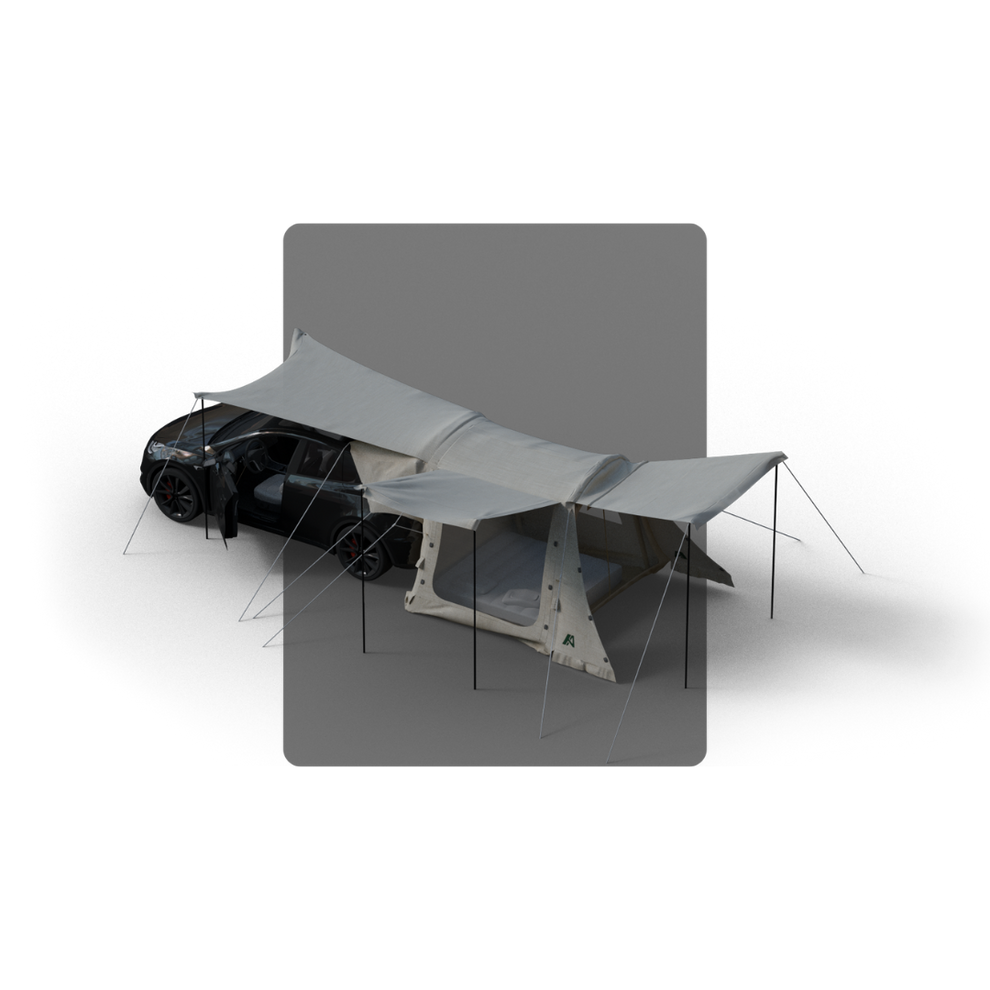
Flagship Equipment Spotlight: TENTSLA X1 Tesla Camping Tent ($649)
Engineered specifically to seamlessly merge automotive engineering with outdoor glamping luxury, the TENTSLA X1 represents the pinnacle of vehicle-integrated car camping equipment for Tesla Model Y, Model 3, and Model X owners.
| Chassis Architecture | Proprietary high-pressure inflatable air-beam frame system (Zero fragile poles) |
| Shell & Floor Textiles | Rugged 420D Oxford fabric on exterior and floor; breathable 210D Oxford inner fabric |
| Thermal & UV Shielding | Multi-layer silver-coated fabric delivering certified UV protection and radiant heat insulation |
| Structural Hardware | Aerospace aluminum auxiliary support poles and heavy-duty ground anchor stakes |
| Setup Velocity | Rapid 5-minute single-person inflation using included manual or high-volume electric pump |
| Vehicle Integration | Custom-tailored elasticized airlock tunnel circulating vehicle Camp Mode HVAC into the tent |
Overlander's Sourcing Advice: Eliminate the frustration of bent tent poles and wet ground setups. Order the turnkey TENTSLA X1 Tesla camping Tent directly, or explore cutting-edge off-grid setups in our field guide to the Cybertruck Camping Tent.
Direct Technical Comparison: Vehicle-Connected Gear vs. Traditional Ground Gear
| Evaluation Vector | Vehicle-Integrated System (TENTSLA X1 Setup) | Traditional Ground Tent + Foam Pad | Rooftop Tent (RTT) System |
|---|---|---|---|
| Setup & Strike Speed | 5 minutes (Inflatable air beams, zero poles) | 20 – 35 minutes (Poles, stakes, fly ropes) | 3 – 8 minutes (Unfolding ladder & struts) |
| Active Climate Control | 100% Integrated (Vehicle HVAC ducted directly) | Zero (Dependent entirely on ambient weather) | Zero to Poor (Requires external diesel heaters) |
| Vehicle Aerodynamics & Range | Zero range loss (Stores internally in trunk/frunk) | Zero range loss (Stored internally) | Severe 10% – 25% highway aerodynamic drag penalty |
| Living Area Versatility | Multi-room: In-car bedroom + full standing tent room | Single cramped floor room; low headroom | Single elevated bed; zero standing/changing space |
| Drive-Away Capability | Yes (Zips closed as freestanding camp shelter) | Yes (Completely independent of vehicle) | No (Must pack entire rooftop tent to leave camp) |
| Equipment Weight & Payload | Compact (~35 lbs total pack weight) | Lightweight to Moderate (15 – 30 lbs) | Heavy (120 – 180+ lbs on vehicle roof rails) |
Pros and Cons: Vehicle-Integrated Car Camping Systems
| Gear Philosophy | Documented Practical Advantages (Pros) | Real-World Operational Liabilities (Cons) |
|---|---|---|
|
Vehicle-Integrated Car Camping Equipment (Tailgate Tents, Custom Mattresses, 12V Fridges) |
|
|
|
Generic Ground-Camping Gear (Standard Dome Tents, Vinyl Air Beds, Coolers) |
|
|
Operational Realities: Power Budgets, Payload Weight, and Pack Volume
Before purchasing your complete suite of car camping equipment, you must understand the immutable physical boundaries of mobile camping: electrical energy capacity, vehicle payload ratings, and pack volume displacement.
1. Managing the Onboard Power Budget
If you camp in an internal combustion engine (ICE) vehicle, your starter battery has a tiny capacity (typically under 0.8kWh) and will die within two hours of running auxiliary accessories. You must carry an independent lithium power station (500Wh to 1000Wh). If you camp in an EV (like a Tesla Model Y or Cybertruck), you are sitting on an immense 75kWh to 123kWh energy reserve.
However, running active vehicle climate control overnight still follows thermodynamic laws:
- In temperate conditions (55°F to 70°F), maintaining 68°F internal cabin temperature consumes roughly 1% to 1.5% battery capacity per hour (approx. 8% to 12% over an eight-hour night).
- In sub-freezing winter conditions (20°F / -6°C), vehicle heat pumps work significantly harder, consuming 2% to 2.5% per hour. Installing custom-fit thermal window shields and zipping your rear hatch into a dual-wall tent reduces this heating workload substantially.
- Understand your vehicle's specific software modes by reading our guide on Tesla Camp Mode vs Dog Mode.
2. Vehicle Gross Vehicle Weight Rating (GVWR)
Every vehicle has a certified Gross Vehicle Weight Rating (GVWR) stamped on the driver-side door jamb. That number dictates the maximum legal weight of the vehicle, passengers, and all cargo. Inexperienced campers often overload crossovers with heavy rooftop tents (160 lbs), steel slide-out drawer systems (120 lbs), full water tanks (8.34 lbs per gallon), and bulky gear. Heavy loads degrade braking distances, strain suspension bushings, and reduce EV driving range by 15% to 30%. Prioritize lightweight, high-density gear—such as inflatable air-beam tents weighing under 35 pounds—over heavy structural steel rooftop hardware.
3. Highway Aerodynamics and Driving Range
Rooftop tents (RTTs) and bulky exterior cargo boxes look rugged on social media, but on the highway, they destroy vehicle aerodynamics. Bluff, un-streamlined rooftop boxes act like aerodynamic parachutes, increasing vehicle drag coefficient ($C_d$) and slashing fuel economy by 3 to 5 MPG on gas vehicles, and slashing highway range by 15% to 25% on electric vehicles. The beauty of modular, vehicle-integrated car camping equipment is that the tent, mattress, fridge, and induction cooker store entirely inside your vehicle's aerodynamic profile, preserving 100% of your highway range to reach distant backcountry trailheads.
Who Should Invest in Vehicle-Specific Gear vs. Who Can Camp Basic
Every dollar allocated to outdoor gear should match your trip frequency, geographic terrain, and comfort requirements. Sourcing high-end car camping equipment is a transformative investment for dedicated explorers, but unnecessary for casual backyard campers.
Campers Who Must Invest in Vehicle-Integrated Gear:
- Four-Season & Extreme Weather Overlanders: If you camp during freezing winter snows, humid midwestern summers, or torrential coastal rains, standard nylon ground tents will make you miserable. Vehicle-connected tents backed by active climate control provide life-saving comfort and warmth.
- Electric Vehicle Owners (Tesla Model Y, Model 3, Model X, Cybertruck): If you drive an EV, your vehicle already possesses the world's most advanced mobile climate control and energy storage. Failing to pair that vehicle with a tailored air-beam tent and custom mattress is leaving 80% of your car's capability untapped. For truck owners, analyze market pricing in our report on Cybertruck Tent Price and explore setup strategies in Tesla Cybertruck Camping Setup.
- Digital Nomads & Long-Distance Road Trippers: If you live on the road for weeks at a time working remotely, fast 5-minute setups, cold refrigerated food storage, and a guaranteed flat bed are non-negotiable for mental and physical stamina.
Campers Who Can Stick to Basic Ground Gear:
- Once-a-Year Fair-Weather Campers: If you pitch a tent one weekend every summer in a manicured state park campground with bathhouses and plug-in electric pedestals, a basic $80 sporting-goods dome tent and a foam sleeping pad are completely adequate.
- Ultralight Wilderness Backpackers: If your objective is hiking fifteen miles into remote wilderness areas where vehicles are prohibited, car camping systems are useless. You need sub-two-pound backpacking gear.
5 Costly Mistakes Campers Make When Sourcing Car Camping Equipment
Overlanding Specialist Warning: The "Unsealed Tailgate Exhaust" Disaster
The most common mistake amateur campers make when attempting vehicle camping is using a cheap universal blue tarp or loose netting over an open tailgate without an airtight vehicle seal. In cold weather, drafts rush into the cabin; in warm weather, thousands of mosquitoes and biting gnats enter through the tailgate gaps. Furthermore, on traditional combustion vehicles, running an engine for heat with a poorly sealed tent can pull deadly carbon monoxide fumes directly into your sleeping quarters. Always ensure vehicle-attached tents feature high-tension, elasticized multi-point sealing tunnels, and never run a gas engine while sleeping.
- Relying on Cheap Home Vinyl Air Mattresses: Buying a $30 flocked vinyl air bed from a big-box store. Within three hours, the cold ambient air inside the vehicle causes the air inside the mattress to contract, leaving you sinking into the vehicle floor. Vinyl offers zero insulating R-value and squeaks loudly against plastic car interiors with every turn. Always invest in CertiPUR-US certified multi-layer memory foam or specialized R-5+ insulated self-inflating pads.
- Neglecting Dual-Stage Air Inflation Pressure Limits: Using an uncalibrated high-pressure tire pump on inflatable tent air beams. Bicycle tire pumps or vehicle tire compressors run at 35 to 80 PSI with tiny air volume, which will either take forty minutes to fill an air beam or spike localized pressure and rupture the internal TPU bladder. Tent air beams require high-volume low-pressure (HVLP) airflow calibrated strictly between 7 and 9 PSI.
- Ignoring Tailgate Latch Sensor Workarounds: Leaving your rear hatch open on modern computer-controlled vehicles without disengaging the interior lights or latch sensor. On many modern crossovers, an open hatch keeps internal CAN-bus electronic modules awake, rapidly draining your 12V low-voltage auxiliary battery. Use specialized carabiner clips or activate dedicated software modes (like Tesla Camp Mode) that tell the vehicle the hatch is intentionally open.
- Buying Oversized Coolers That Block Bed Deployment: Purchasing a massive 75-quart rotomolded cooler that consumes the entire rear cargo area. When it is time to fold the seats flat to sleep, the cooler has to be hoisted out into the dirt under the rain. Measure your interior dimensions: your fridge and heavy gear must fit into front footwells, sub-trunks, or inside the connected tent annex.
- Failing to Account for Interior Glass Condensation: Camping in cold weather without cracking a window or running active HVAC. Two breathing adults exhale roughly one liter of water vapor overnight. Without ventilation or thermal window covers, that moisture condenses across the glass and runs into the vehicle electronics and carpet, causing mold and electrical issues.
Essential Buying Checklist: Sourcing Vehicle-Integrated Gear
Before issuing payment for any hardware claiming to be the ultimate car camping equipment, audit prospective products against these four non-negotiable engineering benchmarks:
1. Fabric Denier and Hydrostatic Water Head Ratings
Never buy an outdoor shelter that fails to disclose its textile specifications. Demand high-tenacity, ripstop synthetic weaves:
- Inner Shell & Walls: Minimum 210D Oxford fabric providing breathable tear resistance.
- Outer Flysheet & Ground Floor: Minimum 420D Oxford polyester with an internal polyurethane (PU) waterproof coating rated for at least 3,000mm to 5,000mm hydrostatic water head pressure. This guarantees zero leakage during heavy coastal rainstorms.
- Review international outdoor textile and flammability guidelines governed by the ASTM International Standards for Camping Tent Fabrics.
2. Vehicle-Specific Tailored Geometry
Avoid "universal-fit" gear that claims to fit every minivan, pickup truck, and compact crossover equally. A universal vehicle tent features loose, baggy connection sleeves that flap loudly in the wind, create water collection pools, and allow insects to enter through gaps. Settle for nothing less than precision-tailored connection sleeves engineered specifically around your vehicle make and model lines.
3. Certified Electrical & Mechanical Safety
Ensure that all onboard electronic gear carries genuine laboratory certifications:
- Compressor fridges and pumps must carry CE, FCC, or UL-listed electrical certifications with integrated low-voltage battery cutoffs that prevent the device from draining your vehicle's starter battery.
- Adhere strictly to wilderness conservation and responsible fire ethics established by the Leave No Trace Center for Outdoor Ethics Guidelines and the National Park Service (NPS) Camping Regulations.
4. Modular Pack-Down Efficiency
Measure the packed dimensions of the equipment. An entire car camping setup—inflatable tent, mattress, window shields, blanket, and compressor—must pack down cleanly to occupy less than 30% of your vehicle's total trunk and sub-trunk volume, leaving ample room for clothing, food, and recreational equipment. Connect with like-minded community explorers through Tesla Camping Events and follow field testing stories on our Tesla Camping Blog.
Expert Overlanding Verdict: The Ultimate Basecamp Blueprint
In our professional assessment across thousands of miles of backcountry vehicle expeditions, the conclusion is absolute: traditional ground camping gear is obsolete for vehicle-based overland travelers. Attempting to force generic poles, thin foam, and melting coolers into an modern crossover or EV ruins the outdoor experience and wastes the extraordinary capabilities of your vehicle.
Here is your clear, actionable procurement roadmap:
- Anchor Your Shelter with an Inflatable Tailgate Tent: Invest in the TENTSLA X1 ($649). Its 420D Oxford construction, 5-minute air-beam inflation, and custom-tailored vehicle tunnel transform your vehicle into a climate-controlled, multi-room master suite that fiberglass pole tents cannot match.
- Eliminate Sleep Friction with a Contoured Mattress: Do not compromise on your sleep surface. Buy a custom-cut, high-density memory foam mattress tailored to your vehicle's wheel wells, and pair it with a durable, water-repellent Camping Blanket for Outdoor Trips.
- Seal Your Thermal Envelope: Install custom-fit multi-layer thermal blackout window shields. You will block solar radiation during the day, guarantee complete night privacy, and slash vehicle HVAC battery consumption by up to 40%.
- Transition to Electric Living: Ditch gas canisters and melting ice. Deploy a 12V compressor fridge and a portable induction cooktop powered directly by your vehicle. You gain pristine food safety, zero-ice convenience, and fire-ban-compliant culinary performance anywhere you park.
By treating your vehicle as an integrated outdoor habitat and sourcing professional-grade car camping equipment, you eliminate camp setup friction, unlock four-season weather independence, and experience the wilderness with uncompromised comfort and safety.
Frequently Asked Questions
The foundational car camping equipment required for an EV includes a vehicle-tailored inflatable tailgate tent (such as the TENTSLA X1), a custom-fit high-density memory foam mattress that levels the folded rear seat gap, custom-cut multi-layer thermal blackout window shields to eliminate cabin heat transfer, a portable 12V dual-zone compressor refrigerator, and weather-resistant outdoor blankets.
An inflatable tailgate tent attaches directly over the open hatch of your vehicle, extending the vehicle's interior living space into a sheltered living room. Unlike standalone ground tents, vehicle-integrated air-frame tents eliminate fragile fiberglass poles, set up in under five minutes using a manual or 12V pump, and allow campers to circulate the vehicle's active climate control directly into the living space.
In our testing across moderate ambient temperatures (45°F to 75°F), running active climate control overnight consumes between 8% and 15% of a standard 75kWh to 82kWh traction battery over an 8-hour sleep cycle. Extreme freezing winter weather or desert heat can push consumption to 15% to 22%, making thermal window covers and insulated vehicle tents essential to reduce thermal loss.
Yes, premium vehicle tents feature drive-away capabilities. The vehicle connection sleeve zips completely closed, allowing the inflated structure to remain fully freestanding at the campsite while you take the vehicle to explore trails, charge at a Supercharger, or resupply in town.
Authoritative References & Outdoor Safety Standards
- National Park Service (NPS): Safe Vehicle Camping, Wilderness Sanitation, and Food Storage Guidelines
- Leave No Trace Center for Outdoor Ethics: Seven Principles of Outdoor Recreation and Vehicle Camping
- ASTM International: Standard Specifications for Camping Tents, Fabric Flammability, and Water Resistance (ASTM F1933)