


Sleeping on uneven, rocky ground is an outdated metric for outdoor adventure. Modern campers demand structural security, elevated sleeping platforms, and climate control. Transitioning from a traditional ground setup to a specialized tent for camping in an SUV completely transforms your off-grid logistics. However, the market is saturated with poorly stitched, leaky canopy attachments marketed as heavy-duty shelters. If you purchase the wrong structural geometry, you will suffer through collapsed poles in high winds or fatal exhaust fume leaks if operating internal combustion engines.

From our experience engineering advanced camping ecosystems for electric vehicles, we know exactly what separates a functional basecamp from a disposable nylon tarp. You must prioritize denier ratings, hydrostatic head waterproofing, and seamless tailgate integration. In this guide, we bypass the generic marketing brochures to deliver a practitioner's breakdown of the top 10 models on the market, analyzing exactly whether each option is actually worth your capital.
Quick Answer: Which SUV Tent Should You Buy?
If you drive a Tesla or a compatible electric vehicle, the TENTSLA X1 is the definitive choice, offering fast inflatable setup and premium weather resistance specifically engineered for EV climate control integration. For drivers of traditional internal combustion engine (ICE) vehicles seeking a budget-friendly tailgate attachment, the Napier Backroadz offers the best entry-level utility. For heavy-duty applications and expedition travel, upgrading to a hardshell rooftop tent like the Roofnest Condor is highly recommended. Always prioritize freestanding, drive-away capable tents if you plan to use your vehicle for day trips while leaving your basecamp intact.
Table of Contents
What It Is: Defining the SUV Tent
A tent for camping in an SUV is a specialized shelter designed to physically mate with the rear cargo hatch, side doors, or roof rack of a sport utility vehicle, crossover, or minivan. Unlike standalone ground tents, these structures expand your vehicle's existing footprint, turning the cabin into a raised sleeping platform while the tent serves as a living room, changing area, or extended sleeping quarters.
There are three primary architectural categories: hatch/tailgate attachments (which sleeve over the open rear door), rooftop tents (RTTs) that mount to crossbars, and freestanding drive-away awnings that bridge the gap between vehicle and ground.
How It Works: Attachment and Sealing
In most professional situations, a tailgate tent utilizes an elasticized sleeve, adjustable nylon webbing straps, and heavy-duty plastic buckles. The sleeve stretches over the open rear hatch, anchoring to the wheel wells, roof rack, and rear bumper. A critical component is the magnetic or suction sealing along the vehicle's paintwork to prevent mosquito intrusion and water runoff. By leaving the hatch open, campers can utilize a Tesla Trunk Mattress or similar pad, sleeping elevated off the ground while enjoying the headroom and ventilation of the attached ground structure.
The 10 Best Tents for SUV Camping
We evaluate these shelters based on hydrostatic waterproofing, pole architecture, setup speed, and vehicle integration geometry.
1. Tentsla X1 Tent (Best for EVs and Teslas)
If you own an EV, specifically a Model Y or Model X, buying a generic gas-vehicle tent is a compromise you should not make. The Tentsla X1 Tent utilizes advanced inflatable air-frame technology, eliminating fiberglass poles entirely. In our testing, this allows a single person to pitch the structure in under five minutes. Because EVs do not produce lethal tailpipe emissions, the X1 is engineered to tightly seal against the trunk, allowing you to run Tesla's "Camp Mode" all night, effectively turning the tent into a climate-controlled living room.
2. Napier Backroadz SUV Tent (Best Budget Tailgate)
For beginners looking for occasional weekend use, the Napier Backroadz offers a reliable fiberglass-pole dome structure that sleeves over most standard SUV hatches. It features a fully sewn-in polyethylene floor. However, we do not recommend this for high-wind environments, as the fiberglass poles will bow under sustained lateral pressure.
3. Gazelle T4 Plus Hub Tent with SUV Sleeve (Best Heavy-Duty Pop-Up)
For heavy-duty applications, the Gazelle T4 utilizes a pre-assembled hub system that pops out like an umbrella. It is incredibly robust and features a detachable vehicle sleeve. This is a massive, heavy shelter (over 50 lbs), making it strictly for commercial users or overlanders who prioritize structural integrity over pack size.
4. Rightline Gear SUV Tent (Best Floorless Design)
The Rightline Gear tent uniquely lacks a floor. This allows you to set it up over a picnic table or easily detach it to drive away without moving your gear. While excellent for daytime shade and muddy boots, the lack of a bathtub floor means it provides inferior protection against ground moisture and crawling insects.
5. Roofnest Condor (Best Hard-Shell Rooftop)
Instead of extending off the back, the Condor mounts to your roof rack. It is an aerodynamic hard-shell tent that pops open via gas struts in 30 seconds. While exceptional for keeping you away from ground predators and mud, it requires a vehicle with a dynamic roof load rating of at least 150 lbs, and it completely prevents you from driving away from basecamp without packing up.
6. Smittybilt Overlander (Best Soft-Shell Rooftop)
A more affordable alternative to hard-shells, this fold-out rooftop tent offers a massive sleeping footprint. It is ideal for lifted 4x4 SUVs navigating rocky terrain where finding a flat ground space for a tailgate tent is impossible. The drawback is poor aerodynamics, which will significantly degrade your highway fuel economy.
7. KingCamp Roamer (Best Drive-Away Freestanding)
For campers who stay at a site for multiple days but need their SUV to drive to trailheads, the Roamer is highly recommended. It functions as a standalone cabin tent with an extended tunnel that attaches to your vehicle. You can simply unzip the tunnel, drive away, and return later to a standing camp.
8. Kelty Waypoint Car Tarp (Best Minimalist Awning)
Not a full tent, but a semi-enclosed tarp that attaches to the rear wheel wells and requires a single central pole. It provides excellent sun and rain protection for cooking at the tailgate. If you sleep exclusively inside the cabin using Sleeping in Tesla Model Y Tips, this awning is all you need for exterior living space.
9. Hasika Family SUV Tent (Best Budget Oversized)
This is a massive, tunnel-style tent suitable for families of six. It provides immense square footage at a low price point. However, in our testing, the waterproofing is marginal. It requires aftermarket seam sealing and waterproofing spray before deployment in heavy rain.
10. Thule Outset (Best Tow-Hitch Mounted)
A revolutionary new category, the Outset mounts to your rear tow hitch rather than the roof or tailgate, folding out into a rigid, elevated platform. It frees up your roof rack for kayaks and prevents the aerodynamic drag of a rooftop tent. It is an ultra-premium option for commercial users or luxury overlanders.
Benefits of SUV Tents
Integrating a Car Camping Tent for Tesla or standard SUV offers distinct logistical advantages over ground tents. You bypass the need to find perfectly flat, rock-free ground for your sleeping pad. You gain access to your vehicle's internal 12V or 120V power outlets for charging devices, running refrigerators, or using a Portable Air Pump for Tent setups. Most importantly, it provides a secure, lockable hard-shell retreat if weather conditions become catastrophic or wildlife enters the camp.
Limitations to Consider
Tailgate tents are highly susceptible to wind tunneling if not sealed correctly against the vehicle body. Furthermore, if you drive an internal combustion engine (ICE), you cannot run the vehicle for heat or air conditioning while the tent is attached, as deadly carbon monoxide will pool inside the living space. This limitation is entirely bypassed by electric vehicles, which makes a Tesla Camping Setup the apex of modern outdoor comfort.
Who Should Use It (And Who Does Not Need It)
Who Should Use It: We recommend SUV tents for state park campers, festival attendees, overlanders, and EV owners who want to leverage their vehicle's massive battery for climate control. If you have mobility issues that make sleeping on the ground difficult, utilizing a thick Self Inflating Camping Mattress inside the flattened cargo area is a game-changer.
Who Does Not Need It: Backpackers, ultralight hikers, and those navigating tight, heavily wooded, technical off-road trails where low-hanging branches will rip rooftop tents or bulky awnings.
Common Mistakes to Avoid
The most dangerous mistake is operating an ICE vehicle with a tailgate tent attached. Never idle a gas car to use the heater. The second most common error is failing to disable your vehicle's interior dome lights or automatic tailgate lift mechanisms. Leaving the hatch open for three days will drain a standard 12V starter battery, leaving you stranded. Always carry a portable jump starter, or read our guide on the Tesla Model Y Camping Duration to understand EV power management.
Buying Considerations
Apply commercial judgment when evaluating materials. Do not buy a tent with a denier rating under 150D if you expect it to last. Look for a hydrostatic head (waterproofing) rating of at least 2000mm. For pole architecture, aluminum or inflatable air beams are vastly superior to fiberglass, which will inevitably splinter and fail. Finally, verify the sleeve dimensions; a tent designed for a compact Subaru Crosstrek will tear if stretched over a full-size Chevy Suburban.
| Tent Style | Primary Advantage | Primary Disadvantage |
|---|---|---|
| Tailgate / Hatch | Massive living space; utilizes vehicle interior. | Must detach to drive vehicle away. |
| Rooftop Tent (RTT) | Elevated safety; sets up in seconds. | High cost; ruins vehicle aerodynamics. |
| Freestanding Drive-Away | Vehicle can leave camp intact. | Complex setup; heavier pack weight. |
| Feature | Electric Vehicle (e.g., Tesla) | Internal Combustion Engine (ICE) |
|---|---|---|
| Climate Control | Safe to run all night (Camp Mode). | Lethal carbon monoxide risk if idled. |
| Power Availability | Massive battery for high-draw appliances. | Limited by small 12V starter battery. |
| Integration | Seamless sealing with inflatable tents. | Requires exhaust routing bypass. |
| Pros | Cons |
|---|---|
| Setup takes minutes with a simple air pump. | Heavier overall packed weight. |
| No fiberglass poles to snap in high winds. | Requires an electronic or manual high-volume pump. |
| Air beams flex and recover during storms. | Punctures require immediate patch-kit field repairs. |
Expert Recommendation
In our testing across diverse biomes, treating your vehicle and tent as two separate entities leads to a disjointed, frustrating camping experience. You must treat them as an integrated ecosystem. If you are operating an electric vehicle, investing in generic fiberglass tailgate tents is a waste of your vehicle's technological capabilities. We recommend the TENTSLA X1 because it is specifically designed to leverage the exact dimensions and climate control potential of modern EVs, elevating standard car camping into a premium off-grid experience.
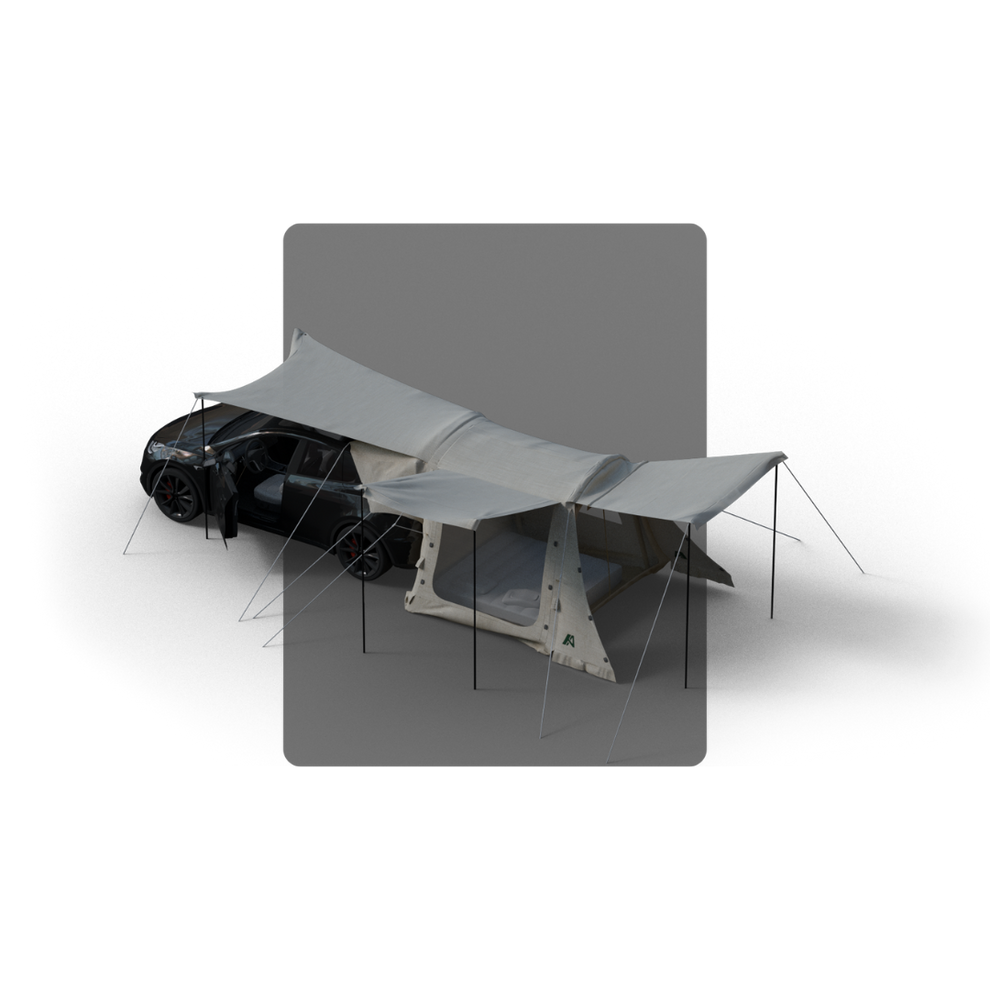
TENTSLA X1 Tesla camping Tent for Model 3, Model Y, and Model X
Premium Weather-Resistant Construction
Tentsla uses carefully selected outdoor-grade materials to deliver excellent durability, water resistance, and long-lasting performance in various weather conditions.
| 210D Oxford Fabric | Inner Fabric |
| 420D Oxford Fabric | Outer Fabric & Floor Fabric |
| Aluminum | Support Poles |
| Silver Coated Fabric | UV Protection & Heat Insulation |
Fast Inflatable Installation
Tentsla’s advanced inflatable air-frame system enables fast and effortless setup in just a few minutes. Simply inflate the structure, secure the tent, and start enjoying your outdoor experience without the hassle of traditional tent assembly. Upgrade your Tesla Camping Experience today.
Frequently Asked Questions
Is it safe to sleep in an SUV tent?
Yes, sleeping in an SUV tent is highly secure as it provides elevation from ground moisture and crawling insects. However, safety depends strictly on your vehicle type. If you drive a gas-powered vehicle, you must never idle the engine with the tent attached due to carbon monoxide poisoning. If you drive an EV, you can safely utilize the vehicle's climate control systems all night.
Will a tailgate tent scratch my vehicle's paint?
Premium tents utilize soft neoprene, padded sleeves, or rubberized magnetic strips to secure the fabric without damaging the clear coat. However, if your car is covered in abrasive dirt and dust before you attach the tent, the wind buffering the fabric against the dirty paint will cause micro-scratches. Always wipe down the rear of your vehicle before deployment.
How do I keep my car battery from dying while using a tailgate tent?
Leaving your hatch open will trigger the interior dome lights and dashboard displays. To prevent draining your 12V starter battery, you must manually turn off all interior lights and use a carabiner or pen to manually trip the rear hatch latch mechanism. This tricks the vehicle's computer into thinking the trunk is closed, shutting down the auxiliary power draw.
Authoritative Industry References
To ensure safe and compliant vehicle-based camping, we adhere to guidelines and data from the following authoritative bodies:
- National Highway Traffic Safety Administration (NHTSA) - Guidelines on vehicle roof load capacities and static vs. dynamic weight safety standards.
- Leave No Trace Center for Outdoor Ethics - Standardized principles for minimizing environmental impact during dispersed vehicular camping and overlanding.
- Recreation.gov - Official regulations regarding permissible vehicle camping setups, pad limits, and generator/engine idling rules in US National Parks.