


The electric vehicle revolution did more than just change how we commute; it fundamentally altered how we experience the great outdoors. For decades, sleeping in your car meant cracking a window to avoid suffocation, waking up freezing or sweating, and draining your 12-volt battery just to charge a smartphone. Tesla changed this paradigm entirely. However, the EV camping industry is plagued with generic advice and misunderstandings about how the vehicle's high-voltage system actually operates during an overnight stay.

At TENTSLA, we are not just observers; we manufacture the industry-leading hardware that integrates with these vehicles. We have spent thousands of nights sleeping in Model 3s, Model Ys, and Cybertrucks across extreme climates. We know precisely what happens in Tesla camp mode, down to the exact kilowatt-hour consumption. In this comprehensive guide, we will cut through the myths, explain the exact sequence of technical events that occur when you tap that campfire icon, and provide commercial and practical judgment on how to optimize your overnight overland adventures.
Quick Answer: What Exactly Happens in Tesla Camp Mode?
When you activate this software feature, 7 distinct system changes occur to transform your EV into a climate-controlled cabin:
- Continuous HVAC: The high-voltage battery keeps the air conditioning and heater running all night at your desired temperature.
- Sentry Mode is Disabled: Exterior cameras stop recording to conserve battery, and interior alarms are deactivated so you do not trigger them while sleeping.
- Auto-Locking is Suspended: Walk-away door locking is disabled; you must manually lock the vehicle from the inside screen or app.
- Low-Voltage Ports Stay Energized: Your USB-C ports, 12V/16V cigarette lighter sockets, and wireless charging pads remain active.
- The Screen Stays On: A digital campfire screensaver plays, and media/music controls remain accessible.
- High-Voltage Contactors Remain Closed: The main battery pack stays connected to supply continuous energy.
- Battery Floor Protection: If the battery drops to 20%, Camp Mode automatically shuts off to ensure you have enough range to drive to a charger.
Direct Answer
If you are searching for exactly what happens in Tesla camp mode, the direct answer is that it is a software override that bypasses the vehicle's normal "sleep" state. In most professional situations, when you exit a vehicle, the high-voltage battery disconnects to prevent vampire drain. Camp mode forces the high-voltage contactors to remain engaged, routing power from the massive floor battery to the HVAC compressor, the low-voltage auxiliary ports, and the infotainment screen. It effectively turns your Tesla into a massive, mobile, climate-controlled power bank, allowing you to sleep comfortably in extreme heat or sub-zero freezing temperatures without emitting carbon monoxide or idling an engine.
Table of Contents
- What It Is: The Definition of Camp Mode
- How It Works: The 7 System Changes Explained
- The Tangible Benefits of Sleeping in an EV
- Limitations and Energy Consumption
- Who Should Use It & Who Does Not Need It
- Comparison: Camp Mode vs. Dog Mode vs. Keep Climate On
- Common Mistakes Beginners Make
- Buying Considerations: Gear Required for Camp Mode
- Pros and Cons of EV Camping
- Expert Recommendation & Product Spotlight
- Frequently Asked Questions
What It Is: The Definition of Camp Mode

Camp Mode is a specialized climate control setting introduced by Tesla via an over-the-air (OTA) software update late in 2019. Prior to this, users had to employ "hacks" like leaving the car in neutral with the emergency brake engaged to keep the air conditioning running while they slept. Recognizing the massive community of overland enthusiasts, Tesla formally integrated a dedicated button.
It is not just a fan setting. It is a comprehensive power-management profile. When wondering what happens in Tesla camp mode, you must understand that it reconfigures the vehicle's security, lighting, and thermal management systems to prioritize human habitation over driving readiness or long-term energy preservation.
How It Works: The 7 System Changes Explained
From our experience engineering the finest Tesla Camping Accessories on the market, we have reverse-engineered the practical outputs of this feature. Here is the deep dive into the seven things that occur:
- Continuous Thermal Management: The octovalve (or traditional PTC heater in older Model 3s) runs continuously. The car will automatically cycle the AC compressor or heat pump to maintain the exact degree you set. It pulls fresh air from outside, filters it through the HEPA filter (in Model Y/S/X), and circulates it through the cabin.
- Sentry Mode and Tilt Alarms Disable: If you toss and turn in your sleep, an active car alarm will trigger. Camp mode automatically disables interior motion sensors, tilt sensors, and Sentry Mode. This is a critical security nuance you must be aware of when parking in public spaces.
- Auto-Lock Suspension: Because your phone (the key) is inside the car, the vehicle assumes it is occupied. Walk-away door locking is disabled. You must manually tap the lock icon on the screen or in your app before going to sleep to ensure your safety.
- Low-Voltage Power Availability: The 12V (or 16V lithium in newer models) socket in the trunk or center console remains active. This is crucial for commercial users or medical patients who need to power CPAP machines, portable refrigerators, or laptops overnight.
- The Digital Campfire: The central touchscreen dims heavily and displays a looping video of an animated campfire, complete with crackling audio. You can tap the screen to access media controls (Netflix, Spotify) or turn the screen off entirely for complete darkness.
- High-Voltage Battery Drain: The car actively consumes energy from the main drive battery. The rate of consumption depends entirely on the ambient exterior temperature and your desired interior temperature.
- The 20% Hard Stop: Tesla engineered a fail-safe. If your battery capacity drops to 20%, Camp Mode will abruptly shut off. This prevents you from waking up stranded in the wilderness with a dead car.
The Tangible Benefits of Sleeping in an EV
The benefits of this system are revolutionary. In traditional tent camping, you are at the mercy of the elements. In a Tesla, you sleep in a secure, steel-reinforced micro-cabin with perfect 70-degree Fahrenheit (21-degree Celsius) air conditioning, regardless of whether it is snowing outside or 100 degrees in a desert. This makes the Best Tesla for Car Camping effectively better than a luxury RV for short weekend trips.
Furthermore, because there is no internal combustion engine, there are zero tailpipe emissions and zero engine idling noise. You can legally and safely camp in enclosed spaces, national parks with strict noise ordinances, or crowded festival grounds without bothering your neighbors or risking carbon monoxide poisoning.
Limitations and Energy Consumption
We believe in absolute transparency: Camp Mode is not flawless. The primary limitation is battery drain. In our testing, maintaining a 70°F cabin when it is 60°F outside consumes about 1% to 1.5% of the battery per hour. However, if it is 15°F outside and you are blasting the heat, consumption can spike to 3% to 4% per hour. If you arrive at a campsite with 30% battery, you cannot use Camp Mode through the night due to the 20% cutoff threshold.
Another limitation is HVAC noise. The heat pump in newer Teslas can be quite loud from the outside as it works to scavenge heat from cold ambient air. While quiet inside, it can hum noticeably to anyone parked next to you. Lastly, condensation is a major issue. Two humans exhaling moisture in a sealed glass box will result in dripping wet windows by morning if you do not manage airflow correctly.
Who Should Use It & Who Does Not Need It
Who should use it: Weekend warriors, overland explorers, and festival-goers. If you are taking a road trip across the country and want to save hundreds of dollars on hotel rooms, Camp Mode is your best financial asset. Furthermore, for heavy-duty applications like remote remote workers needing a climate-controlled mobile office for 8 hours, it is unmatched.
Who does not need it: Day trippers or those who strictly stay in full-service hotels. If you never intend to sleep in your vehicle or power heavy electronics from the trunk, you will never need this feature. For short grocery runs where you leave a pet in the car, you should use Dog Mode instead. To understand the exact nuances, read our breakdown on Tesla Camp Mode vs Dog Mode.
Comparison: Camp Mode vs. Dog Mode vs. Keep Climate On
| Feature | Camp Mode | Dog Mode | Keep Climate On |
|---|---|---|---|
| Primary Purpose | Human sleeping / living in car | Keeping pets safe while away | Running quick errands |
| Screen Display | Campfire animation / Media access | "My owner will be back soon" message | Standard UI (Screen turns off) |
| Sentry Mode | Disabled | Enabled | Enabled |
| USB/12V Ports | Active | Inactive | Active |
| Auto-Locking | Suspended | Active (Locks when you walk away) | Active |
Common Mistakes Beginners Make
In most professional situations, poor preparation leads to miserable nights. The most common mistake we see is failing to crack a window or use ventilated window shades. While the HVAC circulates air, managing the humidity from human breath requires slightly cracking the rear windows to prevent waking up to a rainstorm inside your car.
The second mistake is ignoring the hard plastic of the folded seats. A sleeping bag is not enough. You must invest in a proper Tesla Camping Mattress engineered specifically to bridge the trunk gap and cushion the seat hinges. Without one, you will wake up with severe back pain. Finally, forgetting to manually lock the doors from the touchscreen before falling asleep is a massive security oversight.
Buying Considerations: Gear to Maximize Camp Mode
To truly leverage what happens in Tesla camp mode, the software alone is insufficient. You need physical hardware to convert a crossover SUV into a legitimate camper. If you are questioning Sleep Two Adults in Tesla Model Y, the answer is yes, provided you have the right setup. We recommend evaluating your needs across three categories: Mattress platforms, window privacy shades, and exterior space extension.
For commercial users or families needing extra space, confining two adults and a dog inside the glass roof of a Model Y is claustrophobic. This is where tailgate tents become mandatory. By connecting a specialized tent to the rear hatch of the Tesla, the HVAC system from Camp Mode pumps air conditioning directly into the tent, effectively doubling your climate-controlled living space.
Pros and Cons of Tesla Camp Mode
| Pros (Benefits) | Cons (Limitations) |
|---|---|
| Perfect climate control (AC and Heating) all night long. | Consumes 10% to 20% of your driving range overnight. |
| Powers laptops, fridges, and CPAP machines via 12V/USB. | Shuts off abruptly if battery reaches 20% capacity. |
| Zero tailpipe emissions; safe for enclosed or stealth camping. | Disabling Sentry Mode reduces perimeter security monitoring. |
| Access to premium entertainment (Netflix, Hulu) on the screen. | Requires expensive aftermarket mattresses for actual comfort. |
Buying Guide: Essential Tesla Camping Upgrades
| Upgrade Category | Why It Is Necessary | Our Recommendation |
|---|---|---|
| Tailgate Tent | Expands living space; allows you to stand up, change clothes, and store dirty gear outside the vehicle while sharing the car's AC. | TENTSLA X1 (Seamless hatch integration). |
| Custom Memory Foam Mattress | Factory seats do not fold perfectly flat. A mattress bridges the gap and provides orthopedic support. | Review our Tesla Model 3 Mattress Size guide. |
| Blackout Window Shades | Camp Mode turns the screen on, which can illuminate your face to people outside. Shades provide total privacy and thermal insulation. | Custom-cut reflective foil shades for exact window geometry. |
| Sleeping Platform | Creates sub-trunk storage underneath the bed for food and gear. | Explore Tesla Model Y Camping Platform options. |
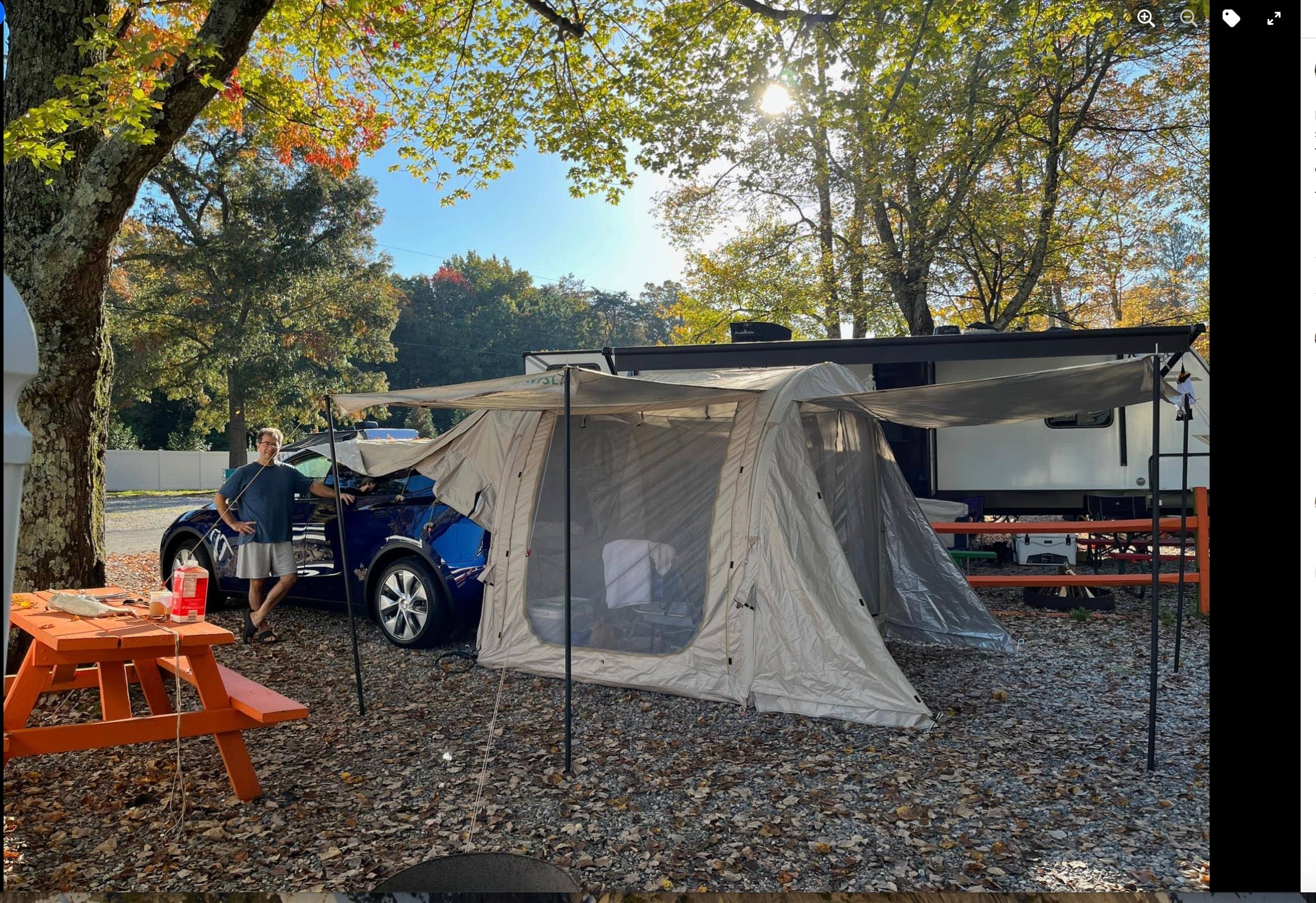
Expert Recommendation: The TENTSLA X1
We do not just write about Tesla camping; we engineer the solutions. If you want to maximize the incredible utility of Camp Mode, sleeping entirely inside the car is a beginner's mistake. For heavy-duty applications, family camping, or extended overland trips, we recommend deploying the TENTSLA X1 Tesla Camping Tent.
Designed explicitly for the Model 3, Model Y, and Model X, the X1 utilizes a specialized trunk connector that seals seamlessly around the vehicle's rear hatch. This allows the climate-controlled air generated by Camp Mode to flow directly into the massive tent structure. It transforms a cramped car into a multi-room, weather-proof luxury suite.
- Complete Kit: Includes the Tentsla X1 Tent, manual pump, aluminum poles, steel pegs, and guy wires.
- Seamless Integration: Features a proprietary Tesla Trunk Connector and Windshield Connector for aerodynamic stability.
- Premium Add-ons: Available with automated E-Pumps and modular add-on beds for immediate deployment.
Before planning your next trip, we also suggest reviewing the Tesla Tent Price 2026 to budget your overland build effectively, or if you are one of the lucky early adopters, check out the Cybertruck Camping Tent options available.
Frequently Asked Questions
Does Camp Mode work if the car is plugged into a charger?
Yes. This is the ultimate "cheat code" for Tesla camping. If you reserve an RV spot with a 30-amp or 50-amp pedestal, you can plug your Mobile Connector in. The car will pull shore power to run the HVAC and electronics, meaning you wake up with a 100% battery charge instead of experiencing overnight drain.
Can I turn off the screen while in Camp Mode?
Yes. While the screen defaults to the campfire animation, you can tap the screen and select "Screen Clean Mode" or simply use the display brightness settings to completely black out the screen, ensuring a pitch-black environment for deep sleep.
Why did my Camp Mode shut off in the middle of the night?
If your battery state of charge (SOC) hits exactly 20%, Tesla's software will automatically disable Camp Mode and power down the HVAC system. This is a non-negotiable safety feature designed to ensure you retain enough battery capacity to drive to the nearest Supercharger the following morning.
Authoritative References & Industry Standards
To ensure our operational guidance aligns with federal and manufacturer safety standards, we reference the following authorities: