

How Does Tesla Camping Work? A Practical Guide to Camp Mode, Sleeping Setups, and Tesla Tents
Nov 03, 2026

Tesla camping is more than parking an electric car at a scenic campsite and sleeping in the back. The real advantage is the combination of a large battery, built-in climate control, a quiet electric drivetrain, and a vehicle interior that can be adapted for overnight use. With the right preparation, a Model Y, Model 3, Model X, or Model S can become a comfortable base for road trips, weekend camping, and overnight stops.
But there is an important distinction: Tesla Camp Mode manages the vehicle's climate and selected electrical functions. It does not automatically turn the car into a fully equipped camper. Sleeping space, insulation, ventilation, privacy, storage, and campsite selection still determine whether the experience is comfortable.

Quick Answer: How Does Tesla Camping Work?
Tesla camping works by using Camp Mode to keep the parked vehicle's cabin climate running while you sleep or spend time inside. Depending on the vehicle and software version, Camp Mode also keeps the touchscreen active and provides power through the USB ports and low-voltage outlet. You activate it from the climate controls while the car is in Park, then prepare a flat sleeping surface and organize your camping equipment.
The high-voltage battery supplies the energy for climate control and other vehicle functions. This means you do not need to idle a gasoline engine, but you do use battery energy while parked. Battery consumption varies with outside temperature, cabin settings, vehicle condition, and how long you stay.
Our recommendation: use Camp Mode for climate management, a properly fitted mattress or camping platform for sleep, and a separate tent when you need more room or privacy. Do not assume Camp Mode replaces a complete camping setup.
For a broader equipment checklist, see our guide to Tesla camping accessories.
Table of Contents
- What Is Tesla Camping?
- How Tesla Camp Mode Works
- How to Set Up a Tesla for Camping
- Tesla Camping and Sleeping Options
- Benefits of Tesla Camping
- Limitations You Should Understand
- Battery Use and Overnight Planning
- When a Tesla Camping Tent Is Worth Buying
- Tesla Camping Setup Comparison
- Common Tesla Camping Mistakes
- Buying Considerations
- Our Expert Recommendation
- Frequently Asked Questions
1. What Is Tesla Camping?
Tesla camping means using a Tesla electric vehicle as part of an overnight outdoor setup. Some owners sleep directly inside the vehicle. Others use the car as a climate-controlled sleeping space and attach or position a tent beside it. A third group uses the Tesla mainly as transportation and campsite power support, while sleeping in a conventional tent.
These approaches are related, but they solve different problems. Sleeping inside the car prioritizes convenience and weather protection. A tent adds usable space and makes it easier to change clothes, store equipment, or spend time outside the vehicle. A ground tent offers more flexibility when the campsite does not allow vehicle-based sleeping or when the vehicle's interior is too small for the group.
The feature that makes Tesla camping different from ordinary car camping is Camp Mode. It allows the vehicle to maintain cabin temperature while parked, rather than relying on the traditional approach of running an internal-combustion engine for heating or cooling.
Which Tesla models can be used for camping?
Model Y is one of the most practical choices because its rear cargo area and folding seats provide a relatively useful sleeping space. Model X offers a larger vehicle format, while Model 3 can work for solo travelers or people who are comfortable with a more compact sleeping arrangement. Model S owners can also explore vehicle camping, but the available sleeping area and setup depend on the model year and interior configuration.
Do not assume every Tesla has identical controls, interior dimensions, power outlets, or software behavior. Check the owner's manual for your exact vehicle before planning a trip.
2. How Does Tesla Camp Mode Work?
Camp Mode is a vehicle software setting designed for people who remain inside a parked Tesla. It keeps the cabin climate operating and, according to Tesla's owner documentation, can provide power to electronics through USB ports and the low-voltage outlet. The touchscreen remains active for supported entertainment and vehicle controls.
The system draws energy from the high-voltage battery. It is not a separate generator, and it does not create unlimited electricity. Heating or cooling the cabin can reduce the driving range available after the camping session.
What stays active in Camp Mode?
- Cabin climate: The vehicle attempts to maintain the selected temperature while Camp Mode remains active.
- USB and low-voltage power: Supported devices can be powered or charged through the vehicle's available outlets.
- Touchscreen: The display remains available for supported vehicle functions and entertainment.
- Media: You can use supported audio and entertainment features while parked.
- Mobile app controls: Depending on software and connectivity, you can monitor or adjust relevant settings through the Tesla app.
How to turn on Tesla Camp Mode
- Park in a permitted, suitable location. Choose a level area where overnight vehicle occupancy is allowed. Avoid blocking traffic, emergency access, or other campsite users.
- Shift into Park. Camp Mode is accessed while the vehicle is parked.
- Open the climate controls. Use the climate interface on the touchscreen.
- Select Camp. The exact screen layout can vary with software version and vehicle model.
- Set a comfortable temperature. Avoid unnecessarily aggressive heating or cooling. A moderate setting can help reduce energy use.
- Prepare your sleeping area. Arrange the seats, mattress, bedding, window covers, and personal items before settling down.
- Check the vehicle and app before sleeping. Confirm that Camp Mode is active, the battery has enough reserve, and you understand how to monitor the vehicle.
Tesla's manuals describe Camp Mode as a feature for staying inside the vehicle. The exact activation requirements and low-battery behavior can differ by model and software version, so follow the instructions displayed by your own vehicle rather than relying on a universal online shortcut.
3. How to Set Up a Tesla for Camping
A good Tesla camping setup starts with the sleeping surface, not with accessories. From our experience reviewing vehicle camping configurations, owners often spend too much time choosing gadgets and not enough time checking whether two people can actually lie flat without pressure points, gaps, or uncomfortable seat transitions.
Step 1: Measure the usable sleeping area
Measure the length, width, and height of the space you intend to use. Include the narrowest points around the wheel arches, seat backs, trim, and center console. A mattress that looks suitable by its advertised dimensions may not fit the actual interior shape.
For Model Y owners, compare the available space with our guide to sleeping two adults in a Tesla Model Y. Model 3 owners should review Tesla Model 3 mattress sizing before ordering a mattress.
Step 2: Create a level sleeping platform
Fold the rear seats according to the vehicle's instructions and inspect the resulting surface. Some configurations leave a slope or height difference between the seat backs and cargo floor. A fitted camping platform can reduce that unevenness and provide a more stable base for a mattress.
For people who camp regularly, a purpose-built platform is usually a better investment than stacking random boxes or luggage under a mattress. It creates a more predictable sleeping surface and can help organize equipment underneath. Compare available options in our Tesla Model Y camping platform guide.
Step 3: Add a suitable mattress and bedding
A mattress should fit the vehicle, support the sleeper's body, and be easy to pack away. Thickness alone does not determine comfort. A very thick mattress can reduce headroom, interfere with hatch clearance, or make it harder to store equipment.
For beginners, a correctly sized mattress and a warm sleeping bag are more valuable than a large collection of decorative camping accessories. For couples or frequent travelers, consider a dedicated mattress designed around the vehicle's interior dimensions.
See our guide to choosing a Tesla camping mattress for a closer look at fit and sleeping comfort.
Step 4: Manage privacy, light, and ventilation
Window covers make a meaningful difference. They reduce outside light, improve privacy, and can help limit direct solar exposure. They should not be installed in a way that blocks necessary ventilation or creates an unsafe sleeping environment.
Do not assume that a closed vehicle is automatically comfortable simply because Camp Mode is running. Consider condensation, humidity, bedding moisture, and the number of people sleeping inside. Keep the sleeping area organized and avoid covering vents or interfering with vehicle sensors and controls.
Step 5: Plan power and charging
Charge your Tesla before leaving and identify charging options along the route and near the campsite. USB and low-voltage outlets are useful for smaller electronics, but they should not be confused with a household electrical system. Check the vehicle's specifications before connecting any device with a high power demand.
Never assume a campground's ordinary electrical pedestal is suitable for charging an EV. Confirm compatibility and permission with the campground operator or use a designated EV charging station.
4. Tesla Camping and Sleeping Options
There is no single best way to camp with a Tesla. The right setup depends on the number of people, weather, trip length, privacy requirements, and whether you want to spend most of your time inside or outside the vehicle.
Sleep inside the Tesla
This is the simplest arrangement for solo travelers and couples who can fit comfortably in the vehicle. You benefit from the car's climate control and a sheltered sleeping area. The trade-off is limited space for luggage, cooking equipment, and movement.
Use a Tesla camping tent
A tent expands the usable camping area and creates a separate sheltered space beside or around the vehicle, depending on the tent design. This is a practical option for people who want more room without carrying a full-size trailer or camper.
A tent does not replace Camp Mode. It provides shelter and living space; the vehicle's climate system remains a separate function. Before purchasing, check the tent's fitment, attachment method, weather limits, setup requirements, and compatibility with your specific Tesla model.
Use a conventional ground tent
A ground tent is often the better option for families, groups, or campers who want a separate sleeping space. It can also be more practical when the campsite rules do not permit sleeping in vehicles. The Tesla then serves as transportation and a convenient place to store selected equipment.
5. Benefits of Tesla Camping
Climate control without engine idling
The main advantage is the ability to maintain cabin comfort without running a gasoline engine. This is especially useful during overnight stops when outdoor temperatures are uncomfortable. Camp Mode is designed for this specific parked-vehicle use case.
A quieter overnight experience
An electric vehicle avoids the continuous engine noise associated with idling a conventional car. You may still hear the climate system, fans, compressors, or other vehicle components, but the overall experience can be quieter than sleeping in a running gasoline vehicle.
Convenient power for small electronics
Available USB and low-voltage outlets make it convenient to charge phones and other compatible small devices. This is useful for navigation, photography, communication, and entertainment. It is not a reason to overload the vehicle's electrical outlets or connect equipment beyond their rated capacity.
Less equipment for short trips
For a one-night road trip, sleeping inside the Tesla can reduce the need to carry a large tent, separate sleeping shelter, and bulky camping furniture. A mattress, bedding, window covers, and a few essentials may be enough.
Flexible travel between destinations
A Tesla camping setup can work well for road trips that combine driving, sightseeing, and occasional overnight stays. You can use established campgrounds, designated overnight facilities, and other locations where vehicle sleeping is explicitly permitted.
6. Limitations: What Tesla Camping Cannot Do
We recommend being realistic about the limitations before spending money on a camper kit. A Tesla is still a passenger vehicle. Camp Mode improves the parked experience, but it does not provide the space, sanitation, cooking facilities, or independent utilities of a motorhome.
- Limited sleeping room: Interior dimensions restrict how comfortably multiple adults can sleep.
- Battery consumption: Climate control and parked electronics use energy that would otherwise be available for driving.
- Reduced security functions: Camp Mode disables certain security features, including Sentry Mode and the vehicle alarm system, according to Tesla's documentation.
- Limited electrical capacity: Vehicle outlets are not a substitute for a dedicated campsite electrical supply.
- Condensation and humidity: Sleeping in a closed vehicle can create moisture, especially when several people are inside.
- Limited bathroom and cooking facilities: You still need to plan for toilets, washing, food preparation, and waste disposal.
- Location restrictions: Not every parking area permits overnight sleeping or camping.
For commercial users, long-distance drivers, or people who need a reliable overnight base several nights per week, a dedicated camper conversion may be more suitable. For occasional recreational use, a simple vehicle sleeping setup is often the more economical choice.
7. How Much Battery Does Tesla Camping Use?
This is one of the most important planning questions, and it is also where generic online advice can be misleading. There is no universal Camp Mode battery-consumption figure that applies to every Tesla, every season, and every campsite.
Heating and cooling demand changes with outdoor temperature. A cold night can require substantial heating, while a hot afternoon or humid night can increase cooling demand. Cabin temperature, insulation, vehicle model, battery condition, software behavior, and the duration of the stay also matter.
What affects overnight battery use?
- Outside temperature: Extreme heat and cold generally increase climate-control demand.
- Selected cabin temperature: A large difference between the outside temperature and your setting can require more energy.
- Trip duration: A short rest stop and an eight-hour overnight stay are very different energy requirements.
- Vehicle configuration: Model, heat-pump equipment, software, and vehicle condition can affect energy use.
- Other active features: Entertainment, connected devices, and other parked-vehicle functions can add to consumption.
How to plan your battery reserve
Start with a high state of charge, check the route to the next charger, and leave a meaningful reserve for unexpected driving or weather changes. Do not plan a remote overnight stay around the assumption that Camp Mode will consume a fixed percentage every hour.
For a first trip, choose a campground or overnight location within a comfortable distance of a charging option. Monitor the battery during the evening and check it again before sleeping. If the vehicle displays a low-battery warning or indicates that a feature may stop operating, take that warning seriously.
8. When Is a Tesla Camping Tent Worth Buying?
A Tesla camping tent is worth considering when you want more usable space than the vehicle interior provides. It can create a sheltered area for changing clothes, organizing equipment, relaxing outside the car, or accommodating a camping routine that does not fit comfortably inside the cabin.
It is not essential for every Tesla camper. Solo travelers who only need a place to sleep may be better served by a fitted mattress and window covers. Couples who want a larger outdoor living area, or travelers who regularly camp in established sites, may get more value from a vehicle-compatible tent.
TENTSLA X1 Tesla Camping Tent
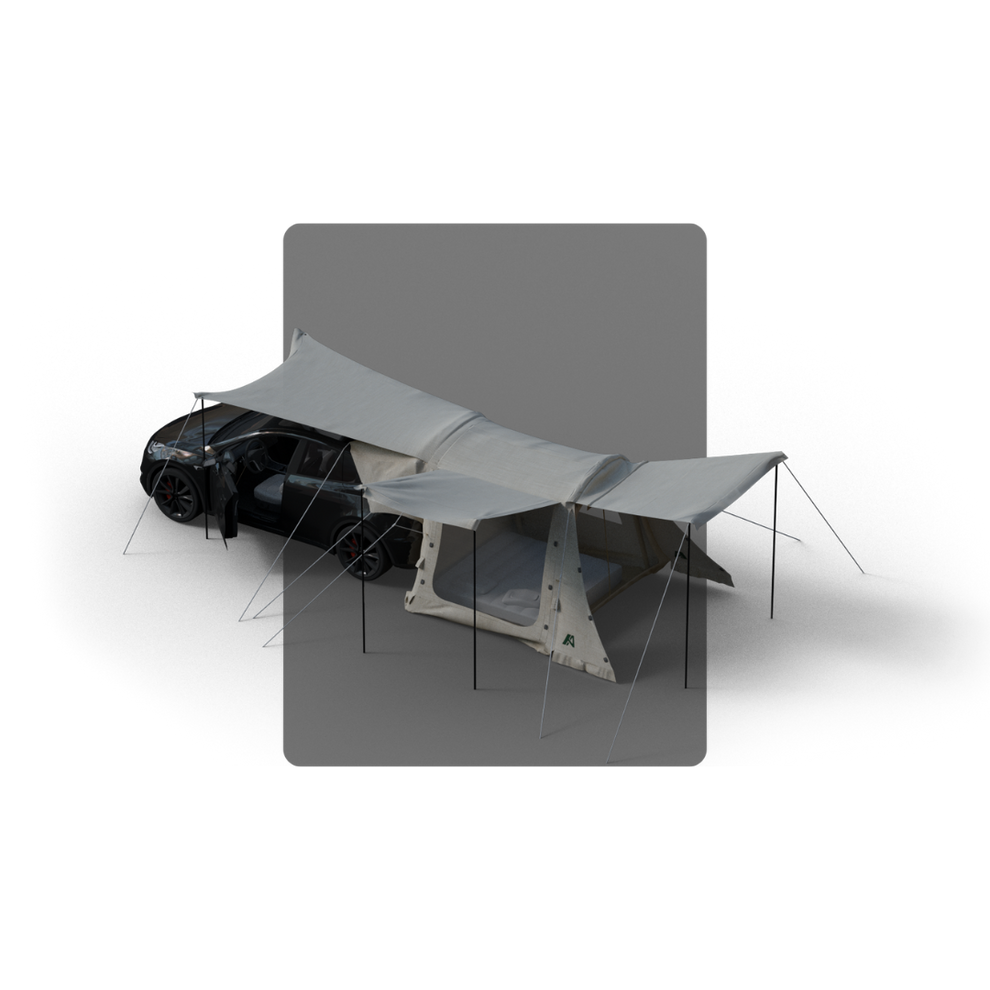
TENTSLA X1 Tesla Camping Tent
$649
The TENTSLA X1 is designed for Tesla Model 3, Model Y, and Model X owners who want a dedicated tent solution for outdoor trips. Its inflatable air-frame design is intended to simplify setup compared with conventional pole-by-pole assembly.
View TENTSLA X1 product details
Explore TENTSLA X1Materials and construction
| Material | Application | Practical consideration |
|---|---|---|
| 210D Oxford Fabric | Inner fabric | Outdoor-oriented fabric construction for the tent interior. |
| 420D Oxford Fabric | Outer fabric and floor fabric | Heavier fabric specification for the exterior and floor areas. |
| Aluminum | Support poles | Used in the tent's structural support components. |
| Steel | Tent pegs | Used to secure the tent at the campsite. |
| Silver-coated fabric | UV protection and heat insulation | Designed to help reduce solar exposure and heat transfer. |
Why the inflatable frame matters
The X1 uses an inflatable air-frame system. Instead of assembling a traditional structure through multiple pole sections, users inflate the frame, secure the tent, and prepare the camping area. This can be attractive to travelers who value a simpler setup process after a long drive.
However, an inflatable frame does not mean the tent is maintenance-free or suitable for every weather condition. Follow the manufacturer's setup and anchoring instructions. Check the campsite surface, secure the tent with the supplied pegs, and inspect the structure before use. Weather resistance should never be interpreted as permission to camp in severe wind, storms, or unsafe conditions.
We recommend the X1 for Tesla owners who want a dedicated vehicle-related tent and expect to use the extra sheltered space regularly. If you only sleep inside the car for occasional overnight stops, buy a correctly fitted mattress first and consider a tent later.
For more buying context, read our guides to Tesla tent pricing and important Tesla tent features.
9. Tesla Camping Setup Comparison
The best setup depends on how you actually travel. The following comparison focuses on practical use rather than simply listing equipment.
| Camping setup | Best for | Main advantage | Main limitation | Our recommendation |
|---|---|---|---|---|
| Sleep inside the Tesla | Solo travelers and compact overnight trips | Fast setup and access to Camp Mode | Limited space and privacy | Best starting point for beginners. |
| Tesla + mattress + platform | Couples and frequent vehicle campers | More consistent sleeping comfort | Uses cargo space and adds equipment cost | Best upgrade for regular overnight use. |
| Tesla + vehicle-compatible tent | Road trips and longer campsite stays | Additional sheltered living space | Requires setup and campsite room | Best when outdoor space matters. |
| Tesla + conventional ground tent | Families and groups | Flexible sleeping arrangements | Separate tent setup and packing | Best when several people need separate sleeping space. |
| Dedicated camper or RV | Extended trips and frequent full-time-style travel | More living space and facilities | Higher purchase and operating costs | Choose when a passenger car no longer meets your needs. |
Quick summary table
| Question | Practical answer |
|---|---|
| What makes Tesla camping possible? | Camp Mode, cabin climate control, battery power, and a usable interior sleeping area. |
| Do you need a tent? | No. A tent is an optional way to add sheltered space. |
| Do you need a mattress? | For comfortable overnight sleeping, a properly fitted mattress is strongly recommended. |
| Does Camp Mode use battery? | Yes. Climate control and other active functions draw energy from the vehicle battery. |
| Can you camp anywhere? | No. Follow campground rules, parking restrictions, and local overnight-occupancy regulations. |
| Is Model Y a good camping choice? | Its interior layout makes it a practical option, but fit and comfort should be checked for the actual occupants. |
| Is a Tesla tent worth it? | It can be worthwhile for frequent campers who need additional sheltered space. |
Pros and cons of Tesla camping
| Pros | Cons |
|---|---|
| Cabin climate can remain active while parked in Camp Mode. | Climate control consumes battery energy. |
| Quieter than sleeping in a vehicle with a running gasoline engine. | Climate-system and vehicle operating sounds are still audible. |
| Convenient USB and low-voltage power for compatible devices. | Limited outlet capacity compared with a dedicated camper electrical system. |
| Can reduce the amount of equipment needed for short trips. | Interior space is limited, especially for multiple adults. |
| Flexible combination of vehicle sleeping and tent camping. | Camp Mode disables certain security features. |
| No need for a separate gasoline generator to maintain the vehicle cabin climate. | Charging access and overnight battery reserve require planning. |
10. Common Tesla Camping Mistakes
1. Assuming Camp Mode uses almost no energy
This is one of the most expensive assumptions to make on a remote trip. Climate demand changes with weather and cabin settings. Plan with a reserve instead of relying on a fixed percentage from someone else's overnight experience.
2. Buying a mattress before measuring the vehicle
Universal mattress labels do not guarantee a proper fit. Measure the actual sleeping area and check the mattress dimensions, shape, thickness, and storage size before purchasing.
3. Treating Camp Mode as a security feature
Camp Mode is designed for comfort and staying inside the parked vehicle. Tesla documentation states that Sentry Mode and the vehicle alarm system are disabled while it is active. Choose a safe location and keep valuables out of sight.
4. Forgetting that vehicle camping is still camping
You still need drinking water, food storage, sanitation, waste disposal, weather-appropriate clothing, and a plan for emergencies. A vehicle does not remove the need for ordinary outdoor preparation.
5. Using campground power without permission
Do not plug a Tesla into an ordinary RV or campsite outlet simply because the connector appears compatible. Ask the campground whether EV charging is permitted and use approved charging equipment and infrastructure. Some campground electrical systems are not designed for continuous EV charging loads.
6. Choosing a tent based only on price
A cheap tent that does not fit the vehicle, takes too long to set up, or performs poorly in the conditions you encounter is not a bargain. Compare fitment, materials, frame design, anchoring, packed size, and manufacturer instructions before making a decision.
11. Buying Considerations: What Equipment Is Actually Worth It?
We recommend building a Tesla camping setup in stages. This avoids spending heavily on equipment before you know how you prefer to camp.
Start with the essentials
- Fitted mattress: Prioritize comfort and correct dimensions.
- Sleeping bag or bedding: Match the temperature rating to the conditions you expect.
- Window covers: Improve privacy and reduce direct light.
- Charging plan: Identify reliable charging points before traveling.
- Storage bags: Keep clothing, food, and equipment organized.
- Basic safety equipment: Carry a first-aid kit, flashlight, water, and suitable emergency supplies.
Upgrade for frequent camping
If you camp several times per month, a dedicated platform can be a sensible upgrade. It improves the consistency of the sleeping surface and can make it easier to organize gear. A vehicle-compatible tent becomes more attractive when you spend significant time at the campsite rather than using the Tesla only as a place to sleep.
For Model Y owners comparing complete equipment packages, our Tesla Model Y camper kit buying guide can help you assess different approaches.
Check these details before buying a tent
- Does the tent support your exact Tesla model and model year?
- How does the tent attach or connect to the vehicle?
- Can it be used independently where appropriate?
- What are the packed dimensions and total weight?
- What materials are used for the inner, outer, and floor fabrics?
- What is the frame construction, and how is it inflated or assembled?
- Are pegs, pumps, repair components, and other necessary accessories included?
- What weather conditions does the manufacturer specify?
- Can one person set it up, and how long does the process take in realistic conditions?
- What warranty and customer support are available?
12. Our Expert Recommendation: Build the Setup Around Your Camping Habits
Our view is straightforward: Tesla camping is worth trying if you already own a compatible Tesla and want a more flexible way to travel. It is not necessary to buy a complete camper package before your first overnight trip. Start with a safe location, a comfortable sleeping surface, and a realistic battery plan.
For beginners
Start with one overnight trip at an established campground or another location where vehicle sleeping is permitted. Use Camp Mode, a fitted mattress, basic bedding, window covers, and a conservative battery reserve. This will show you whether you enjoy sleeping inside the vehicle before you spend money on a larger setup.
For couples
Check the sleeping dimensions carefully. Two adults need enough width and length to sleep without constantly disturbing each other. A fitted mattress and platform are usually more important than adding a large collection of accessories. If the interior feels too restrictive, add a tent to create more usable space.
For frequent road-trippers
Prioritize quick setup, storage efficiency, and repeatable comfort. A platform, mattress, organized storage, and a vehicle-compatible tent can make the routine much easier. The value comes from using the equipment repeatedly, not from buying the largest kit available.
For extended trips and heavy-duty applications
If you need a kitchen, bathroom, substantial storage, independent power systems, or room for several people, a dedicated camper or RV may be the more sensible investment. A Tesla camping setup is best viewed as a flexible passenger-vehicle solution, not a direct replacement for a fully equipped motorhome.
13. Frequently Asked Questions About How Tesla Camping Works
1. How does Tesla camping work?
Tesla camping uses Camp Mode to maintain cabin climate while the vehicle is parked. Supported USB and low-voltage outlets remain available for compatible electronics, and the touchscreen stays active. You prepare the interior for sleeping and monitor battery consumption throughout the stay.
2. Do you need to leave a Tesla running while camping?
No. You do not need to run a gasoline-style engine. Activate Camp Mode while the vehicle is in Park. The vehicle uses energy from its high-voltage battery to operate the climate system and supported functions.
3. Can you sleep in a Tesla overnight?
Yes, many owners use their Tesla for overnight sleeping. Comfort depends on the model, available interior dimensions, mattress fit, temperature, and number of occupants. Always use a location where overnight vehicle sleeping is permitted.
4. Does Tesla Camp Mode keep the air conditioning on?
Camp Mode is designed to maintain the selected cabin climate while the vehicle is parked. This can include cooling or heating as needed. The actual behavior depends on vehicle settings, environmental conditions, and the vehicle's operating limits.
5. How much battery does Tesla Camp Mode use overnight?
There is no reliable universal percentage for every Tesla. Energy use depends on outdoor temperature, cabin temperature, vehicle model, software, and how long the climate system operates. Check the battery level before and during your trip, and plan a reserve for the next drive.
6. Can you charge a phone while sleeping in a Tesla?
Yes, compatible devices can generally be powered or charged through the vehicle's available USB ports and low-voltage outlet while Camp Mode is active. Check your vehicle's outlet specifications and avoid connecting equipment that exceeds its rated capacity.
7. Is Tesla Model Y good for camping?
Model Y is a practical choice for vehicle camping because its interior layout can provide a useful sleeping area when configured correctly. A fitted mattress or platform can improve comfort. Measure the available space and check whether the setup works for the number of people traveling.
8. Can two adults sleep in a Tesla Model Y?
Two adults can sleep in a Model Y if the available space and their body dimensions are suitable. Comfort varies with mattress size, sleeping position, and personal preference. Measure the sleeping area and test the setup before relying on it for a long trip.
9. Does Camp Mode keep Sentry Mode active?
No. Tesla owner documentation states that Sentry Mode and the vehicle alarm system are disabled while Camp Mode is active. This is an important security limitation. Choose a suitable overnight location and do not assume Camp Mode provides the same security behavior as normal parked operation.
10. Can you use a Tesla camping tent without sleeping inside the car?
That depends on the tent's design and manufacturer instructions. Some vehicle-related tents are designed to connect to a car, while other configurations may allow independent use. Check the specific product's setup instructions and compatibility before purchasing.
11. Is a Tesla camping tent worth the money?
It can be worth buying if you camp regularly and need more sheltered space for changing, storage, or relaxing. If you only need a place to sleep for occasional overnight stops, a fitted mattress and window covers may be a better first purchase.
12. Can you camp in a Tesla at any parking lot?
No. Parking permission and overnight camping rules vary by property, city, campground, and public land manager. Confirm local rules before staying overnight. A place where parking is allowed is not necessarily a place where sleeping or camping is permitted.
References
- Tesla Model Y Owner's Manual – Operating Climate Controls and Camp Mode. Official vehicle documentation covering climate settings, Camp Mode functions, and operating limitations.
- Tesla Support – Summer Driving Tips. Tesla's guidance on Camp Mode, cabin comfort, and vehicle climate features.
- National Park Service – Finding and Setting Up a Campsite. Official guidance on campsite selection, facilities, site rules, and safe camping preparation.