


The transition from a cramped, traditional ground tent to a fully integrated vehicular camping setup fundamentally changes how you experience the outdoors. For decades, families and small groups were forced to endure sleeping on uneven roots, battling ground moisture, and dragging heavy coolers into nylon domes. By leveraging your vehicle's cargo space through a 4 person SUV tent, you effectively double your livable footprint. You gain elevated sleeping quarters, climate control access (especially if you are utilizing EV modes like Tesla Camp Mode), and a secure connection to your vehicle's power grid.

However, the market is saturated with cheap, universal-fit tailgate tents that leak at the seams and collapse under moderate wind. From our experience engineering premium overlanding equipment at TENTSLA, a substandard sleeve connection between the tent and your hatchback will funnel rainwater directly into your trunk. In most professional situations, you must prioritize structural weather resistance and seamless vehicular integration over a low price point. In this uncompromising guide, we will cut through the marketing noise, evaluate the exact mechanics of SUV tents, and detail the 6 best 4 person SUV tent camping options currently available, helping you make a structurally sound buying decision.
Quick Answer: The Top SUV Tents for 4 People
If you are actively searching for a reliable 4 person SUV tent camping solution, your decision must be driven by setup speed and weather resistance. Here is our definitive ranking:
- TENTSLA X1 Premium Inflatable Tent: The undisputed king for Tesla and mid-size SUV owners. Uses a fast-pitch air column frame, heavy-duty 420D Oxford floor fabric, and creates a seamless, weather-tight seal.
- Napier Backroadz SUV Tent: A highly popular, budget-friendly fiberglass pole tent. Excellent for beginners, but the universal vehicle sleeve requires meticulous strapping to prevent drafts.
- Rightline Gear SUV Tent: A unique floorless design. This allows you to set it up over a picnic table attached to your vehicle, but you must sleep inside the vehicle cargo area.
- Gazelle T4 Hub Tent with Overland Connector: A massive, heavy-duty pop-up hub tent. Incredibly fast to set up, but the packed size is extremely long and heavy.
- Kodiak Canvas Truck/SUV Tent: Made of marine-grade canvas. Built for extreme cold and heavy-duty applications, but requires significant setup time and is very heavy.
- Smittybilt Overlander Annex: Best for true overlanding rigs with roof racks, providing a massive 4-person ground room connected to an upper platform.
We recommend absolutely prioritizing inflatable air-frame technology (like the TENTSLA X1) if you hate threading fiberglass poles in the dark. If you sleep in the vehicle, ensure your Tesla Camping Air Mattress fits perfectly between the wheel wells.
Table of Contents
- What is a 4 Person SUV Tent?
- How the Vehicle Connection Works
- The 6 Best Options Detailed
- Commercial and Practical Benefits
- Limitations and Hard Truths
- Who Should Use It
- Who Does Not Need One
- Common Vehicular Camping Mistakes
- Expert Buying Considerations
- Summary and Comparison Tables
- Expert Recommendation: TENTSLA
- Frequently Asked Questions (FAQ)
What is a 4 Person SUV Tent?
A 4 person SUV tent (often referred to as a hatchback tent or a tailgate tent) is a hybrid shelter designed to physically connect to the rear cargo area of an SUV, minivan, or crossover. Unlike a traditional ground tent, these structures feature an elongated, elasticized "sleeve" or tunnel. This sleeve wraps securely around the vehicle's open rear hatch, bridging the gap between the vehicle's interior and the tent's main cabin.
The "4 person" designation in camping terminology dictates the floor space. Generally, a 4-person tent offers roughly 60 to 70 square feet of floor space (e.g., an 8x8 foot layout). In a vehicular camping scenario, this capacity is often split: two adults sleep comfortably elevated inside the climate-controlled rear of the vehicle (utilizing a Tesla Model Y Camping Platform), while two children or additional adults sleep in the attached ground tent.
How the Vehicle Connection Works
The success or failure of your camping trip hinges entirely on the integrity of the vehicle connection sleeve. To attach the tent, you park your vehicle, open the rear liftgate, and stretch the elastic sleeve over the top of the hatch and around the bumper. You then anchor the sleeve to the vehicle's wheel wells, roof rack, or undercarriage using adjustable nylon webbing straps and plastic J-hooks.
In our testing, cheap universal sleeves gap around the rear tires, allowing mosquitoes, exhaust fumes from neighboring sites, and heavy rain to enter the sleeping area. Premium tents utilize custom-tailored sleeves with heavy-duty magnets or suction cups to create a hermetic seal against the vehicle's body panels.
The 6 Best 4 Person SUV Tents Detailed
We have audited the market based on durability, setup speed, and integration quality. If you are specifically building a rig out of a Model 3 or Cybertruck, you must also cross-reference our guides on the Tesla Model 3 Camping Tent and Cybertruck Camping Tent ecosystems.
1. TENTSLA X1 Premium Inflatable Tent
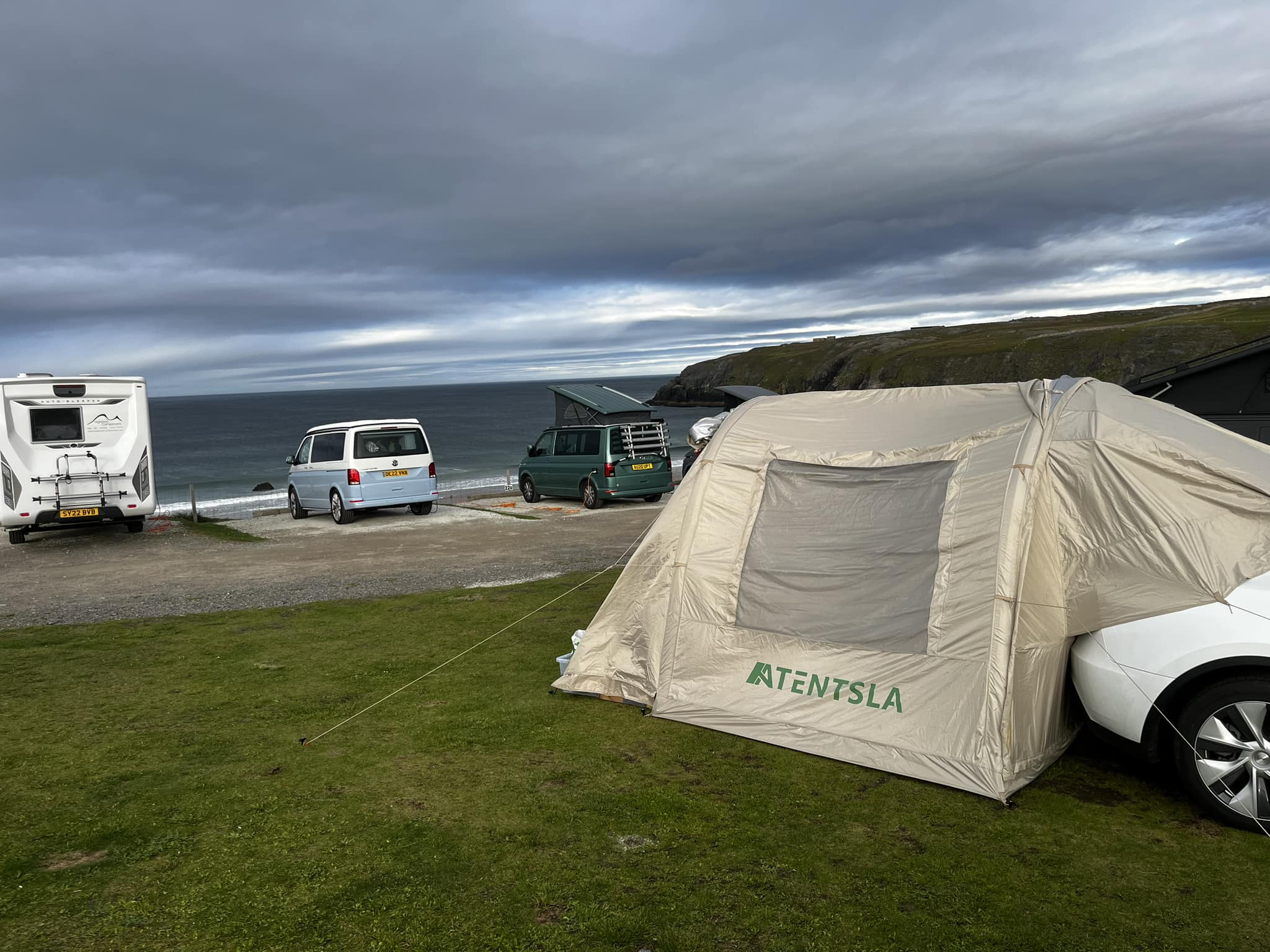
The apex of vehicular integration. By replacing fragile fiberglass poles with an inflatable air-frame, setup time is reduced to under 5 minutes. The 420D Oxford floor fabric is highly abrasion-resistant, and the silver-coated outer fabric provides immense heat insulation. It creates a flawless seal against mid-size SUVs and Tesla models.
2. Napier Backroadz SUV Tent
The industry standard for budget-conscious families. It is a traditional pole-and-sleeve design that connects to almost any hatchback. While it offers excellent headroom and a built-in tub floor, the fiberglass poles can splinter under high winds, and the universal fit requires significant adjusting to seal correctly.
3. Rightline Gear SUV Tent
This is a floorless design intended for users who sleep entirely inside the vehicle but want an enclosed living room for changing, dining, or escaping mosquitoes. Because it lacks a floor, you do not have to unload your gear from the back of the SUV before setting it up. However, it is not ideal for ground sleeping.
4. Gazelle T4 Hub Tent with Overland Connector
Gazelle tents use a pre-assembled hub system that pops open like an umbrella in 90 seconds. The T4 is massive and incredibly durable. The downside is the packed size; a hub tent is over 5 feet long when collapsed, meaning it will likely consume the entire back seat of your vehicle during transit.
5. Kodiak Canvas Truck/SUV Tent
For heavy-duty applications in extreme cold or dense forests, marine-grade cotton duck canvas is unmatched. It breathes better than nylon (reducing interior condensation) and withstands heavy snowfall. The trade-off is extreme weight and a much longer, physical setup process.
6. Smittybilt Overlander Annex
If you already own a rooftop tent (RTT), adding a ground-level annex creates a highly secure 4-person setup. The annex hangs from the RTT, providing a massive ground room. It requires a dedicated roof rack system, making it the most permanent and expensive modification on this list.
Commercial and Practical Benefits
The primary benefit of a 4 person SUV tent is the maximization of the vehicle's physical footprint. By attaching the tent to the trunk, you gain access to your vehicle's 12V or 110V power outlets without running extension cords through wet grass. You can securely store expensive gear (cameras, coolers, generators) inside the locked vehicle cabin while still having immediate access to it from inside the tent.
For EV owners, the benefits are exponential. By sealing the tent to the rear hatch and activating Camp Mode, the vehicle's HVAC system can push climate-controlled air (AC or heat) directly into the attached ground tent, completely redefining four-season camping comfort.
Limitations and Hard Truths
We must present practical judgment: vehicular camping traps your vehicle. The absolute largest limitation of an SUV tent is that once you are set up, your vehicle is immobilized. If you realize you forgot firewood or want to drive to a trailhead, you must physically detach the vehicle sleeve, zip up the tent's vehicle door, and drive away. Reattaching the sleeve perfectly when you return in the dark is frustrating.
Secondly, weather resistance at the sleeve is notoriously difficult. Heavy, driving rain can pool on the roof of the SUV and channel directly down the elastic sleeve if it is not pitched with a severe downward slope.
Who Should Use It
For beginners and families: SUV tents are the ultimate transition gear. If you have young children who are terrified of sleeping in a dark ground tent, letting them sleep in the connected SUV cargo area provides a sense of locked, hard-sided security while the parents sleep in the attached annex.
Who Does Not Need One
For heavy-duty applications and basecampers: If you set up a hunting basecamp for a week and need your truck to drive to different locations daily, an attached SUV tent is a massive logistical failure. You should buy a high-quality standalone canvas tent and leave your vehicle completely detached and mobile.
Common Vehicular Camping Mistakes
If you leave your hatchback open for 48 hours without tricking the latch sensor (by pushing a carabiner into the latch mechanism), your vehicle's computer will keep the internal systems awake, completely draining your 12V starter battery. You will wake up in a beautiful forest with a dead vehicle. Always research your specific vehicle's hatch sleep protocols. If you are an EV owner, understanding the Outdoor Tesla Lifestyle and battery drain rates during Camp Mode is mandatory.
Expert Buying Considerations
When you sit down to deploy your capital on a 4 person SUV tent, demand thick floor materials. The floor must be at least a 210D Oxford fabric with a polyurethane (PU) coating; cheap polyethylene (tarp material) floors crack and leak after a single season.
Evaluate the frame architecture. Fiberglass poles splinter. Aluminum poles are better, but they bend under heavy snow loads. For the absolute fastest, most wind-resistant setup, inflatable air columns (TPU bladders) are rapidly becoming the industry standard. Finally, ensure the tent features a fully sealable "vehicle door" mesh so the tent can stand alone independently when you need to drive the vehicle away.
Summary and Comparison Tables
Quick Summary Table: Frame Technologies
| Frame Material | Setup Speed | Wind Resistance | Durability |
|---|---|---|---|
| Inflatable Air-Frame | Very Fast (Pump required) | High (Bends and rebounds) | Excellent |
| Fiberglass Poles | Slow (Manual threading) | Low (Prone to snapping) | Poor |
| Pop-Up Hub (Fiberglass) | Extremely Fast | Moderate | Good (Bulky to pack) |
| Steel / Aluminum Tubing | Very Slow | Very High | Extreme (Heavy duty) |
Comparison Table: Floor Plans for 4 People
| Configuration Strategy | Ground Sleeping Space | Vehicle Sleeping Space | Best Use Case |
|---|---|---|---|
| Full Ground Tent | 4 People (8x8 ft) | Gear Storage Only | Standard SUV camping; heavy gear loads. |
| Split Floorplan | 2 People (Cots or pads) | 2 People (Air mattress) | Families with young children. |
| Floorless Annex | 0 People (Dining/Living) | 2-4 People (Depending on SUV) | Muddy/snowy environments; tailgating. |
Pros and Cons of Hatchback SUV Tents
| Pros (Advantages) | Cons (Limitations) |
|---|---|
| Massively expands usable, weather-protected living space. | Immobilizes the vehicle once the camp is fully pitched. |
| Allows access to vehicle 12V power and climate control. | Universal sleeves can leak if not strapped meticulously. |
| Elevates sleeping quarters off the cold, wet ground. | Exhaust pipe must be strictly monitored to prevent CO poisoning. |
| Cheaper and more aerodynamic than a permanent Rooftop Tent (RTT). | Requires disabling interior vehicle lights to prevent battery drain. |
Expert Recommendation: The TENTSLA X1 Advantage
In most professional situations, the frustration of threading cheap fiberglass poles in a rainstorm while trying to stretch a generic nylon sleeve over a hot exhaust pipe ruins the camping experience. You must invest in dedicated, high-quality infrastructure.
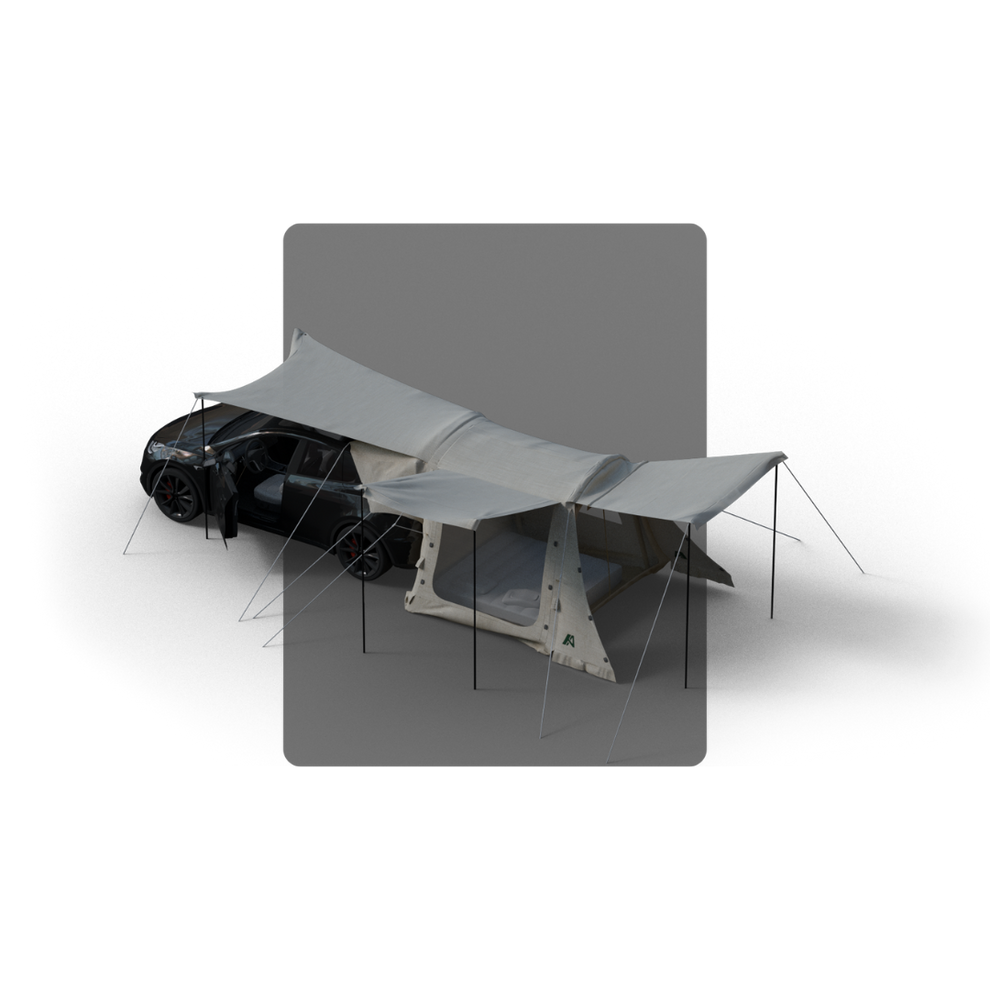
TENTSLA X1 Premium SUV Camping Tent
Engineered specifically to eliminate the structural weaknesses of legacy tailgate tents. The TENTSLA X1 utilizes an advanced inflatable air-frame system, allowing a single person to pitch a massive 4-person shelter in minutes.
- Premium Materials: Inner 210D Oxford fabric and ultra-durable 420D outer/floor fabric block moisture completely.
- Thermal Defense: Silver-coated exterior fabric provides extreme UV protection and heat insulation, vital for summer overlanding.
- Seamless Integration: Designed explicitly for precision sealing against modern SUV and Tesla hatchbacks.
By pairing the structural rigidity of the X1 with a bespoke air mattress, you transform your daily driver into a legitimate, four-season recreational vehicle.
Frequently Asked Questions (FAQ)
Can I run my SUV engine to heat the tent?
Absolutely not, unless you drive a fully electric vehicle (EV). Running an internal combustion engine (ICE) with an attached SUV tent will channel lethal carbon monoxide (CO) gas directly into your sleeping area, resulting in death. If you need heat in an ICE vehicle, you must use a specialized, externally vented diesel heater or a propane catalytic heater equipped with a low-oxygen shutoff sensor.
Will an SUV tent scratch the paint on my car?
If your vehicle is covered in dirt and dust when you apply the tent sleeve, the nylon straps and elastic bands will rub the grit into your clear coat when the wind blows, causing micro-scratches. You must always wipe down the rear quarter panels, liftgate, and bumper with a microfiber towel and quick detailer before attaching the tent sleeve.
Can I detach the tent and drive away?
Yes, provided you purchase a freestanding SUV tent. High-quality models (like the TENTSLA X1) feature a dedicated zippered mesh door on the vehicle side. You simply unhook the sleeve straps from your tires, zip the tent door shut, and drive away. The tent will remain standing securely at your campsite until you return.
Authoritative Industry References
To ensure our vehicular camping guidelines align with safety and environmental standards, we reference the following authorities:
- National Park Service (NPS): Federal regulations regarding vehicle idling, designated camping footprints, and wildlife safety protocols for soft-sided tents. Visit the NPS
- Leave No Trace Center for Outdoor Ethics: The premier authority on minimizing the impact of vehicular overlanding and heavy-duty basecamp setups on fragile ecosystems. Visit Leave No Trace
- ASTM International: Defining the globally recognized performance and safety standards for camping tents, including flammability resistance (CPAI-84) and fabric tensile strength. Visit ASTM International