


Car camping has evolved. Gone are the days when sleeping in your vehicle meant contorting your spine over folded seats and waking up with debilitating back pain. Modern overlanders, SUV owners, and EV enthusiasts demand a sleep setup that rivals their home mattress. However, the market is saturated with cheap, polyvinyl chloride (PVC) pool floats masquerading as heavy-duty sleeping gear. A catastrophic seam blowout at 2 AM in freezing temperatures is not an inconvenience; it is a critical gear failure that ruins the entire expedition.

From our experience engineering and testing overland sleeping solutions at TENTSLA, selecting the best car air mattress requires ruthless scrutiny of dimensions, R-value (insulation), and valve architecture. If you are sleeping in a climate-controlled EV—like utilizing Tesla Model Y Camp Mode—your needs differ vastly from someone camping in an uninsulated 4Runner in the Rockies. In this uncompromising guide, we will cut through the marketing noise, evaluate the 6 best car air mattresses available in 2026, and provide you with the exact technical criteria to make a sound buying decision.
Quick Answer: The Best Car Air Mattress Tier List
If you are actively gearing up for an overland trip and need a definitive recommendation, here are the top 6 options ranked by their specific use case:
- TENTSLA Self-Inflate Mattress (Double): The undisputed king for custom-fit EV and mid-size SUV camping. Built-in electric pump, heavy-duty flocked PVC, and specifically tailored to bypass wheel well intrusions.
- Exped MegaMat Auto: The premium choice for extreme cold-weather camping (high R-value foam core) but comes with a punishing price tag and bulky packed size.
- Luno Life Signature Air Mattress: Excellent for specific 4Runner/Subaru configurations, utilizing independent air chambers and base extenders, though it lacks self-inflation.
- TENTSLA Mattress for Tesla Trunk: The absolute best tailored solution for Model Y/3 owners, maximizing headroom and utilizing the sub-trunk geometry perfectly.
- Heytrip SUV Air Mattress: A solid mid-tier budget option with segmented inflation zones, ideal for weekend warriors who do not need extreme durability.
- Nemo Roamer Double: Exceptional comfort and self-inflating open-cell foam, but often too wide for standard compact SUV wheel wells without aggressive deflating.
In most professional situations, we strongly recommend a self-inflating foam-core hybrid (like the Exped or TENTSLA) over a pure air-only mattress to prevent the "bouncy castle" effect and eliminate cold spots.
Table of Contents
- What is a Car Air Mattress?
- How Hybrid Air/Foam Technology Works
- The Top 6 Mattresses Detailed
- Commercial and Practical Benefits
- Limitations and Hard Truths
- Who Should Use Them
- Who Does Not Need Them
- Common Overlanding Mistakes
- Expert Buying Considerations
- Summary and Comparison Tables
- Expert Recommendation: TENTSLA Solutions
- Frequently Asked Questions (FAQ)
What is a Car Air Mattress?
A car air mattress is a specialized piece of sleep gear engineered specifically to fit the dimensions of a vehicle's cargo area when the rear seats are folded flat. Unlike a standard rectangular camping pad, a true car mattress features a custom geometry. It will typically have cutouts or tapered edges to accommodate intrusive wheel wells, and some utilize "gap fillers" or solid foam extenders to bridge the cavernous gap between the folded rear seats and the front driver/passenger seats.
For EV owners, precision is paramount. Understanding exactly what size mattress fits in Model 3 is critical, as a mattress that is two inches too wide will bow upward in the center, ruining spinal alignment.
How Hybrid Air/Foam Technology Works
The days of manually pumping a pure plastic balloon are over. The elite tier of car mattresses now utilizes self-inflating hybrid technology. Inside the durable PVC or TPU outer shell is a thick layer of open-cell foam (similar to a kitchen sponge).
When you open the one-way valve, atmospheric pressure rushes in to fill the vacuum within the compressed foam, automatically inflating the mattress to about 70% capacity in minutes. You then use a built-in pump or a manual top-off sack to achieve the desired firmness. This hybrid approach is non-negotiable for serious campers because the foam core halts convective air currents inside the mattress, preventing the cold ground from freezing your back (a high R-value). If you are extending your setup with a Tesla Model 3 Camping Tent, managing thermal loss from the ground up is your first line of defense.
The Top 6 Car Air Mattresses Detailed
1. TENTSLA Self-Inflate Mattress for Tent (Double)
The absolute workhorse. This mattress is engineered with heavy-duty flocked fabric coated over thick PVC ABS, rendering it highly resistant to dog claws and gear abrasion. It features a built-in electric pump, eliminating the need to search for 12V adapters in the dark. At 77.5 x 59 inches, it is the premier choice for mid-to-large SUVs and pairs flawlessly with the Premium Tesla Camping Tent ecosystem.
2. Exped MegaMat Auto
The gold standard for extreme thermal insulation. Custom-shaped to fit the exact contours of Subaru Outbacks and Tesla Model Ys, it boasts an incredible 8.1 R-value. It is essentially a portable memory foam bed. However, for commercial users and budget-conscious weekend warriors, its massive price tag (often exceeding $400) and large packed volume are significant deterrents.
3. Luno Life Signature Air Mattress
Luno is famous for its modularity. The mattress consists of two separate air chambers, allowing one person to sleep firmly while the other sleeps soft, or allowing a solo traveler to only inflate half the bed to save space. They include robust base extenders to fill footwell gaps. The drawback? It is a pure air mattress (low R-value) and requires a noisy external 12V pump to inflate.
4. TENTSLA Mattress for Tesla Trunk
Precision matters. This is the Tesla Camping Mattress engineered specifically for the unique geometry of EV cargo spaces. It maximizes every inch of width without riding up on the wheel wells. For Model Y owners utilizing Camp Mode, this is the most seamless, integrated sleep system available on the market.
5. Heytrip SUV Air Mattress
A highly functional mid-tier option. It features six independent inflation zones, meaning if you puncture one section, you don't end up sleeping entirely on the hard plastic trim of your trunk. It is highly versatile but lacks the extreme durability and thermal insulation of the top-tier foam hybrids.
6. Nemo Roamer Double
Nemo makes exceptional backpacking gear, and their vehicle pad is incredibly plush. It features custom-cored foam to keep the weight down while maintaining a 6.0 R-value. The limitation here is the rectangular shape; it lacks the specific wheel-well cutouts necessary to lay perfectly flat in smaller crossovers like the RAV4 or Model 3 without aggressive deflating.
Comparison of various car camping mattress profiles, demonstrating the necessity of specific vehicle cutouts.
Commercial and Practical Benefits
The primary benefit of utilizing a dedicated car air mattress is the absolute maximization of usable space. Throwing a standard twin airbed into the back of an SUV results in the edges folding up against the trim, shrinking your sleeping footprint and creating an uncomfortable "taco" effect.
Furthermore, purpose-built mattresses protect your vehicle's interior. High-quality flocked surfaces prevent the mattress from squeaking loudly against leather seats every time you shift your weight, and the heavy-duty base materials prevent seatbelt buckles and cargo tie-downs from puncturing the air chambers.
Limitations and Hard Truths
We must present practical judgment: pure air mattresses (like the Luno or cheap Amazon knockoffs) are inherently flawed for cold-weather camping. The air inside the mattress mimics the outside ambient temperature. Without a foam core to stop convective currents, a pure air mattress will literally pull the body heat out of your spine, leaving you freezing even in a zero-degree sleeping bag. If you are camping below 50°F (10°C), a hybrid foam mattress is strictly required.
Secondly, storage volume is a major limitation. Self-inflating foam mattresses are massive when rolled up. They do not compress into a Nalgene-sized stuff sack. They will command a significant portion of your trunk space or require a rooftop box for transit.
Who Should Use Them & Who Does Not Need Them
For commercial users and heavy-duty applications: Overlanders, digital nomads living out of their vehicles, and EV owners utilizing the Tesla Camping Air Mattress ecosystem must invest in premium, high R-value hybrid pads. When your vehicle is your primary habitat, sleep quality directly dictates your operational endurance and safety on the road.
Who Does Not Need Them: For beginners who are only sleeping in the back of their Honda CR-V for one night at a summer music festival, dropping $300 on an Exped MegaMat is a profound waste of capital. A cheap, generic air mattress layered with a thick wool blanket underneath will suffice for mild, casual use.
Common Overlanding Mistakes
Atmospheric pressure drops as you climb. The trapped air inside a rock-hard mattress expands rapidly at high altitudes, blowing out the internal baffles or ripping the sonic welds, destroying the mattress instantly. Always leave the valve open during elevation changes, and only inflate to about 85% firmness. The mattress should cradle your hips, not reject them.
Expert Buying Considerations
When executing your purchase, you must audit the valve architecture. A premium mattress must have a low-profile, dual-action, one-way valve. This allows you to dump air out rapidly without it sucking back in while you are trying to wrestle the pad into its storage bag. Avoid any mattress that uses cheap, protruding pool-float valves; they will catch on your sleeping bag and pop open in the middle of the night.
If you are extending your living space by integrating your vehicle with Popular Tesla Camping Tents, ensure your mattress dimensions allow for easy ingress and egress without stepping directly on the valve.
Summary and Comparison Tables
Quick Summary Table: Core Mattress Technologies
| Technology Type | Insulation (R-Value) | Packed Size | Best Use Case |
|---|---|---|---|
| Pure Air (PVC) | Very Low (< 2.0) | Extremely Small | Summer camping, ultra-compact storage needs. |
| Self-Inflating Foam Hybrid | High (5.0 - 8.0+) | Very Large / Bulky | Four-season camping, maximum comfort and support. |
| Independent Chambers | Moderate | Medium | Solo travelers needing modular space saving. |
Comparison Table: TENTSLA Self-Inflate vs. Standard Pure Air Mattress
| Feature | TENTSLA Self-Inflate (Double) | Standard Pure Air Mattress |
|---|---|---|
| Inflation Method | Built-in Electric Pump (Effortless) | External 12V Pump (Noisy, corded) |
| Material Shell | Flocked PVC ABS (Puncture resistant) | Thin Vinyl (Prone to tearing) |
| Shape & Fit | Custom contoured for wheel wells | Generic rectangle (Edges fold up) |
| Thermal Insulation | High (Foam core blocks cold transfer) | None (Pulls heat away from body) |
Pros and Cons of Dedicated Car Mattresses
| Pros (Advantages) | Cons (Limitations) |
|---|---|
| Maximizes every inch of the cargo area for a flat sleep surface. | Exponentially more expensive than standard camping pads. |
| Thick profiles hide uneven trunk hinges and folded seat gaps. | Premium foam models require significant trunk space when packed. |
| Durable bottom fabrics resist tearing from cargo hooks. | Difficult to completely deflate without utilizing a vacuum pump. |
| Provides superior insulation compared to sleeping on hard plastic. | Highly vehicle-specific; may not fit if you buy a different car. |
Expert Recommendation: TENTSLA Sleep Systems
In most professional situations, the operational friction of dealing with external pumps, dead 12V sockets, and freezing air chambers ruins the overland experience. To guarantee comfort and reliability, you must secure a heavily engineered hybrid system.
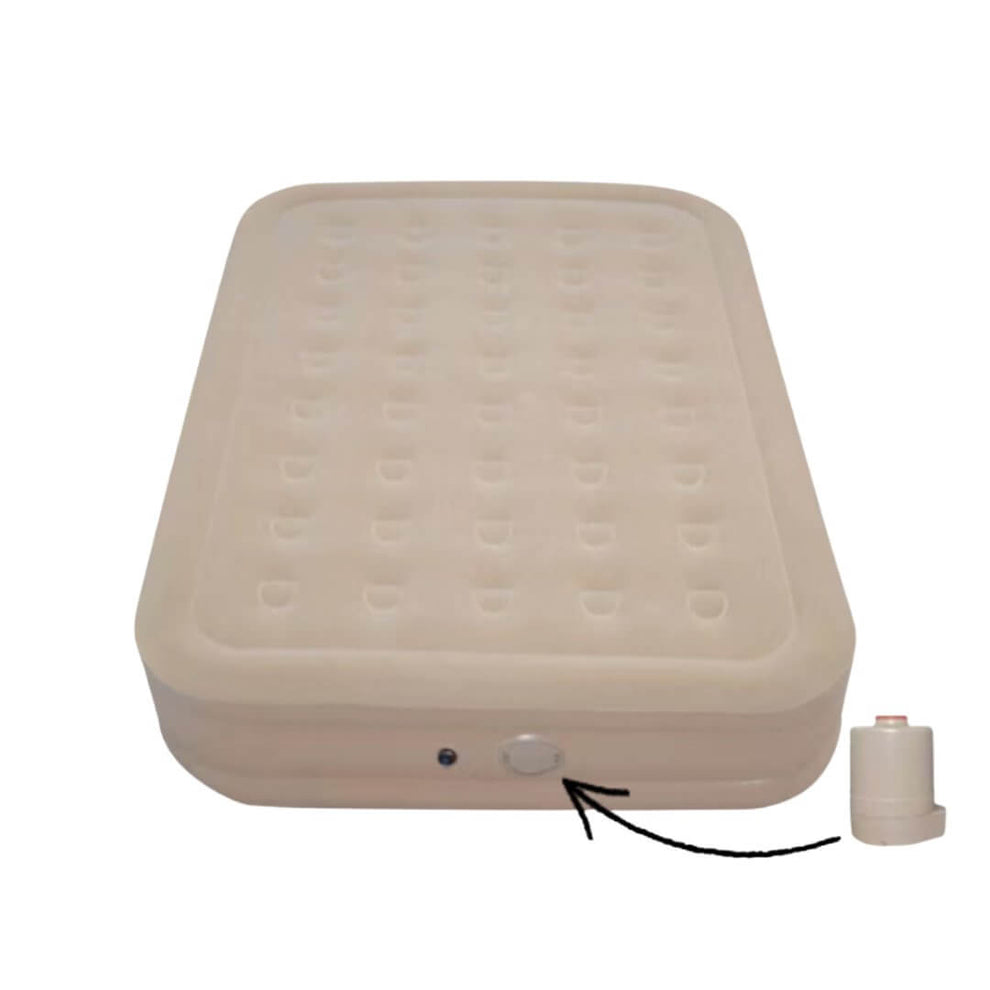
TENTSLA Self-Inflate Mattress for Tent (Double)
The definitive solution for vehicle-based camping. The TENTSLA Double eliminates the "bouncy castle" instability of cheap air beds by integrating high-density materials with rapid, self-contained inflation.
- Autonomous Setup: Features a built-in electric pump, eliminating external cords and lost nozzles.
- Extreme Durability: Constructed from Flocking Fabric Coated PVC ABS for superior puncture resistance and a quiet, non-squeaking sleep surface.
- Precision Dimensions: Engineered at 77.5 x 59 x 15.7 inches to dominate the cargo space of mid-size SUVs and EV platforms.
- Complete Kit: Includes the mattress, charging cable, dust bag, and a rapid repair kit.
A premium car mattress serves as the foundation for an integrated vehicle-to-tent overlanding ecosystem.
If you are operating specifically within the Tesla ecosystem, the Tesla Trunk Mattress offers unparalleled contour mapping, perfectly aligning with the sub-trunk geometry to maximize vertical headroom.
Notice the specific contouring and anti-slip base designed explicitly for the Model Y and Model 3 trunk geometry.
Frequently Asked Questions (FAQ)
Can I just use a regular twin air mattress in my car?
Technically yes, but practically no. A standard twin air mattress is a generic rectangle. The cargo area of an SUV is shaped by the wheel wells. A generic mattress will either be too narrow (wasting space) or too wide (forcing the edges to fold up against the walls, creating a highly uncomfortable U-shape). It also lacks the durability required to slide against plastic automotive trim without puncturing.
What is R-Value and why does it matter for car camping?
R-Value measures a material's resistance to heat flow. A pure air mattress has an R-value of roughly 1.0; it offers zero insulation and will pull the heat out of your body into the cold car floor. A hybrid foam mattress with an R-value of 5.0 or higher acts as a thermal barrier, essential for staying warm in temperatures below 50°F (10°C).
How do I fix a puncture in my car air mattress while on the trail?
Never rely on duct tape. You must carry a dedicated TPU/PVC repair kit with chemical adhesive (like Gear Aid Seam Grip). Locate the leak using soapy water, deflate the mattress entirely, clean the area with alcohol, apply the adhesive over the puncture, and let it cure for at least 2 hours before re-inflating.
Authoritative Industry References
To ensure our overlanding and thermal insulation guidelines align with global outdoor engineering standards, we reference the following authorities:
- ASTM International: Defining the ASTM F3340-18 standard test method for measuring the thermal resistance (R-value) of camping sleeping pads. Visit ASTM
- Leave No Trace Center for Outdoor Ethics: Providing the definitive framework for sustainable vehicle-based camping and minimizing the impact of overland vehicle footprint. Visit Leave No Trace
- Overland Journal: The premier publication for environmentally responsible, vehicle-based expedition travel, providing rigorous long-term testing protocols for 12V electronics and sleep systems. Visit Overland Journal