


The era of sleeping on jagged rocks in flimsy nylon ground shelters is over. Modern outdoor enthusiasts demand structural integrity, severe-weather protection, and seamless integration with their vehicles. Automotive tents have fundamentally changed how we approach overlanding, offering climate-controlled extensions to SUVs, trucks, and specifically, modern Electric Vehicles (EVs). However, the market is currently saturated with low-grade products that collapse under light winds or fail to form a proper seal around the vehicle hatch.

From our experience engineering and rigorously testing vehicle-integrated shelters at TENTSLA, selecting the correct shelter dictates the entire success of your off-grid experience. You cannot apply generic camping principles to a 4,000-pound vehicle. You must prioritize aerodynamic footprint, deployment speed, and material denier. In this comprehensive guide, we will evaluate the 5 best automotive tents for camping on the market today, explaining exactly what sets them apart, and providing actionable commercial judgment so you can determine whether it is actually worth using, buying, or upgrading for your specific vehicle setup.
Quick Answer: The Best Automotive Tents
If you need to make an immediate purchasing decision, these are the top five automotive tents currently dominating the market based on durability, setup efficiency, and vehicle integration:
- TENTSLA X1: The absolute best tailgate tent for EV owners. Features a rapid inflatable air-frame, seamless seal for Tesla vehicles, and heavy-duty 420D Oxford fabric.
- Roofnest Falcon 3 EVO Air: The premier hardshell rooftop tent (RTT). Ultra-low profile (8 inches closed) with extreme impact resistance.
- Napier Backroadz SUV Tent: The best budget-friendly traditional pole tent. Offers a massive 10x10 footprint but requires manual assembly.
- Rightline Gear 6-Person SUV Tent: The best universal-fit sleeve tent for oversized trucks and SUVs.
- Dometic HUB 2: The best modular, free-standing awning system for commercial users and tailgaters.
We recommend the TENTSLA X1 for modern campers looking to leverage their vehicle's HVAC system overnight, completely bypassing the frustrating fiberglass pole setups of legacy tents.
Table of Contents
- What Are Automotive Tents?
- How Vehicle Integration Works
- The Commercial and Practical Benefits
- Limitations and Hard Truths
- Who Should Use It & Who Does Not Need It
- Common Mistakes in Vehicle Camping
- Expert Buying Considerations
- The 5 Best Automotive Tents Detailed
- Summary and Comparison Tables
- Expert Recommendation: TENTSLA X1
- Frequently Asked Questions (FAQ)
What Are Automotive Tents?
Automotive tents are specialized outdoor shelters engineered to physically attach to, or mount upon, a motor vehicle. They generally fall into two primary categories: Tailgate/Hatchback Tents and Rooftop Tents (RTTs). Unlike traditional ground tents that function independently, automotive tents utilize the structural mass of the vehicle as an anchor point. They extend the living, sleeping, or storage space of the vehicle directly into the wilderness.
How Vehicle Integration Works
The mechanics of an automotive tent depend heavily on its mounting style. Rooftop tents bolt directly to aftermarket roof racks or crossbars. They utilize hydraulic struts or folding hinges to deploy a sleeping platform elevated off the mud and away from apex predators.
Conversely, tailgate tents deploy on the ground and utilize an elasticized fabric sleeve that stretches over the open rear hatch of an SUV or EV. This sleeve creates a watertight and bug-proof corridor between the vehicle's cabin and the tent interior. In our testing, the effectiveness of a tailgate tent is entirely dependent on the tension and adjustability of the vehicle sleeve. A poor seal allows exhaust fumes, mosquitoes, and rain to penetrate the sleeping area.
The Commercial and Practical Benefits
The benefits of upgrading to automotive tents are vast, particularly for EV owners. When you combine a high-quality tailgate tent with a vehicle like the Tesla Model Y, you unlock climate-controlled camping. By keeping the vehicle in "Camp Mode," the car's HVAC system continuously pumps perfectly temperature-controlled, HEPA-filtered air directly into the attached tent.
For heavy-duty applications, these tents offer unparalleled security. If a severe storm rolls in, campers can immediately retreat into the hard shell of the vehicle without stepping outside into the rain. Furthermore, by outfitting your cabin with a premium Tesla Camping Mattress, you effectively turn your vehicle into the master bedroom, while the attached tent serves as a massive living room or secondary sleeping quarters for children and pets.
Limitations and Hard Truths
We must present practical judgment: automotive tents are not flawless. The primary limitation of a tailgate tent is vehicle dependency. If you set up camp and suddenly need to drive to town for firewood, you must detach the tent sleeve from the vehicle. While freestanding models allow you to zip up the vehicle port and drive away, it is an extra logistical step.
For rooftop tents, the limitation is aerodynamic drag and static weight limits. Bolting a 150-pound tent to your roof will drastically reduce your highway fuel efficiency or EV range. You must also ensure your vehicle's dynamic roof load limit can safely support the hardware while driving at highway speeds.
Who Should Use It & Who Does Not Need It
Who Should Use It: We recommend automotive tents for overlanders, family campers, festival attendees, and EV owners maximizing their vehicle's utility. If you frequently attend Tesla Camping Events, an inflatable tailgate tent is the absolute gold standard for rapid deployment and comfort.
Who Does Not Need It: For beginners executing lightweight backcountry backpacking trips, automotive tents are entirely useless. They are heavy, bulky, and require vehicle access to the campsite. Furthermore, for commercial users operating massive Class-A RVs, an automotive tent is redundant.
Common Mistakes in Vehicle Camping
If you inadvertently press the trunk close button on your key fob while the tent sleeve is stretched over the hatch, the mechanical force of the liftgate will easily rip the 420D nylon, destroying the tent and potentially damaging the vehicle's hydraulic struts. You must configure your vehicle settings to manual operation before deployment.
Another profound error is ignoring the gap underneath the rear bumper. Many generic tents drape over the top hatch but leave the undercarriage exposed. You must secure the lower straps tightly around the rear tires to prevent bugs from flying up through the exhaust area.
Expert Buying Considerations
When selecting a tent, evaluate the structural framework. Traditional fiberglass poles splinter under heavy wind loads and are incredibly frustrating to thread through fabric sleeves in the dark. We highly recommend upgrading to inflatable air-frame technology. By utilizing a high-pressure hand pump, an air-frame tent erects itself in under three minutes and will bend rather than snap during gale-force winds.
Material density is also critical. Do not accept anything less than 210D Oxford fabric for the canopy, and 420D for the floor. Thin polyester taffeta will puncture the moment you set a heavy cooler on it or encounter rough gravel.
The 5 Best Automotive Tents Detailed
1. TENTSLA X1 (Best Overall & Best for EVs)
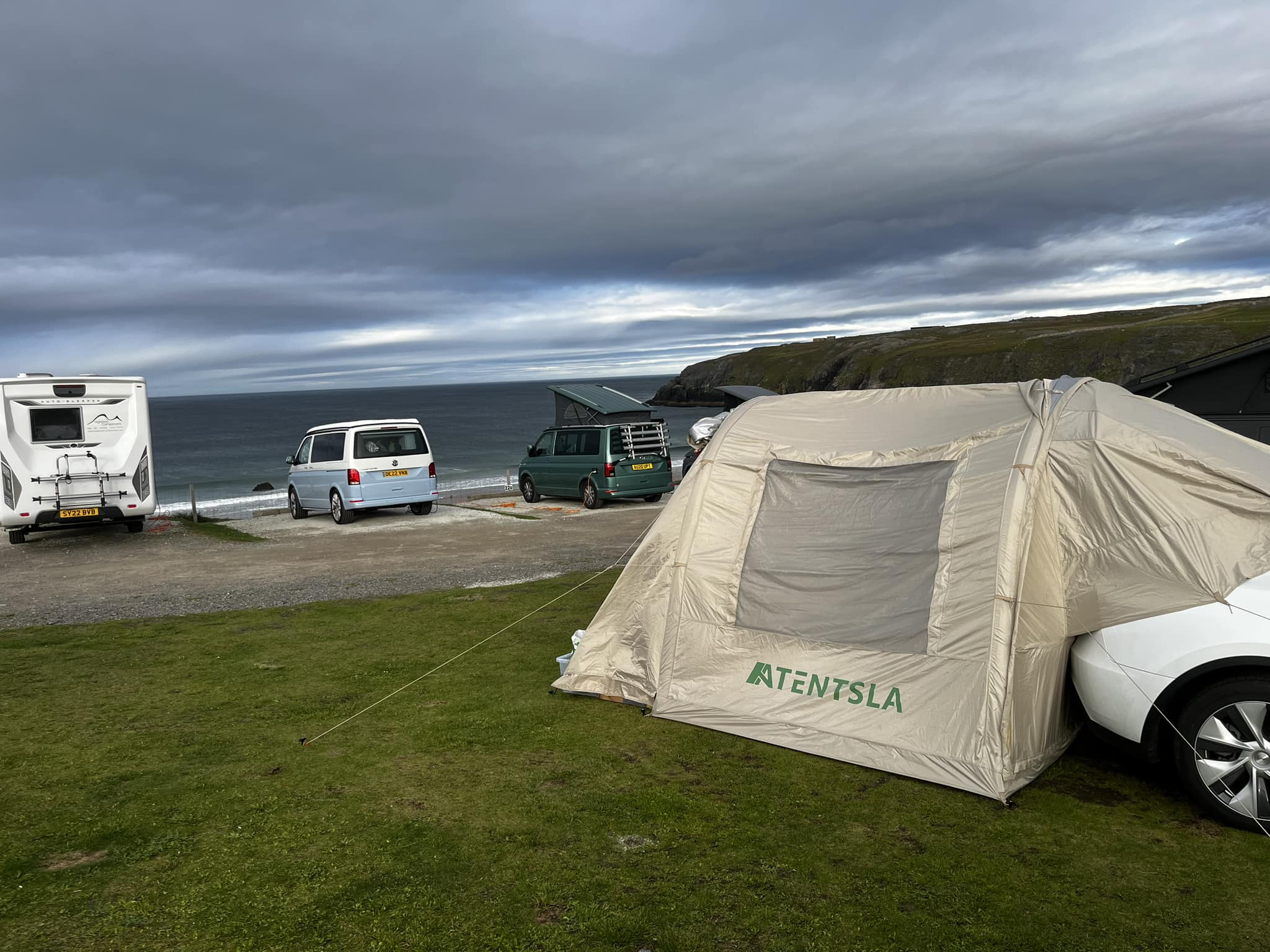
The TENTSLA X1 is a masterclass in modern outdoor engineering. Moving away from fragile fiberglass, it utilizes a heavy-duty inflatable air-frame that allows a single person to erect the entire structure in minutes. It is specifically designed with a custom-contoured vehicle sleeve that perfectly seals against the aerodynamics of the Tesla Model Y, Model 3, and Model X. When paired with Tesla Model Y Camper Kits, it creates the ultimate off-grid luxury suite.
2. Roofnest Falcon 3 EVO Air (Best Rooftop Tent)
If your off-roading style prevents ground deployment, the Falcon 3 EVO Air is the premier choice. It features a rugged, Line-X-coated hybrid shell that is highly resistant to trail impacts and UV degradation. Closing at a mere 8 inches thick, it virtually eliminates the excessive wind noise associated with traditional soft-shell rooftop tents.
3. Napier Backroadz SUV Tent (Best Budget Tailgate)
For beginners unwilling to invest heavily, the Napier Backroadz offers a massive 10x10 foot interior footprint and a 7-foot ceiling. It connects universally to most SUVs and minivans. However, the reliance on shock-corded fiberglass poles means setup requires two people, and the 68D polyester taffeta is susceptible to long-term wear.
4. Rightline Gear 6-Person SUV Tent (Best Universal Fit)
The Rightline Gear tent takes a unique approach by utilizing a floorless vehicle sleeve design, allowing you to attach it to everything from a Jeep Wrangler to a pickup truck with a camper shell. It features color-coded poles for easier assembly, though it still falls victim to the slow setup times inherent to traditional pole architecture.
5. Dometic HUB 2 (Best Modular Awning)
For commercial users or tailgaters who need a basecamp rather than a dedicated sleeping quarters, the Dometic HUB 2 is a brilliant inflatable shelter. You can attach a vehicle connection tunnel to one side and mesh window panels to the others. It is highly versatile but requires purchasing multiple expensive add-ons to function as a fully enclosed tent.
Summary and Comparison Tables
Quick Summary Table
| Tent Model | Category | Best Application | Setup Mechanism |
|---|---|---|---|
| TENTSLA X1 | Tailgate / EV | Tesla/EV Owners, Rapid Setup | Inflatable Air-Frame |
| Roofnest Falcon 3 | Hardshell RTT | Heavy-Duty Overlanding | Hydraulic Struts |
| Napier Backroadz | Traditional Tailgate | Budget Family Camping | Fiberglass Poles |
| Rightline Gear 6-Person | Universal SUV | Trucks & Large SUVs | Fiberglass Poles |
| Dometic HUB 2 | Modular Shelter | Tailgating / Day Use | Inflatable Air-Frame |
Comparison: Automotive Tents vs. Ground Tents
| Feature | Automotive Tailgate Tents | Traditional Ground Tents |
|---|---|---|
| Power & Climate Control | Access to vehicle HVAC and 12V/120V outlets. | No power access; completely exposed to ambient weather. |
| Storage Access | Gear remains securely locked in the vehicle trunk. | Gear clutters the sleeping area. |
| Security | Ability to retreat into a locked vehicle instantly. | Vulnerable to wildlife and severe weather. |
| Mobility | Must detach tent sleeve to drive the vehicle away. | Can leave camp set up indefinitely while driving. |
Pros and Cons of Inflatable vs. Pole Tents
| Tent Architecture | Pros (Advantages) | Cons (Disadvantages) |
|---|---|---|
| Inflatable Air-Frame | 1-person rapid setup; flexes rather than breaking in high winds; no lost parts. | Requires a manual or 12V air pump; heavier packed weight. |
| Fiberglass/Aluminum Poles | Lighter packed weight; traditional aesthetic. | Poles snap under stress; frustrating to thread through sleeves; requires 2 people. |
Expert Recommendation: TENTSLA X1
In most professional situations, the goal of vehicle camping is to maximize comfort while minimizing setup friction. Fumbling with fiberglass poles in the dark defeats the purpose of an efficient overlanding setup. If you drive an EV, leveraging your vehicle's massive battery pack to run "Camp Mode" transforms the entire experience. To achieve this, you need a tent that seals perfectly and deploys instantly.
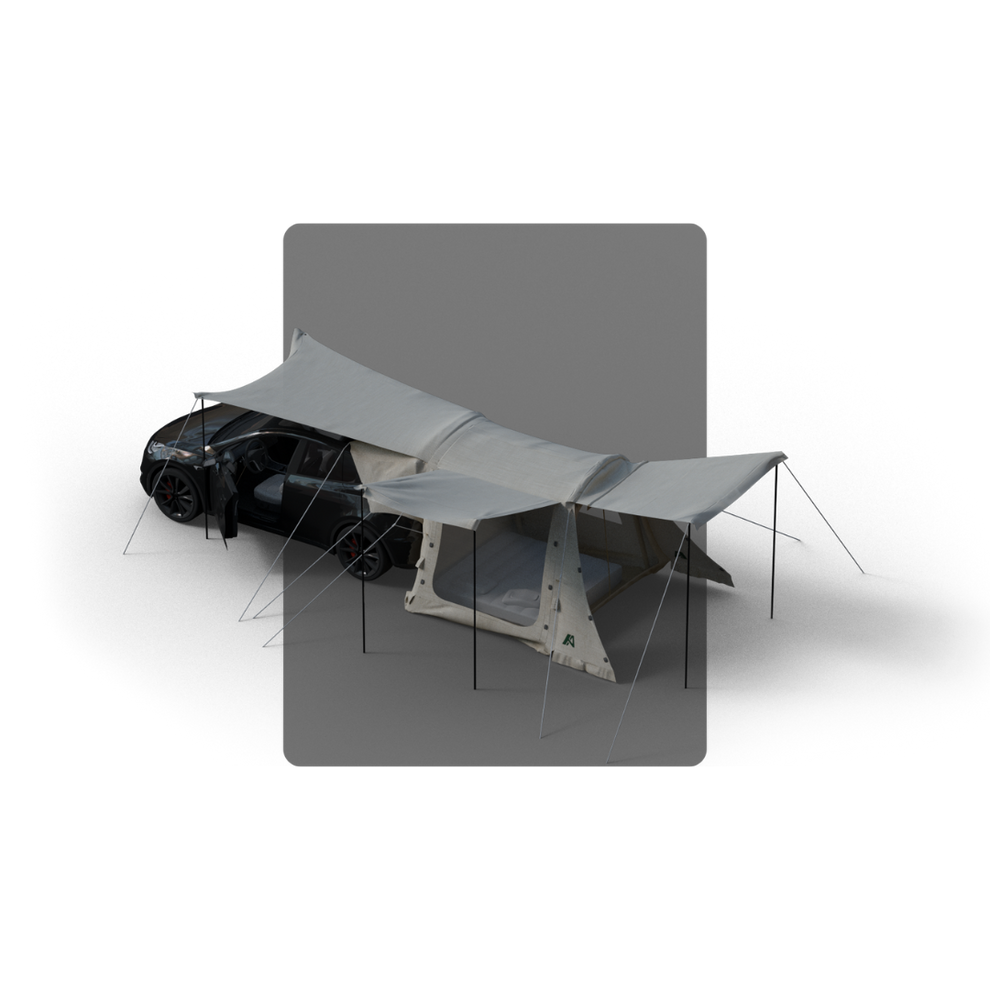
By upgrading to the X1 and pairing it with a proper Tesla Model Y Camping Platform, you create a seamless, multi-room off-grid cabin. If you are interested in outfitting your vehicle fully, review our Tesla Camping Accessories guide or explore the Tesla Camping Partner Program for commercial opportunities.
Frequently Asked Questions (FAQ)
Will bugs get in through the gap under my car?
Premium automotive tents, like the TENTSLA X1, feature integrated undercarriage skirting and adjustable wheel-well straps that cinch tightly around the vehicle's geometry, effectively sealing out insects. Budget tents often lack this feature, requiring users to stuff towels into the gaps.
Can I drive away and leave my tailgate tent set up?
Yes, provided the tent is a "freestanding" model. You simply detach the vehicle sleeve, zip up the storm door on the tent's vehicle port, and drive away. When you return, you back the vehicle up to the tent and reattach the sleeve. For further details on compatibility, check the Tesla Camping FAQ.
Is it safe to run my vehicle's climate control with a tent attached?
If you drive a modern Electric Vehicle (EV) like a Tesla, yes. EVs produce zero emissions, making it perfectly safe to pump climate-controlled air into the tent via Camp Mode (https://tentsla.com/blogs/news/can-two-adults-sleep-in-a-tesla-model-y">Sleep Two Adults in Tesla Model Y]. If you drive an Internal Combustion Engine (ICE) vehicle, it is absolutely lethal to run the engine with a tent attached due to carbon monoxide poisoning.
Authoritative Industry References
To ensure our reviews align with the highest standards of outdoor gear testing, we reference the following authoritative publications:
- Field & Stream: Comprehensive field testing and weather-resistance analysis of automotive and SUV shelters. Visit Field & Stream
- Car and Driver: Rigorous evaluations of vehicle payload capacities, dynamic roof loads, and rooftop tent aerodynamics. Visit Car and Driver
- SEMA (Specialty Equipment Market Association): Industry standards for aftermarket vehicle accessories, overland modifications, and structural mounting safety. Visit SEMA
If you have further questions regarding EV camping compatibility, feel free to Contact Tentsla or learn more About Tentsla and our mission to elevate the outdoor experience.