

The 10 Checklist of Car Camping Necessities for a Weekend Trip: Real-World Gear Guide
Oct 09, 2026

Most weekend camping trips go wrong long before dinner is served. Campers arrive at their site after a three-hour drive, open the trunk, and realize their sleep pad does not clear the rear wheel wells, the cheap fiberglass poles snapped in the afternoon breeze, or the interior of their vehicle feels like a greenhouse by sunrise. Traditional outdoor advice treats car camping as standard backpacking with a shorter walk from the trunk. That approach is completely backwards. Your vehicle is a mobile power plant, weather shelter, and cargo platform. Mastering your checklist of car camping necessities means choosing gear engineered specifically for vehicle integration rather than throwing old garage supplies into the trunk.

Quick Answer: The 10 Car Camping Essentials for a Seamless Weekend
To run a comfortable, hassle-free weekend trip, your kit must center on 10 gear categories: (1) Vehicle-Integrated Inflatable Shelter that connects to the tailgate; (2) Tailored Vehicle Mattress with memory foam and air hybrid support; (3) 12V High-Output Air Pump for rapid inflation; (4) Dedicated Climate Management (leveraging EV Camp Mode or insulated thermal blackout window covers); (5) Camp Kitchen & Induction System; (6) Dual-Zone Illumination (task lighting and warm ambient lanterns); (7) High-Capacity Water Storage with rapid spigot dispensing; (8) Leveling Chocks to eliminate awkward sleeping angles; (9) Ergonomic Camp Seating & Packable Table; and (10) Modular Organization Totes. If you drive a modern EV, integrating your hatchback with a purpose-built Tesla Camping Tent like the Tentsla X1 delivers continuous climate control that traditional standalone tents cannot match.
Article Directory
- The Mechanics of Vehicle Camping: Turning Your Car into Basecamp
- Quick Summary Table: The 10 Car Camping Necessities
- The 10 Checklist Items: In-Depth Field Analysis
- Gear Spotlight: Tentsla X1 Inflatable Tesla Camping Tent
- Direct Comparison: Vehicle Tailgate Shelter vs. Ground Tent vs. Rooftop Tent
- Pros and Cons of Vehicle-Connected Camping Systems
- Who Needs Tailgate Integration vs. Who Should Stick to Ground Tents
- Common Mistakes Campers Make When Sleeping in Cars
- Essential Buying Considerations Before Your Next Trip
- Frequently Asked Questions
- Authoritative Camping & Vehicle Standards
The Mechanics of Vehicle Camping: Turning Your Car into Basecamp
Car camping has evolved far beyond reclining your driver seat and sleeping under a scratchy wool blanket. Modern vehicle camping uses the car body as a structural anchor. When you connect an enclosed vestibule to the open tailgate, the interior cargo bay becomes a master bedroom, while the external tent serves as a stand-up changing room, gear staging zone, and weather lounge.
For electric vehicle owners, this integration delivers a massive practical advantage. Modern EVs allow you to run the heat pump and HVAC fans continuously all night without tailpipe emissions or noisy generator rumbling. In our testing, climate control circulates cool or heated air straight through the open hatchback into a sealed, weather-resistant Car Camping Tent for Tesla. This maintains a steady 68°F (20°C) inside your sleeping area, regardless of whether outside temperatures drop to freezing or spike in humid summer air.
However, running this setup requires the right gear. If your tent sleeve does not seal tightly around the car body, your climate control spills outside, wasting battery power and drawing in insects. Every item on your packing list must work with your vehicle's physical dimensions and electrical architecture.
Quick Summary Table: The 10 Car Camping Necessities
| Checklist Item | Recommended Equipment Spec | Operational Failure Prevented | Practical Recommendation |
|---|---|---|---|
| 1. Integrated Shelter | Inflatable air-beam tailgate tent (420D Oxford) | Broken poles, leaky car seals, long setup times | Must include a secure vehicle sleeve |
| 2. Tailored Mattress | High-density memory foam + self-inflating core | Hip pain from uneven floor seams and wheel wells | Choose custom-cut vehicle shapes |
| 3. High-Output Air Pump | 12V DC dual-stage electric pump (auto-shutoff) | Manual foot-pumping exhaustion at dusk | Essential for fast tent and bed setup |
| 4. Climate Management | EV Camp Mode + silver-coated thermal screens | Condensation buildup and heat loss through glass | Insulate all panoramic glass roofs |
| 5. Cooking System | Single-burner induction cooktop or dual-fuel stove | Scorched pans, high wind flameouts, soot | Run induction off EV 120V power outlets |
| 6. Camp Illumination | Rechargeable warm LED strip + hanging lantern | Blinding glare from harsh direct headlamps | Use diffuse 2700K warm lighting |
| 7. Water Infrastructure | 10L to 20L rigid container with brass/quick-flow spigot | Leaky single-use plastic jugs | Use BPA-free food-grade jugs |
| 8. Leveling Hardware | Multi-tier curved RV tire chocks | Blood rushing to head on uneven slopes | Level wheels before setting up camp |
| 9. Ergonomic Seating | Aircraft-grade aluminum folding low-back chairs | Back fatigue and sagging fabric seats | Keep packed chair depth under 6 inches |
| 10. Modular Cargo Bins | Stackable low-profile waterproof containers | Scattered gear rolling around the trunk | Label food, cook, and sleep kits separately |
The 10 Checklist Items: In-Depth Field Analysis
1. Vehicle-Integrated Inflatable Shelter

From our experience on the trail, traditional ground tents create friction: you have to unload all your gear from the car, pitch the tent 30 feet away, and hike back and forth every time you need a jacket or phone charger. Rooftop tents are bulky, drag down highway fuel range by 15% to 20%, and permanently trap you at camp once deployed.
In most professional situations, we recommend an inflatable tailgate shelter like the Tentsla X1 Tent. By using high-pressure air-beams instead of bendable aluminum poles, the structure inflates in minutes. The elastic vehicle sleeve wraps securely around the rear quarter panels, expanding your living area and allowing your vehicle's climate control to warm or cool the extended vestibule.
2. Vehicle-Contoured Mattress with Custom Wheel-Well Cutouts
Throwing a rectangular home air mattress into the back of an SUV or crossover does not work. Standard mattresses bunch up against the wheel arches, reducing your sleeping width and leaving hips resting against bare plastic trim. Cheap PVC air beds also bleed air as overnight temperatures drop, leaving you waking up on hard floorboards.
We recommend a purpose-built Tesla Trunk Mattress or a high-density Self Inflating Camping Mattress. Look for dual-layer construction: open-cell polyurethane memory foam encased in an airtight TPU skin. The foam provides physical cushioning and insulation (R-value above 4.0), while the internal air volume lets you adjust firmness with a quick twist of the purge valve.
3. High-Output 12V Electric Air Pump
Arriving at your campsite after dark is stressful enough without having to hand-pump a double mattress and tent beams. Hand pumps are slow, while cheap battery pumps lack the pressure to firm up high-density air-beams.
Keep a dedicated Portable Air Pump for Tent setups in your sub-trunk. A quality dual-stage pump plugs straight into your car's 12V auxiliary port. It uses high-volume turbine mode to fill empty air bladders in under two minutes, then automatically switches to a high-pressure piston mode that reaches 10 to 15 PSI before shutting off automatically.
4. Active Climate Control & Thermal Blackout Covers
A vehicle cabin has significant glass area. Without proper shade, the greenhouse effect will heat your interior past 85°F by 7:30 AM, ending your sleep abruptly. In cold weather, uninsulated glass windows leach body heat and collect condensation that drips onto your sleeping bag.
If you drive an electric vehicle, engage Camp Mode to keep ventilation running quietly all night. Complement this with custom reflective silver-coated window covers. Silver coatings reflect solar heat away during the day and keep radiant warmth inside on chilly mountain nights, while providing complete privacy at crowded campsites.
5. Low-Profile Kitchen System & Induction Cooking
Camp cooking should be straightforward, not an hour-long cleanup chore. Gas stoves with disposable green propane bottles are messy, produce soot on cookware, and present carbon monoxide hazards if used near vehicle openings.
For modern vehicle setups, we recommend packing a compact 1200W to 1800W single-burner induction cooktop powered by your car's AC outlet or a portable power station. Induction heating boils water twice as fast as propane, produces zero soot, and eliminates open flame hazards. Pair it with a compact non-stick ceramic skillet and a collapsible kettle to keep your kitchen footprint minimal.
6. Dual-Zone Warm LED Lighting (2700K to 3000K)
Blasting your campsite with high-lumen, blue-tinted 6000K LED work lights ruins night vision and attracts every flying insect in the area. High-glare lights make the campsite feel like an industrial construction zone.
Use diffuse, warm-white lighting (2700K to 3000K). We recommend hanging a flexible, silicone-diffused LED light strip along the internal roof ribs of your tent, paired with a small rechargeable lantern on your cook table. Dimmable warm lights provide plenty of illumination for cooking while creating a comfortable, relaxing atmosphere around camp.
7. High-Capacity Rigid Water Dispenser (10L to 20L)
Buying single-use plastic gallon water jugs from the gas station is a recipe for a soggy trunk. Thin milk-jug plastic punctures easily under shifting gear, and single-use jugs create unnecessary plastic waste at camp.
Invest in a heavy-duty, food-grade 10-liter or 20-liter rigid water container with a wide-mouth cleanout port and a smooth brass ball-valve spigot. Set the container on the edge of your tailgate or camping table to create an instant wash-and-prep station for rinsing utensils, filling kettles, and washing hands.
8. Curved Wheel Leveling Chocks
Even a subtle two-degree slope at your campsite feels dramatic when you lie down to sleep. Sleeping with your head lower than your feet causes restless sleep and morning headaches, while an unlevel car forces you to roll toward the side doors all night.
Carry a pair of heavy-duty curved polymer leveling ramps. Back your vehicle onto the campsite, set your phone on the center console to check the digital bubble level, and roll the low-side tires onto the ramps until the cabin sits flat. Leveling takes less than two minutes and guarantees a flat, comfortable sleeping surface.
9. Compact Folding Chairs & Roll-Top Aluminum Table
Cheap umbrella-folding lawn chairs with saggy cup holders force your spine into poor posture, leading to lower back stiffness after an hour around the campfire. They also consume valuable horizontal trunk space.
Choose low-profile, aircraft-grade aluminum camp chairs with rigid backrests that fold down into slim, compact bundles. Pair them with a lightweight roll-top aluminum slat table that packs down into a compact cylinder. These aluminum surfaces support hot cookware safely and wipe clean in seconds.
10. Modular Heavy-Duty Storage Bins
The fastest way to lose control of your campsite is living out of loose grocery bags and soft duffels. Soft bags crush easily, trap odors, and make finding a headlamp or spice jar a frustrating hunt.
Organize gear into rigid, low-profile storage bins that slide cleanly underneath your sleeping platform or stack on the front floorboards. Group items by activity: one bin for kitchenware, one for dry pantry goods, and one for utility gear (cords, repair tape, extra stakes). This setup keeps your trunk clean and prevents gear clutter.
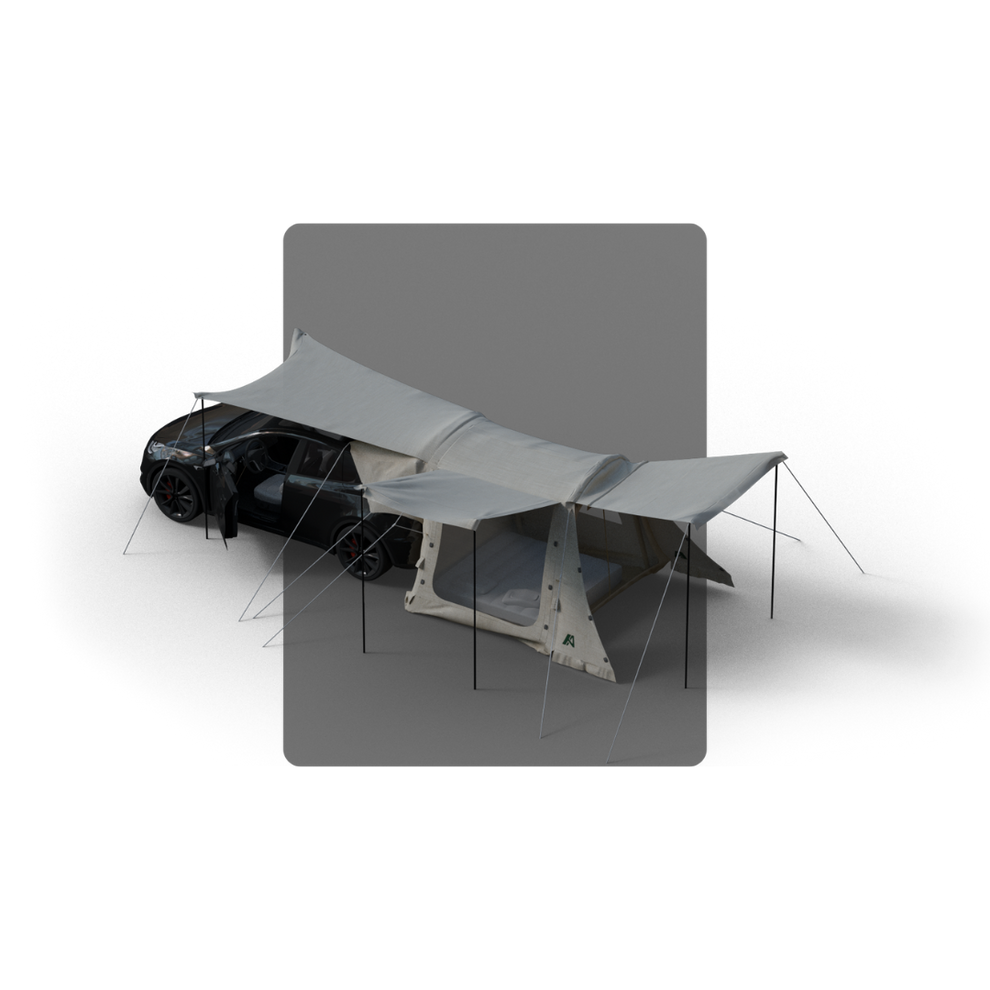
Integrated Shelter Spotlight: Tentsla X1 Camping Tent
If you own a Tesla Model Y, Model 3, or Model X, the Tentsla X1 is purpose-built to turn your electric vehicle into a climate-controlled basecamp. Traditional pole tents struggle with vehicle tailgates, but the Tentsla X1 features an airtight, inflatable air-beam frame that eliminates bent or broken poles completely.
| Retail Price | $649 (Direct Complete Package) |
| Outer Canopy & Floor | Heavy-duty 420D Oxford Fabric with waterproof PU coating |
| Inner Wall Fabric | Breathable 210D Oxford Fabric |
| Thermal Insulation | Silver Coated UV Protection & Radiant Heat Barrier |
| Structural Frame | High-Pressure Inflatable Air-Beam System + Aluminum Poles |
| Vehicle Fitment | Tailored elastic sleeve for Tesla Model Y, Model 3, and Model X |
Expert Recommendation: Read our full breakdown of the Tesla Camping Setup to learn how to keep your tent conditioned overnight using EV Camp Mode.
Direct Comparison: Vehicle Tailgate Shelter vs. Ground Tent vs. Rooftop Tent
| Evaluation Metric | Inflatable Tailgate Tent (Tentsla X1) | Traditional Ground Tent | Hard-Shell Rooftop Tent (RTT) |
|---|---|---|---|
| Setup Duration | 3 to 5 Minutes (Electric Pump) | 15 to 25 Minutes (Manual Poles) | 2 to 5 Minutes (Gas Struts) |
| Vehicle HVAC Access | Direct ducting into tent vestibule | None (Isolated from vehicle) | None (Requires separate diesel heater) |
| Aerodynamic Range Impact | 0% (Packs completely inside trunk) | 0% (Packs inside trunk) | -15% to -25% Highway Range Loss |
| Wind Stability | High (Flexible air beams absorb gusts) | Moderate (Fiberglass poles can snap) | High (Rigid shell construction) |
| Mobility After Setup | Requires unzipping vehicle sleeve | Vehicle free to drive away | Vehicle completely locked at campsite |
| Storage Footprint | Medium trunk bag footprint | Small to Medium trunk bag | Heavy (Remains mounted to roof rack) |
Pros and Cons of Vehicle-Connected Camping Systems
| System Architecture | Field Performance Advantages | Practical Limitations & Drawbacks |
|---|---|---|
|
Vehicle-Connected Inflatable Tent (e.g., Tentsla X1 Ecosystem) |
|
|
|
Standard Freestanding Ground Tents (Traditional dome tents) |
|
|
Who Needs Tailgate Integration vs. Who Should Stick to Ground Tents
Every gear purchase should match your vehicle type, camping style, and route plan. Tailgate-connected systems deliver exceptional comfort, but they are not the right fit for every outdoor scenario.
Who Should Invest in Tailgate-Integrated Systems:
- Electric Vehicle Owners (Tesla Models Y, 3, X): If you have an EV with Camp Mode, sleeping without vehicle integration wastes that capability. A connected inflatable tent lets you heat and cool your sleeping area quietly all night long.
- Couples & Small Families: The vehicle cargo bed serves as a quiet, elevated sleeping area, while the connected tent acts as a separate changing room, lounge, and dog kennel.
- Four-Season Weekend Campers: Campers who head out regardless of weather will appreciate the 420D Oxford fabric, silver UV coating, and air-beam structure, which handle rain, snow, and wind better than thin nylon tents.
- Gear Curators Building a Dedicated Kit: If you are assembling a cohesive weekend kit, browse the complete Camping Accessories for Tesla and review the top-rated Best Tesla Camping Gear to keep your pack-out organized.
Who Should Stick to Traditional Ground Tents:
- Backpackers & Trail Hikers: If you camp miles away from parking trailheads, vehicle tents are too heavy. You need an ultralight two-pound backpacking tent.
- Campers Who Commute Daily from Camp: If your trip involves setting up basecamp and driving into town every morning for rafting or shopping, unhooking a tailgate sleeve twice daily can become tedious.
- Owners of Sedans with Fixed Trunks: Vehicles without a hatchback hatch cannot connect to tailgate sleeves. These cars are better served by standalone ground tents.
Common Mistakes Campers Make When Sleeping in Cars
Field Failure Warning: The most common mistake beginners make is sleeping in an internal combustion engine vehicle with the engine idling for warmth. Exhaust fumes can enter the cabin through tailpipe backdrafts, presenting a lethal carbon monoxide hazard. Never idle a gas car overnight; use an electric vehicle with Camp Mode or an insulated winter sleeping bag.
- Forgetting to Level the Vehicle: Parking on an uneven campsite causes blood to rush to your head or rolls you against the car door all night. Always use leveling chocks to flatten your sleeping surface before setting up camp.
- Ignoring Window Condensation: In non-EVs where windows remain closed, human respiration releases roughly one liter of water vapor per person overnight. Without cracked windows or active HVAC airflow, moisture coats the windshield, saturates headliners, and fosters interior mold.
- Overpacking Loose Items Without Sleep Zone Isolation: Packing gear on top of your sleeping mattress forces you to pull everything out in the dark before you can lie down. Pack sleep gear in the lower sub-trunk and keep kitchen bins accessible on the side.
- Using Thin Yoga Mats as Mattress Pads: Foam exercise mats lack the thermal resistance (R-value) and cushion required for comfortable sleep. Cold drafts from the metal car floor sap body heat, leaving you cold and sore by morning.
Essential Buying Considerations Before Your Next Trip
Before buying new gear for your upcoming weekend, evaluate your equipment across four practical dimensions:
1. Fabric Weight and Weatherproof Coatings
Lightweight 68D or 150D polyester is fine for summer backyard sleepouts, but mountain rainstorms will shred cheap seams. For vehicle camping, choose shelters made from heavy-duty 210D to 420D Oxford cloth with taped polyurethane (PU) waterproof coatings of at least 3,000mm. Silver inner coatings are also valuable, reflecting solar radiation to keep the cabin cool on bright summer mornings.
2. Vehicle Tailgate Seal Design
Inspect how the tent connects to your car. Quality tailgate tents use broad, heavy-duty elastic bands reinforced with adjustable cinch straps and magnetic storm flaps that hug the wheel arches and undercarriage. A loose, gaping sleeve lets warm air escape, flaps noisily in the wind, and lets mosquitoes inside.
3. Packed Dimensions and Sub-Trunk Fit
Always measure your trunk and sub-trunk storage spaces before buying gear. Tailgate tents, memory foam pads, and camping tables should stow neatly below the rear cargo floor. Keeping your camping setup in the sub-trunk preserves your main cargo area for coolers, sports gear, and passenger bags.
4. Modular Power and Camp Mode Compatibility
If you camp with an EV, make sure your gear runs on your car's electrical system. Low-draw 12V pumps, induction cooktops, and USB-C lanterns let you power your entire campsite directly from the vehicle, eliminating the need to haul heavy, expensive gas generators or extra battery packs.
Frequently Asked Questions
Car camping integrates your vehicle as the central power plant, weather shield, and storage locker. In modern electric vehicles, the traction battery powers continuous climate control (Camp Mode), running heating or cooling all night without engine idling or carbon monoxide risks.
In our testing across moderate outside temperatures (45°F to 75°F), running EV climate control consumes between 1% and 1.5% battery capacity per hour (approximately 8% to 12% for an 8-hour sleep). In freezing weather below 30°F, heat pump consumption rises to 2% to 3% per hour.
Yes. Rigid fiberglass and aluminum poles bend permanently or snap under sudden wind shears exceeding 35 mph. Inflatable TPU air-beams flex with severe wind gusts and rebound immediately to their original structural geometry without breaking.
Overpacking loose plastic totes without dedicated sleep zone separation. Storing loose kitchen gear on top of your sleeping mattress forces you to completely unpack the car in the dark before you can lie down.