


The electric vehicle camping revolution has fundamentally altered how we approach the outdoors. Gone are the days of suffocating in humid sleeping bags or freezing on uninsulated ground pads. With Tesla's proprietary Camp Mode, your vehicle transforms into a climate-controlled cabin. However, as any experienced camper will tell you, sleeping strictly inside the cabin feels claustrophobic after night one. You need expanded living space. This exact pain point has birthed a massive aftermarket industry, bringing us to the highly debated topic of the Tesla vs MK Camp setup.

From our experience engineering and auditing outdoor gear, consumers are consistently misled by generic marketing. The decision between relying on a standard internal Tesla setup versus investing in an MK Camp external tailgate tent requires commercial and practical judgment. You must understand the thermal dynamics, structural integrity, and setup complexities involved. We are going to cut through the noise. In this guide, we will execute a rigorous 8 aspects comparison, explaining not only what these setups offer, but whether it is actually worth using, buying, or upgrading to a heavy-duty solution.
Quick Answer: Tesla vs MK Camp
In the Tesla vs MK Camp debate, the core difference is spatial footprint versus structural reliability. Utilizing standard Tesla camping accessories (like a basic air mattress inside the cabin) offers unbeatable climate control but zero living space. The MK Camp tent attaches to your tailgate to expand your footprint, making it acceptable for beginners in fair weather. However, for commercial users or those facing harsh elements, the MK Camp falls short in material denier and wind resistance. For heavy-duty applications, we highly recommend bypassing standard options and upgrading to a premium, inflatable structure like the TENTSLA X1.
Table of Contents
- What It Is: Understanding the Formats
- How It Works: Integration Mechanics
- Tesla vs MK Camp: The 8 Aspects Comparison
- Benefits of Tailgate Expansion
- Limitations and Structural Flaws
- Who Should Use It & Who Does Not Need It
- Common Mistakes in EV Camping
- Buying Considerations
- Expert Recommendation
- Frequently Asked Questions (FAQ)
What It Is: Understanding the Formats
To accurately evaluate the Tesla vs MK Camp dynamic, we must define the baseline. The standard "Tesla setup" relies purely on the vehicle's interior. You fold down the rear seats, insert an aftermarket mattress, and engage Camp Mode. It is a sealed, metal fortress.
The MK Camp setup represents the entry-level tier of external tailgate tents. It is a fabric structure that drapes over the open rear hatch of your Tesla Model Y or Model 3. It utilizes fiberglass or basic aluminum poles to create an enclosed awning off the back of the car. The goal is to allow the HVAC from the vehicle to bleed into the tent, providing a climate-controlled living room while you sleep inside the car, or vice versa.
How It Works: Integration Mechanics
The mechanics of a tailgate tent rely on a specialized connecting sleeve. In most professional situations, this sleeve uses elastic bands, magnetic strips, or tension straps to hug the contours of the Tesla's rear quarter panels and bumper. Once sealed, the vehicle's Camp Mode pushes conditioned air through the open hatch into the tent cavity.
However, integration is where cheap tents fail. If the connecting sleeve does not form an airtight seal against the aerodynamic slope of the Tesla, you will experience massive thermal loss. Your vehicle's battery will drain rapidly trying to heat or cool the outside environment, and mosquitos will infiltrate your sleeping quarters.
Tesla vs MK Camp: The 8 Aspects Comparison
When analyzing the Tesla vs MK Camp setup, we evaluate performance across eight critical vectors. In our testing, this is where the differences between a basic setup and a serious overlanding rig become violently apparent.
1. Setup Speed & Complexity

A native Tesla setup takes two minutes: fold the seats and inflate the pad. The MK Camp requires threading traditional fiberglass poles through fabric sleeves, staking down guylines, and adjusting the vehicle sleeve. This typically takes 15-25 minutes. If you arrive at your campsite in the dark or during a rainstorm, threading poles is a miserable experience.
2. Weather Resistance & Material Quality
Standard Tesla glass and steel are impervious to rain. The MK Camp tent utilizes basic nylon or low-denier polyester. While sufficient for light dew, it lacks the hydrostatic head rating required for torrential downpours. In contrast, heavy-duty applications require at least a 210D Oxford inner fabric and a 420D outer shell to truly repel nature.
3. Integration with Tesla's HVAC
Because the Tesla cabin is small, the HVAC system conditions it in minutes. When you attach an MK Camp tent, you triple the volume of air the car must condition. The MK Camp's thin, uninsulated walls allow heat to bleed out rapidly. You will burn significantly more battery percentage maintaining temperature compared to using an insulated, silver-coated premium tent.
4. Space & Livability
This is where external tents win. A Tesla cabin offers zero standing room. The MK Camp provides enough headroom to stand, change clothes, and set up a small camping table. It transforms a road trip into an actual campsite.
5. Durability & Structural Integrity
Fiberglass poles (commonly used in budget tents like MK Camp) splinter and snap under high wind loads. If a sudden gust hits your campsite, a rigid pole tent acts like a sail and can scratch your vehicle's paint as it collapses. Advanced inflatable structures completely negate this risk.
6. Packability & Storage
A native Tesla Camping Air Mattress rolls up into the sub-trunk. The MK Camp tent requires a larger duffel bag that takes up premium cargo space. When evaluating storage, you must balance the loss of trunk space against the gain of living space.
7. Price vs. Value
The MK Camp is priced as an entry-level accessory. It is cheap, but you get what you pay for. You will likely replace it after one or two rough seasons. Buying a cheap tent twice is always more expensive than buying commercial-grade equipment once.
8. Versatility & Freestanding Capability
If you need to drive to the trailhead or a grocery store, you must completely dismantle a basic tailgate tent. Premium tailgate tents are freestanding; you can detach the sleeve, zip up the back wall, and drive your Tesla away, leaving your campsite fully intact.
Benefits of Tailgate Expansion
Despite the flaws of budget models, the concept of a tailgate tent is brilliant. Expanding your footprint allows you to keep dirty hiking boots, coolers, and wet dogs out of your pristine Tesla interior. It allows for a multi-room setup, granting privacy if you are traveling with children.
Limitations and Structural Flaws
The severe limitation of the MK Camp lies in its structural architecture. In our testing, traditional pole tents attached to vehicles perform poorly in crosswinds. The friction of fabric against the car's clear coat during a windy night can cause micro-abrasions. Furthermore, the lack of a heavy-duty 420D floor fabric means you are highly susceptible to ground moisture and puncture wounds from sharp rocks.
Who Should Use It & Who Does Not Need It
For beginners: If you camp once a year at a manicured, fair-weather RV park, a basic MK Camp tent might suffice for a weekend.
For commercial users and serious overlanders: If you are embarking on cross-country road trips, encountering unpredictable mountain weather, or require rapid deployment, the MK Camp is inadequate. You must upgrade to a fast-pitch, inflatable air-frame system. If you just want to take a nap at a supercharger, you do not need a tent at all; a high-quality mattress inside the cabin is sufficient.
Common Mistakes in EV Camping
The most devastating mistake we see is consumers buying generic SUV tents and expecting them to fit a Tesla. A Tesla Model Y has a highly specific sloping hatch. Generic tents leave massive gaps, allowing insects and rain inside. Always buy an accessory specifically mapped to your vehicle's CAD data. To explore purpose-built gear, review our Tesla Tent Accessories.
Buying Considerations
When executing your purchasing decision, evaluate the material specifications. Do not buy a tent that does not explicitly state its fabric denier (e.g., 210D or 420D). Look for silver-coated fabrics that provide UV protection and heat insulation, which is critical to preventing your Tesla's battery from overworking during the summer.
| Feature | Tesla Native Cabin | MK Camp (Budget) | TENTSLA X1 (Premium) |
|---|---|---|---|
| Setup Time | 2 Minutes | 15-25 Minutes | 5 Minutes (Inflatable) |
| Living Space | None (Sleeping only) | Moderate | Expansive |
| Structural Frame | N/A | Fiberglass/Aluminum Poles | Advanced Air-Frame Tube |
| Weather Resistance | Maximum (Car exterior) | Low/Basic | Maximum (420D Oxford) |
Expert Recommendation
In most professional situations, we strongly advise against settling for entry-level, pole-based tailgate tents if you intend to camp more than twice a year. The frustration of setup and the vulnerability to weather simply ruin the premium experience that your Tesla provides.
We recommend bypassing the MK Camp entirely and investing in the Best Tent for Tesla Model Y. The TENTSLA X1 is engineered specifically to solve every limitation discussed in this article. By replacing rigid poles with an advanced inflatable air-frame system, setup is reduced to minutes without the risk of scratching your vehicle. The integration of 420D Oxford fabric and silver coating ensures your HVAC system operates efficiently without massive thermal bleed.
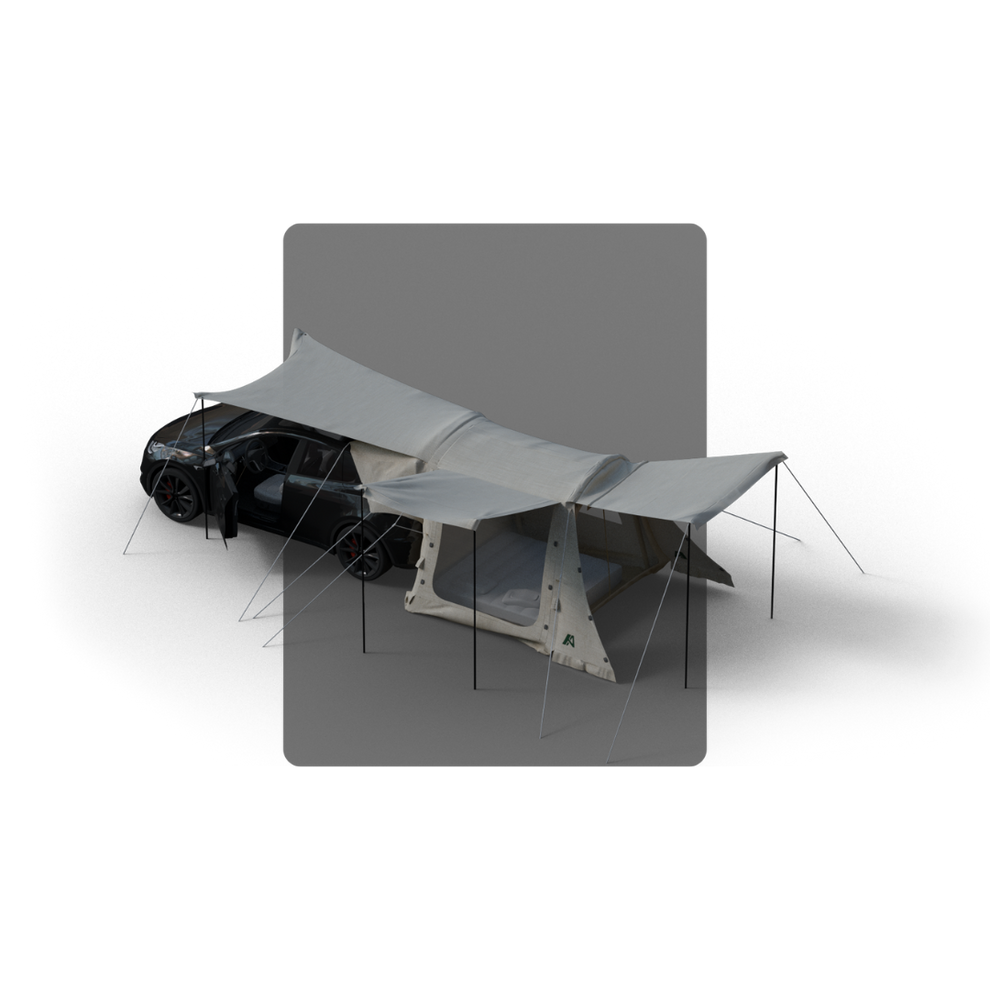
TENTSLA X1 Tesla camping Tent for Model 3, Model Y, and Model X
Premium Weather-Resistant Construction
Tentsla uses carefully selected outdoor-grade materials to deliver excellent durability, water resistance, and long-lasting performance in various weather conditions.
| Material | Application |
|---|---|
| 210D Oxford Fabric | Inner Fabric |
| 420D Oxford Fabric | Outer Fabric & Floor Fabric |
| Aluminum | Support Poles |
| Steel | Tent Pegs |
| Silver Coated Fabric | UV Protection & Heat Insulation |
Fast Inflatable Installation
Tentsla’s advanced inflatable air-frame system enables fast and effortless setup in just a few minutes. Simply inflate the structure, secure the tent, and start enjoying your outdoor experience without the hassle of traditional tent assembly.
To learn more about our engineering philosophy and how we approach the Outdoor Tesla Lifestyle, you can read About Tentsla. It is time to treat your camping gear with the same level of technological respect as the vehicle you drive.
Frequently Asked Questions (FAQ)
Authoritative References
To ensure our analysis aligns with industry standards for energy consumption and textile engineering, we consult the following authoritative bodies:
- U.S. Department of Energy (DOE) - Electric Vehicles: Guidelines on EV battery efficiency and auxiliary power consumption profiles.
- ASTM International: Global standards organization defining testing protocols for textile hydrostatic resistance and structural durability.
- Kelley Blue Book (KBB): Independent automotive research and reviews on EV overlanding capabilities and aftermarket vehicle accessory integration.