


Electric vehicle overlanding has completely rewritten the rulebook on outdoor exploration. Gone are the days of idling an internal combustion engine to keep a heater running, waking up in a freezing mountain tent with condensation dripping onto your sleeping bag, or wrestling with smelly gas generators at crowded campsites. With Tesla's proprietary Camp Mode, your vehicle acts as a rolling, climate-controlled micro-cabin capable of sustaining medical-grade air filtration and precise thermal management all night long. However, picking the right destination requires a calculated approach to charging topography, terrain elevation, and park regulations.

From our experience logging thousands of off-grid EV miles across North America, not all campsites are created equal for an electric vehicle. Pitching your rig in a remote wilderness canyon with zero elevation-gain planning or running a heater in sub-zero alpine conditions without understanding kilowatt-hour draw will turn a dream trip into a flatbed tow truck recovery. Sifting through commercial campground marketing requires real practitioner judgment. In this guide, we break down the 7 Best Places to Camp in a Tesla, analyzing exact Supercharger logistics, climate control demands, terrain hazards, and gear setups to ensure your outdoor expedition is completely seamless.
Quick Answer: What are the Best Places to Camp in a Tesla?
The 7 Best Places to Camp in a Tesla across North America are: 1. Joshua Tree National Park, CA (desert stargazing with dense Supercharger buffers), 2. Moab BLM Lands, UT (rugged dispersed slickrock camping), 3. Banff & Jasper National Parks, Alberta (sub-zero alpine Camp Mode testing), 4. Olympic National Park, WA (temperate rainforest and coastal storm resilience), 5. Shenandoah National Park, VA (accessible mountain ridge drives with NEMA 14-50 campground hookups), 6. Grand Canyon North Rim, AZ (high-altitude escape with low crowds), and 7. Black Rock Desert, NV (ultimate wide-open playa off-grid proving ground). To unlock the full potential of these sites without cluttering the cabin, pairing your EV with a purpose-built inflatable tailgate tent is essential.
Table of Contents
- What Makes a Destination Ideal for Tesla Camping?
- How Tesla Camp Mode Works in the Field
- The 7 Best Places to Camp in a Tesla
- Quick Summary Table: Destination Benchmarks
- Commercial and Practical Benefits of EV Overlanding
- Limitations and Energy Drain Realities
- Who Should Go vs. Who Should Book a Cabin
- Comparison Table: Dispersed BLM vs. National Parks vs. RV Resorts
- Common Mistakes in Tesla Overlanding
- Buying Guide: Outfitting Your Tesla for Camp Mode
- Featured Hardware: TENTSLA X1 Inflatable Tent
- Expert Recommendation from TENTSLA
- Frequently Asked Questions (FAQ)
- Authoritative Industry References
What Makes a Destination Ideal for Tesla Camping?
When curating the Best Places to Camp in a Tesla, we do not simply look for pretty landscapes. We evaluate destinations using four strict engineering and logistical criteria: Supercharger Buffer Distance, Topographical Elevation Delta, Site Levelness, and Utility Hookup Access.
Unlike a traditional 4x4 truck that carries 20 gallons of combustible gasoline, an EV relies on electrical grid proximity. A premier campsite must sit within 30 to 60 miles of a V3 (250kW) Supercharger or offer dedicated 50-amp NEMA 14-50 RV shore power at the campsite. Furthermore, because a Tesla Model Y or Model 3 has lower ground clearance than a lifted pickup, access trails must be traversable without high-centering the battery pack undercarriage. Selecting the right venue ensures that you spend your weekend relaxing rather than experiencing range anxiety.
How Tesla Camp Mode Works in the Field
Tesla Camp Mode maintains cabin airflow, temperature, interior lighting, and 12V/USB power ports while disabling the vehicle's automatic walk-away door locks and perimeter alarm system. This allows you to sleep inside or sleep within an attached tailgate tent while conditioned air circulates continuously through the rear cabin vent.
In our testing, the HVAC system draws between 1.0 kW and 2.5 kW depending on the delta between ambient outdoor air and your target cabin temperature. If it is 30°F outside and you set the cabin to 68°F, the onboard heat pump will consume approximately 10% to 14% of a 75 kWh Long Range battery over an 8-hour stretch. Pairing this system with an ergonomic Tesla Trunk Mattress transforms the vehicle into a private luxury hotel room.
The 7 Best Places to Camp in a Tesla
1. Joshua Tree National Park (California)
Joshua Tree is the undisputed proving ground for EV camping. The stark desert landscape experiences massive temperature swings—scorching 95°F afternoons followed by 40°F desert nights. This dramatic swing highlights the genius of Tesla's HVAC system. Campgrounds like Jumbo Rocks and Ryan Campground offer flat parking pads flanked by surreal monzogranite boulder formations.
Charging Logistics: The park is bracketed by major Superchargers in Twentynine Palms (North) and Yucca Valley (West). You can top off to 90% before entering the park, run Camp Mode for two consecutive nights of stargazing through the panoramic glass roof, and exit with more than 40% battery remaining. For cold desert evenings, wrapping up in a heavy-duty Camping Blanket for Outdoor Trips minimizes the need to crank the electric heater aggressively.
2. Moab Bureau of Land Management (BLM) Lands (Utah)
For adventurous overlanders, Moab's dispersed BLM areas (such as Willow Springs and Klondike Bluffs) provide free, wide-open dispersed camping surrounded by world-class red rock arches. Dispersed camping means zero utility hookups, which is where your Tesla's massive battery capacity acts as a self-contained power station.
Charging Logistics: Moab has two high-capacity Supercharger stations right on Main Street. You can charge while dining downtown, then drive 15 minutes north to claim an isolated slickrock campsite. In our testing, the firm sandstone provides excellent traction for Model Y Dual Motor All-Wheel Drive systems, making it one of the absolute Best Places to Camp in a Tesla.
3. Banff & Jasper National Parks (Icefields Parkway, Alberta)
If you want to test your rig against alpine conditions, driving the Icefields Parkway between Lake Louise and Jasper delivers glacial scenery that rivals anything on earth. Campgrounds like Wilcox Creek and Tunnel Mountain allow you to camp alongside glacial peaks where sub-freezing temperatures are standard even in late spring.
Charging Logistics: Parks Canada has aggressively expanded Level 2 chargers throughout townsites, and Tesla Superchargers in Canmore, Banff, and Jasper ensure reliable corridor transit. While sub-zero temperatures increase battery heating loads, waking up to a warm, defrosted cabin facing the Canadian Rockies is unmatched.
4. Olympic National Park (Washington)
Olympic National Park contains three distinct ecosystems: rugged Pacific coastline, temperate rainforests, and glaciated peaks. Camping at Kalaloch or Mora Campground puts your Tesla directly on the coastal bluffs overlooking the crashing Pacific surf.
Charging Logistics: The Highway 101 loop features reliable Superchargers in Aberdeen, Forks, and Port Angeles. The persistent coastal moisture and relentless rain highlight the value of setting up a rugged Car Camping Tent for Tesla. The tent's waterproof sleeve seals against the Tesla hatch, allowing you to leave the trunk open for heated airflow without letting Pacific rain into your sleeping quarters.
5. Shenandoah National Park & Skyline Drive (Virginia)
Shenandoah offers 105 miles of scenic mountain-ridge roadway along Skyline Drive. Campgrounds like Big Meadows and Loft Mountain provide heavily shaded campsites nestled under dense deciduous canopies, offering cool mountain breezes during muggy East Coast summers.
Charging Logistics: Shenandoah is exceptionally beginner-friendly. Multiple campgrounds offer electric hookups with 30-amp and 50-amp RV connections. Plugging your Tesla into a campsite outlet means you can run air conditioning all night long while waking up with a 100% full charge every single morning.
6. Grand Canyon National Park: North Rim (Arizona)
While the South Rim is crowded with commercial tour buses, the North Rim sits 1,000 feet higher in elevation and receives a fraction of the visitor traffic. Camping at the North Rim Campground places your vehicle among towering ponderosa pines just steps from the canyon rim.
Charging Logistics: Supercharging in Marble Canyon and Jacob Lake provides the necessary electrons to conquer the high-altitude climb. The 8,000-foot elevation means crisp 45°F summer nights, allowing you to enjoy a restful, climate-controlled sleep before hiking down the North Kaibab Trail at sunrise.
7. Black Rock Desert Wilderness (Nevada)
For heavy-duty overlanders seeking absolute isolation, the Black Rock Playa offers hundreds of square miles of flat, alkali dry lakebed. Camping here feels like landing a spacecraft on another planet. There are no designated sites, no roads, and zero light pollution.
Charging Logistics: This is an extreme expedition site. You must charge to 100% at the Fernley or Lovelock Superchargers, drive through Gerlach, and carefully monitor your energy consumption. Setting up a comprehensive Tesla Camping Setup with inflatable structures and auxiliary power systems is mandatory to withstand the sudden playa windstorms.
| Destination | Terrain Type | Nearest Supercharger | Average Nightly Battery Draw | Best Vehicle Match |
|---|---|---|---|---|
| Joshua Tree, CA | Sandy desert, firm dirt | 15 miles (Yucca Valley) | 8% – 10% (Moderate) | Model 3 / Model Y / Cybertruck |
| Moab BLM, UT | Slickrock, packed red clay | 8 miles (Moab Town) | 7% – 9% (Mild) | Model Y AWD / Cybertruck |
| Banff/Jasper, AB | Alpine forest, gravel pads | 5 miles (Banff Townsite) | 14% – 18% (Sub-zero heating) | Model Y Dual Motor / Model X |
| Olympic NP, WA | Coastal bluffs, wet loam | 12 miles (Forks) | 9% – 12% (Rain/Humidity control) | Model 3 / Model Y |
| Shenandoah, VA | Paved/Gravel forest loops | 20 miles (Front Royal) | 0% (When on RV 50A hookup) | All Tesla Models |
| Grand Canyon North, AZ | High alpine pine forest | 35 miles (Jacob Lake) | 10% – 12% (Cool mountain air) | Model Y / Model X |
| Black Rock Desert, NV | Alkali silt playa lakebed | 75 miles (Fernley) | 12% – 15% (High thermal delta) | Model Y AWD / Cybertruck |
Commercial and Practical Benefits of EV Overlanding
In most professional situations, shifting from conventional gas-powered camping to an EV setup provides immediate, measurable advantages:
1. Silent, Fume-Free Climate Control: Traditional campers must run noisy, carbon-monoxide-emitting generators or idle engines to power heaters. A Tesla runs its ultra-quiet heat pump directly from the traction battery, emitting zero fumes and producing zero engine noise to disturb wildlife or fellow campers.
2. Built-in Power Plant: With multiple USB-C 65W fast-charging ports and continuous 12V power, you can run portable fridges, cameras, Starlink dishes, and lighting rigs indefinitely without bringing separate heavy lithium power stations.
3. Medical-Grade Air Filtration: Model Y and Model X feature massive HEPA filtration systems with Bioweapon Defense Mode. When camping in areas impacted by seasonal wildfire smoke or dense spring pollen, your sleeping cabin maintains pristine, hospital-grade air quality.
Limitations and Energy Drain Realities
We believe in straightforward commercial judgment: camping in a Tesla has clear physical limitations that every driver must plan for.
The primary constraint is the Thermal Load Penalty. Electric resistance heaters and heat pumps must work harder when ambient temperatures fall below 20°F. If you camp in freezing conditions with a 25% battery state of charge, the vehicle may drop into battery-saving sleep mode during the night to protect the pack, shutting off your heater. You must maintain a strict 20% minimum reserve buffer upon arrival at any off-grid campsite.
Additionally, the cabin of a Model 3 or Model Y is narrow. While two adults can sleep on a mattress in the back with the seats folded flat, storing your luggage, cooking gear, and outdoor footwear inside the front seats creates extreme clutter. That is why expanding your footprint with dedicated Camping Accessories for Tesla is vital for multi-day journeys.
Who Should Go vs. Who Should Book a Cabin
For tech-forward overlanders and road-trippers: If you value spontaneous weekend escapes, silent wilderness comfort, and seamless navigation through the Supercharger network, EV camping is the most rewarding modern travel medium available.
Who does not need it: If you are planning an extreme rock-crawling expedition over the Rubicon Trail or driving into remote Alaskan wilderness areas situated 300 miles beyond the nearest electrical substation, a standard Tesla crossover is the wrong tool. Stick to dedicated, high-clearance off-road vehicles for unpaved frontier routes.
| Camping Format | Average Nightly Cost | Level of Isolation | Power Availability | Best Gear Configuration |
|---|---|---|---|---|
| Dispersed BLM Land | $0 (Free public land) | Maximum (Solitude) | Tesla Battery Only | Self Inflating Camping Mattress + Tailgate Tent |
| National Park Campgrounds | $20 – $35 / night | Moderate (Designated sites) | Dry sites (No power) | Trunk Mattress + Window Sunshades |
| Commercial RV Resorts | $45 – $80 / night | Low (Crowded pads) | Full 50A Hookups (NEMA 14-50) | Mobile Connector + Full Camp Setup |
Common Mistakes in Tesla Overlanding
In our testing and community audits, novice EV campers repeatedly make three avoidable mistakes:
1. Failing to Account for Elevation Climb on Arrival: Climbing 4,000 feet of mountain passes into Shenandoah or the Grand Canyon consumes energy at triple the standard rate. Calculate your arrival state of charge based on the peak of the mountain, not the valley floor.
2. Forgetting to Level the Vehicle: Sleeping on an incline will cause blood to rush to your head or force you to slide down the mattress all night. Use leveling blocks under the downhill tires to ensure the bed surface is 100% horizontal.
3. Not Locking Out Front Seat Movement: When you fold the rear seats down, moving the front seats all the way forward creates a 6-foot-plus sleeping floor. However, if your Easy Entry profile is triggered by pressing the brake pedal in the middle of the night, the driver's seat will slide back and crush your mattress. Disable Easy Entry and turn on Camp Mode immediately upon parking.
Buying Guide: Outfitting Your Tesla for Camp Mode
| Equipment Category | Essential Spec | Why It Matters |
|---|---|---|
| Sleeping Mattress | Memory foam / Drop-stitch air hybrid | Bridges the gap between folded rear seats and front console without sagging. |
| External Shelter | Inflatable air-beam tailgate tent | Triples your living area, adds changing space, and channels vehicle HVAC into the tent. |
| Pumping System | High-pressure electric air pump | Deploys heavy air-frame tents in under 3 minutes using a Portable Air Pump for Tent. |
| Window Privacy Covers | Reflective multi-layer sunshades | Blocks morning sun glare and insulates glass against extreme thermal transfer. |
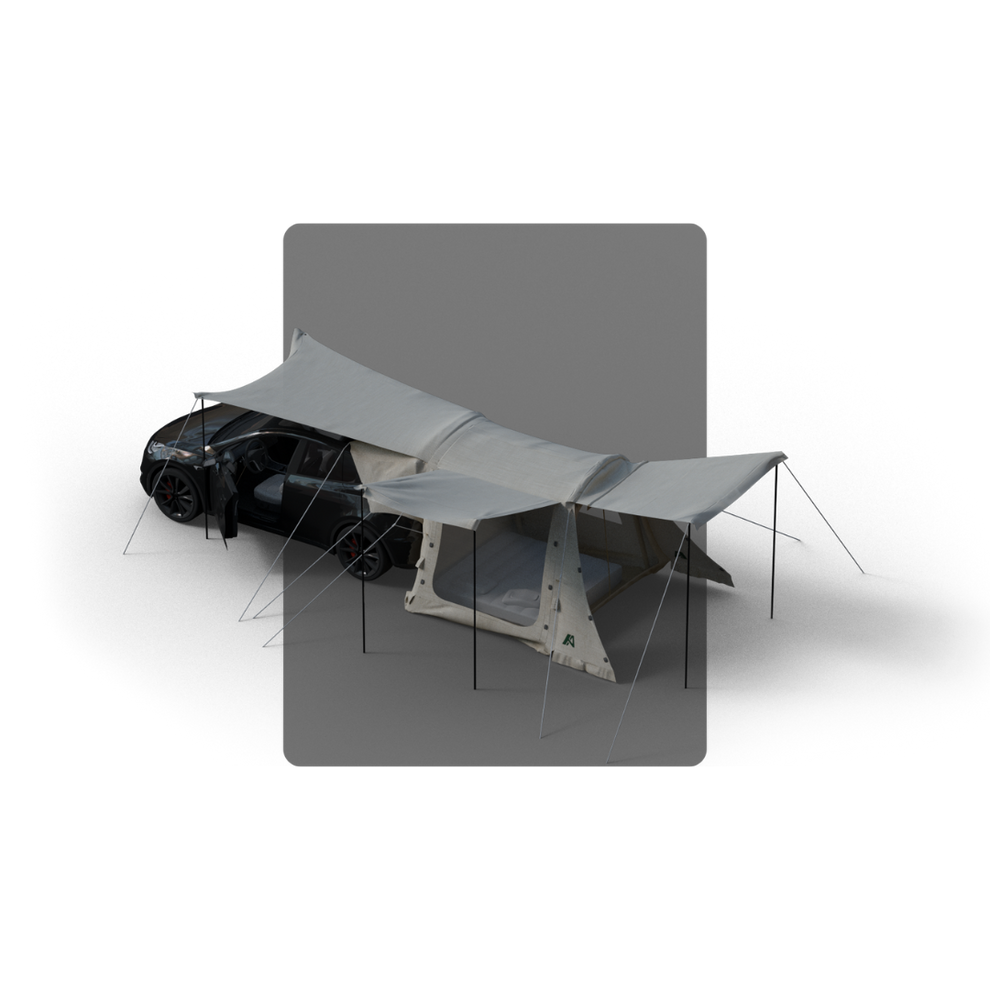
TENTSLA X1 Tesla Camping Tent
Compatible with Tesla Model 3, Model Y, and Model X
The TENTSLA X1 is the ultimate structural upgrade for the Best Places to Camp in a Tesla. Engineered specifically to mate with the aerodynamic hatch contours of Tesla vehicles, it turns your car into a multi-room luxury basecamp.
Premium Weather-Resistant Construction:
| Material | Application |
|---|---|
| 210D Oxford Fabric | Inner Fabric |
| 420D Oxford Fabric | Outer Fabric & Floor Fabric |
| Aluminum | Support Poles |
| Steel | Tent Pegs |
| Silver Coated Fabric | UV Protection & Heat Insulation |
Fast Inflatable Installation:
Tentsla’s advanced inflatable air-frame system enables fast and effortless setup in just a few minutes. Simply inflate the structure, secure the tent, and start enjoying your outdoor experience without the hassle of traditional tent assembly.
Expert Recommendation from TENTSLA
In most professional situations, sleeping confined strictly inside the rear cabin of your car works for a single night at a highway rest stop, but it ruins a multi-day wilderness vacation. Overlanding is about expanding your living space, enjoying the outdoors, and having room to cook, stand, and relax while keeping the vehicle's clean interior protected.
We recommend pairing your EV with the Best Tesla Camping Gear before heading to any of the 7 destinations listed above. By combining an inflatable air-frame shelter like the TENTSLA X1 with a dedicated trunk mattress, you leverage your vehicle's clean battery power to enjoy a premier Tesla Camping Experience that traditional gas vehicles simply cannot deliver. Explore our complete line of purpose-built gear and master the modern frontier.
Frequently Asked Questions (FAQ)
Authoritative Industry References
For verified public land camping regulations, backcountry permits, and EV charging infrastructure maps, consult these official organizations:
- National Park Service (NPS) - Official campsite reservation guidelines, wildlife safety protocols, and park-specific vehicle regulations.
- Bureau of Land Management (BLM) - Guidelines for dispersed dry camping on United States public lands and Leave No Trace principles.
- U.S. Department of Energy (AFDC) - Comprehensive mapping of public alternative fueling stations and national electric vehicle charging corridors.