


The electric vehicle revolution has fundamentally altered how we interact with the great outdoors. Gone are the days of sweating through a humid summer night in a stifling nylon tent or shivering in a sleeping bag while winter winds howl outside. Tesla single-handedly transformed car camping from an uncomfortable compromise into a premium glamping experience with the introduction of its proprietary climate control features. However, as the used EV market expands and new buyers enter the ecosystem, a critical question frequently arises: Do all Teslas have camping mode?

From our experience outfitting thousands of EV owners with premium outdoor gear at TENTSLA, there is an immense amount of confusion surrounding Tesla's software capabilities. Whether you are looking to purchase a used 2018 Model 3 or taking delivery of a brand-new Cybertruck, understanding the precise mechanical limitations of your vehicle is paramount before heading off-grid. In this comprehensive, practitioner-led guide, we will cut through the noise, explain exactly how this software operates, detail its impact on your battery, and provide you with commercial and practical judgment on how to optimize your setup.
Quick Answer: Which Teslas Have Camp Mode?
Yes, virtually all modern Teslas have camping mode. Specifically, any Tesla Model S, Model 3, Model X, Model Y, or Cybertruck running software version 2019.40.50 or newer features the dedicated "Camp Mode" interface. The only exceptions are legacy Model S and Model X vehicles (typically pre-2013) that lack the updated MCU (Media Control Unit) hardware to run modern software. However, even these older models possess a "Keep Climate On" feature that mimics the core heating and cooling functionality necessary for overnight sleeping.
Table of Contents
- What is Tesla Camp Mode?
- How Camp Mode Actually Works
- The Unmatched Benefits of EV Camping
- Limitations and Battery Drain Realities
- Who Should Use It & Who Doesn't Need It
- Comparison: Camp Mode vs Dog Mode vs Keep Climate
- Common Mistakes Rookie Campers Make
- Buying Considerations for Tesla Camping
- Pros and Cons of Sleeping in Your Tesla
- Expert Recommendation: The TENTSLA X1
- Frequently Asked Questions (FAQ)
What is Tesla Camp Mode?
Camp Mode is a specialized software protocol designed to maintain optimal cabin conditions for extended periods while the vehicle is parked. Introduced in late 2019, it solved a major pain point for EV owners. Prior to this update, sitting idle in a parked Tesla for long periods would eventually cause the car's computers to go to sleep, shutting down the touchscreen, disabling the USB ports, and turning off the air conditioning.
Camp Mode overrides the vehicle's standard sleep cycle. It keeps the high-voltage battery engaged to run the HVAC system, maintains power to the 12V and USB outlets for charging devices, allows the infotainment system to play music or stream video, and displays a mesmerizing digital campfire on the center console. In most professional situations involving overland travel, this software is the single greatest asset an EV owner possesses.
How Camp Mode Actually Works
To engage Camp Mode, your Tesla must be in "Park." Tap the fan icon at the bottom of the touchscreen to bring up the climate menu, and simply tap the "Camp" icon located on the right side of the panel. Once activated, the vehicle undergoes several mechanical changes:
- Continuous Airflow: The HVAC system bypasses its normal auto-shutoff timer. If you are driving a newer Model Y or Model 3 equipped with the Octovalve heat pump, the system hyper-efficiently scavenges heat from the battery pack and drivetrain to warm the cabin, drastically reducing power consumption compared to older models with resistive PTC heaters.
- Power Management: The DC-to-DC converter remains active, ensuring that your low-voltage accessory ports (12V sockets and USB-C ports) receive continuous power. This is crucial for running a CPAP machine, a portable refrigerator, or a Portable Air Pump for Tent setups.
- Security Overrides: Camp Mode automatically disables Sentry Mode and the vehicle's internal intrusion sensors. This prevents the car alarm from triggering while you toss and turn in your sleep.
Crucial Safety Mechanism: Camp Mode will automatically disable itself if the high-voltage battery drops to 20%. This is a hard-coded failsafe ensuring you are never stranded in the wilderness without enough range to reach a Supercharger.
The Unmatched Benefits of EV Camping

The primary advantage of camping in a Tesla is absolute climate control. We have interviewed overlanders who previously relied on diesel idling or noisy, fume-producing portable generators to stay warm in the winter. A Tesla accomplishes this silently and with zero tailpipe emissions, meaning you can sleep securely with the windows rolled up.
Furthermore, the acoustic insulation of the Tesla cabin provides an incredible barrier against noisy campsites and wildlife. By utilizing a comprehensive Tesla Model Y Camp Mode Guide, users can leverage the premium audio system to play ambient white noise or stream movies on Netflix before falling asleep, completely redefining the rugged outdoor experience.
Limitations and Battery Drain Realities
We believe in applying commercial and practical judgment; relying on Camp Mode requires logistical planning. It is not magic; running a compressor to generate heat or air conditioning requires significant energy.
In our testing, determining Tesla Camping Mode Battery Drain depends entirely on ambient weather conditions. In a mild 65°F (18°C) environment where the car is simply circulating air, you can expect to lose about 10% to 15% of your battery over an 8-hour sleep. However, if you are camping in 20°F (-6°C) winter weather, the battery must actively heat both the cabin and its own thermal mass to prevent cell damage. In freezing conditions, expect to drain 25% to 35% of your battery overnight. If you pull into a remote campsite with only 40% battery remaining, you risk waking up to a disabled climate system.
Who Should Use It & Who Doesn't Need It
For commercial users and serious adventurers: If you are a digital nomad, a landscape photographer, or someone embarking on cross-country road trips, utilizing Camp Mode alongside a Car Camping Tent for Tesla will save you thousands of dollars in hotel fees annually. It turns your vehicle into a mobile, climate-controlled command center.
Who does not need it: If you are merely looking to take a quick 20-minute nap at a rest stop or wait in the car while your spouse shops, Camp Mode is overkill. You should simply use the "Keep Climate On" function, which maintains temperature but turns off the screen and accessory ports to conserve energy.
| Feature | Camp Mode | Dog Mode | Keep Climate On |
|---|---|---|---|
| Primary Purpose | Human sleeping / prolonged occupancy | Keeping pets safe while parked | Short absences / preserving groceries |
| Screen Display | Campfire animation & media access | Large temperature display message | Screen turns off to save power |
| 12V / USB Power | Stays ON | Turns OFF | Turns OFF |
| Internal Alarm Sensors | Disabled (so humans can move) | Disabled (so pets can move) | Active |
Common Mistakes Rookie Campers Make
From our experience, first-time EV campers consistently make a few critical errors that ruin their night. The most common is failing to level the vehicle. The seats in a Model 3 or Model Y fold down, but they retain a slight incline. If you park on a slope facing downward, blood will rush to your head, making sleep impossible. Always carry small RV leveling blocks.
Secondly, human respiration generates significant moisture. If you sleep inside the sealed cabin with two adults, the windows will be dripping with condensation by morning. You must either crack the windows slightly (which defeats the purpose of the climate control in extreme weather) or rely on the vehicle's AC compressor to act as a dehumidifier.
Buying Considerations for Tesla Camping
Is the car alone actually enough to camp comfortably? In most professional situations, the answer is no. While the folded seats offer adequate length for individuals up to 6 feet tall, the cabin lacks vertical headroom and storage space. If you have two adults and their luggage inside the car, claustrophobia sets in rapidly.
To make this a viable, long-term lifestyle choice, you must expand your footprint. You will require a custom-cut memory foam mattress tailored to the contours of the trunk, privacy window shades to block out morning light, and crucially, an extension tent. Attaching a tailgate tent allows you to leave your muddy boots, coolers, and gear outside the vehicle, reserving the pristine, climate-controlled cabin strictly for sleeping.
| The Pros | The Cons |
|---|---|
| Silent, emission-free heating and air conditioning all night long. | Drains high-voltage battery; requires careful range management in the cold. |
| Continuous power to charge laptops, drones, and camera gear. | Internal cabin space is highly restrictive for gear storage and changing clothes. |
| Exceptional security with doors locked and windows up in remote areas. | Condensation buildup on windows if ventilation isn't managed properly. |
| Massive cost savings compared to booking hotels on road trips. | Rear seats do not fold perfectly flat, requiring a specialized mattress pad. |
Expert Recommendation: Elevate Your Setup
We recommend approaching Tesla camping as a hybrid system. The car provides the life-support (climate and power), but you require external hardware to provide the living space. Trying to cram two people, a dog, and a weekend's worth of supplies into the back of a Model Y is an exercise in frustration. If you are serious about Tesla Camping Setup optimization, you must invest in a dedicated tailgate tent.
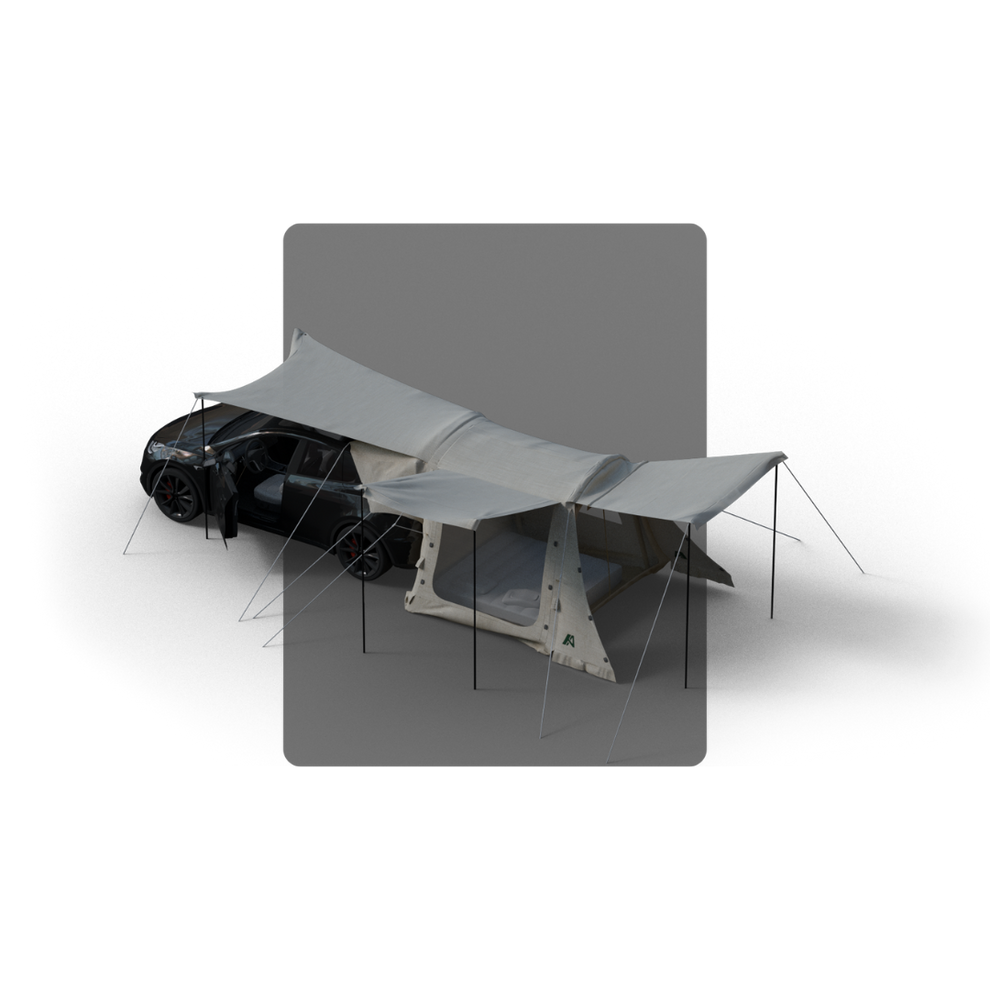
By connecting the Tentsla X1 to your vehicle, you create a seamless flow between the climate-controlled sleeping quarters of your Tesla and a spacious, weather-resistant living room. It transforms the question from "can I survive sleeping in my car?" to "how long can I stay off the grid?" For owners of sedans, we also highly recommend checking out our specific solutions for the Tesla Model 3 Camping Tent.
Frequently Asked Questions (FAQ)
Yes, all modern Teslas currently in production (Model 3, Model Y, Model S, Model X, and Cybertruck) come standard with Camp Mode, provided they are running software version 2019.40.50 or later. Some legacy vehicles built before 2013 without the necessary MCU upgrades may lack the visual campfire interface, but can still utilize the 'Keep Climate On' function.
In moderate weather (around 65°F), Camp Mode typically consumes about 1% to 1.5% of battery per hour. In extreme cold, where the vehicle must actively heat the cabin and the battery pack, consumption can rise to 3% to 4% per hour. We recommend plugging into an RV outlet to entirely negate this draw.
Camp Mode is designed to stay on continuously as long as the vehicle has sufficient charge. However, as a safety protocol, Camp Mode will automatically disable if the high-voltage battery drops below 20% to ensure you have enough range to reach a charging station.
Authoritative Industry References
- U.S. Department of Energy (DOE) - Research regarding electric vehicle efficiency, high-voltage battery safety, and emission-free idle benefits.
- Tesla Official Owners Manual - Technical documentation detailing software restrictions, HVAC operation, and the 20% battery failsafe mechanism for Camp Mode.
- MotorTrend - Independent automotive testing and analysis of EV lifestyle trends, battery drain metrics during overlanding, and interior ergonomics.