

Is It Illegal to Sleep in a Tesla While Driving? The Definitive Legal and Safety Guide
Oct 27, 2026

Every few months, a viral video surfaces on social media showing a driver reclined in the driver's seat of a Tesla, seemingly fast asleep while the vehicle hurtles down an interstate at 75 miles per hour. Viewers are often torn between awe at the technology and sheer terror at the safety implications. As the premier brand specializing in turning electric vehicles into ultimate outdoor basecamps, we are intimately familiar with how comfortably you can sleep in a Tesla. However, the context of when and how you sleep makes the difference between a relaxing camping trip and a catastrophic legal liability. The primary question on the minds of new EV owners is clear: Is it illegal to sleep in a Tesla while driving?

The short answer is an absolute, unequivocal yes. In the automotive industry, relying on current autonomous systems as a substitute for human consciousness is not a "life hack"—it is a dangerous misinterpretation of engineering parameters. From our experience evaluating vehicle systems for our outdoor gear integrations, treating a Level 2 driver-assist suite as a chauffeur is a direct path to criminal negligence charges. In this comprehensive guide, we will analyze the engineering limitations of Autopilot, explore the severe legal ramifications of sleeping behind the wheel, and explain the correct, legal, and highly comfortable way to sleep in your EV using features designed explicitly for stationary rest.
Quick Answer: Is it illegal to sleep in a Tesla while driving?
Yes, it is 100% illegal in all 50 U.S. states and globally. Regardless of whether you have standard Autopilot, Enhanced Autopilot, or Full Self-Driving (FSD) engaged, you are operating a 4,000-pound motor vehicle. Tesla's systems are classified as SAE Level 2 Advanced Driver Assistance Systems (ADAS), meaning the human driver must remain awake, alert, and legally responsible for the vehicle at all times. Sleeping while moving constitutes reckless driving and, in many jurisdictions, driving under the influence (if intoxication is involved) or gross negligence. The only legal way to sleep in a Tesla is to pull over, shift into Park, activate Camp Mode, and rest safely.
Article Directory
- What It Is: Autopilot vs. Full Self-Driving Automation Levels
- Quick Summary Table: Active Driving vs. Camp Mode
- How It Works: How Tesla Detects Sleeping Drivers
- The Legal Reality: Reckless Driving and Liability
- Direct Technical Comparison: SAE Autonomy Levels
- The Genuine Benefits of Tesla Driver-Assist Systems
- Severe Limitations of Sleeping Behind the Wheel
- Pros and Cons Table: Autopilot vs. Stationary Camping
- Who Should Use Autopilot vs. Who Should Use Camp Mode
- 5 Costly Mistakes Drivers Make with Tesla Autopilot
- Buying Considerations: Transitioning from Driving to Camping
- Featured Innovation Spotlight: TENTSLA X1 Camping Tent
- Expert Recommendation: The Safe Way to Rest
- Frequently Asked Questions
- Authoritative References & Legal Standards
What It Is: Autopilot vs. Full Self-Driving Automation Levels
To understand why asking is it illegal to sleep in a Tesla while driving yields such a strict legal response, you must understand the engineering classifications of autonomous vehicles. The global standard for vehicle automation is established by SAE International, ranging from Level 0 (no automation) to Level 5 (full automation under all conditions without human intervention).
Despite the ambitious marketing names—"Autopilot" and "Full Self-Driving" (FSD)—every Tesla currently on the road operates as an SAE Level 2 system. A Level 2 system provides simultaneous steering and acceleration/braking support, but it inherently requires the human driver to perform the "dynamic driving task fallback." This means the car is driving, but you are supervising. You are legally required to maintain situational awareness because the software can and will encounter edge cases—such as construction zones, unpredictable pedestrians, or faded lane lines—that it cannot process safely.
In most professional situations, treating a Level 2 system like a Level 5 system is the equivalent of climbing into the back seat of a moving taxi that has no driver. It is not an autonomous chauffeur; it is an advanced cruise control.
Quick Summary Table: Active Driving vs. Camp Mode
| Activity | Vehicle Status | System Utilized | Legality | Safety Profile |
|---|---|---|---|---|
| Sleeping While Driving | Moving in Drive (D) | Autopilot / FSD Beta | Strictly Illegal (Reckless Driving) | Critically Dangerous (Fatal crash risk) |
| Sleeping Parked Safely | Stationary in Park (P) | Camp Mode / Climate Keep | 100% Legal (Where parking is permitted) | Extremely Safe (Zero tailpipe emissions) |
| Driver Inattention / Texting | Moving in Drive (D) | Autopilot / FSD Beta | Illegal (Distracted Driving) | High Risk (Delayed reaction time) |
| Resting in Passenger Seat | Stationary in Park (P) | Camp Mode | Legal | Safe |
How It Works: How Tesla Detects Sleeping Drivers
Tesla is fully aware that human nature tempts drivers to disengage. To combat this, the software architecture actively works to prevent you from sleeping. If you attempt to fall asleep, the vehicle's internal safety mechanisms will trigger a "strikeout" protocol.
In our testing of the latest software builds, Tesla utilizes a two-pronged approach to driver monitoring:
- Torque Sensors on the Steering Wheel: The vehicle measures rotational resistance on the steering column. If you do not apply slight torque to the wheel periodically, the screen flashes a blue warning.
- Cabin Camera Eye-Tracking: Mounted above the rearview mirror, the interior cabin camera uses neural networks to monitor head position, eye gaze, and eyelid closure. If the camera detects that you are looking down at a phone or that your eyes are closed, it immediately initiates an escalating warning cascade.
If you fail to respond to the visual and auditory warnings (which become aggressively loud), the vehicle will forcefully disengage Autopilot, decelerate safely within its lane, activate the hazard lights, and bring the car to a complete stop. You will then be locked out of using Autopilot for the remainder of that drive. For commercial users or high-mileage commuters, trying to trick these systems is futile and results in permanent bans from the FSD Beta program.
The Legal Reality: Reckless Driving and Liability
Let us address the legal framework directly. When people ask, is it illegal to sleep in a Tesla while driving, they often search for a loophole regarding "autonomous driving laws." There is no loophole. Under the jurisdiction of the National Highway Traffic Safety Administration (NHTSA) and state-level vehicle codes, the human in the driver's seat is the sole legal operator of the vehicle.
If law enforcement observes you sleeping while your Tesla is moving, you will face severe charges:
- Reckless Driving: Operating a vehicle with a willful or wanton disregard for the safety of persons or property. This is a misdemeanor that carries heavy fines, points on your license, and potential jail time.
- Distracted Driving Statutes: Every state has laws requiring active control of a motor vehicle.
- DUI/DWI Escalation: If you fell asleep because you were intoxicated and assumed Autopilot would get you home safely, you will be charged with a DUI. A vehicle on Autopilot is legally no different than a standard car when evaluating intoxicated operation.
Direct Technical Comparison: SAE Autonomy Levels
| SAE Level | System Classification | Human Driver Role | Can You Sleep? |
|---|---|---|---|
| Level 1 | Driver Assistance (e.g., Basic Cruise Control) | Must drive and monitor environment | No |
| Level 2 | Partial Automation (e.g., Tesla Autopilot/FSD) | Must monitor environment & take control | Absolutely Not |
| Level 3 | Conditional Automation | Must be ready to intervene upon request | No (Must remain alert) |
| Level 4 | High Automation (e.g., Waymo Geofenced Taxis) | No intervention needed in specific areas | Yes (If designed as a passenger vehicle) |
| Level 5 | Full Automation (Theoretical future) | Passenger only; no steering wheel required | Yes |
The Genuine Benefits of Tesla Driver-Assist Systems
While we adamantly condemn sleeping while driving, we must acknowledge why these systems exist. Autopilot and FSD are phenomenally powerful tools for driver fatigue reduction, not driver replacement.
When executing a 500-mile road trip, maintaining lane center and micro-adjusting speed in stop-and-go traffic induces massive cognitive fatigue. Autopilot offloads this micro-processing from the human brain. You arrive at your destination significantly more refreshed, with fewer cramped muscles and less mental exhaustion. It is a safety net designed to keep you centered and prevent rear-end collisions if your attention lapses for a fraction of a second. It is a co-pilot, not a replacement pilot.
Severe Limitations of Sleeping Behind the Wheel
The limitations of current autonomous software highlight exactly why it is a fatal mistake to sleep. Tesla’s architecture relies purely on "Tesla Vision" (optical cameras) after the removal of radar and ultrasonic sensors.
Vision systems are incredible, but they suffer from specific physical limitations:
- Direct Sun Glare & Heavy Precipitation: A camera blinded by low winter sun or torrential rain can instantly disable Autopilot, throwing control back to the driver. If you are asleep, the car will veer.
- Phantom Braking: The system may misinterpret a shadow from an overpass as a physical obstacle, slamming on the brakes at highway speeds. An alert driver simply overrides the braking with the accelerator pedal; a sleeping driver becomes a target for a rear-end collision from following semi-trucks.
- Stationary Object Detection: Level 2 systems historically struggle to identify stationary objects (like a stopped fire truck partially in a lane) when approaching at high speeds. Your active supervision is the only thing preventing a catastrophic impact.
Pros and Cons Table: Using Autopilot vs. Sleeping in Park (Camp Mode)
| Activity | Operational Advantages (Pros) | Operational Liabilities (Cons) |
|---|---|---|
|
Using Autopilot Actively (Awake and Supervising) |
|
|
|
Sleeping in Park via Camp Mode (Stationary EV Camping) |
|
|
Common Mistakes Drivers Make with Tesla Autopilot
Safety Advisory: The "Defeat Device" Danger
The most dangerous mistake a driver can make is purchasing an aftermarket steering wheel weight (often called an Autopilot "defeat device" or "nagger"). These metal weights trick the steering column into sensing hands on the wheel. Using these devices disables the primary safety interlock of the vehicle. If you fall asleep with a defeat device attached, the car will not wake you up, and it will not pull over. It will simply drive until it encounters a situation it cannot handle, resulting in high-speed impact. Never use defeat devices.
- Treating FSD Beta as Level 4 Autonomy: Assuming that because the car can navigate city streets, stop at red lights, and make turns, you do not need to watch the road. FSD Beta requires more supervision than highway Autopilot, not less.
- Ignoring the "Cabin Camera Blocked" Warning: Placing tape over the interior cabin camera. Tesla software now heavily penalizes covered cameras, frequently disabling automated features entirely until the lens is cleared.
- Failing to Clean Exterior Cameras: Autopilot relies on pristine optics. If your B-pillar cameras or windshield are covered in salt, mud, or bug splatter, the system will degrade or refuse to engage.
Buying Considerations: Transitioning from Driving to Camping
So, you are exhausted on a road trip, and you cannot legally or safely sleep while driving. What is the solution? You transition from driver to camper. Electric vehicles like the Model 3, Model Y, Model S, and Model X are fundamentally the greatest camping vehicles ever engineered. Because there is no internal combustion engine, you can run the climate control system overnight without fear of carbon monoxide poisoning.
When you are ready to rest, pull into an RV park, a designated rest stop, or a campsite, and engage Camp Mode. As outlined in our Tesla Model Y Camp Mode Guide, this feature keeps the HVAC system running, maintains airflow, and powers the 12V/USB outlets.
To do this comfortably, you must upgrade your interior hardware. Sleeping on a folded-down seat without padding is miserable. We recommend investing in a dedicated Tesla Camping Mattress cut specifically to match the contours of the Model Y or Model 3 trunk space. Once you realize how comfortable the cabin is, the logical next step is expanding your footprint to accommodate gear, pets, or extra passengers by attaching a premium tailgate tent.
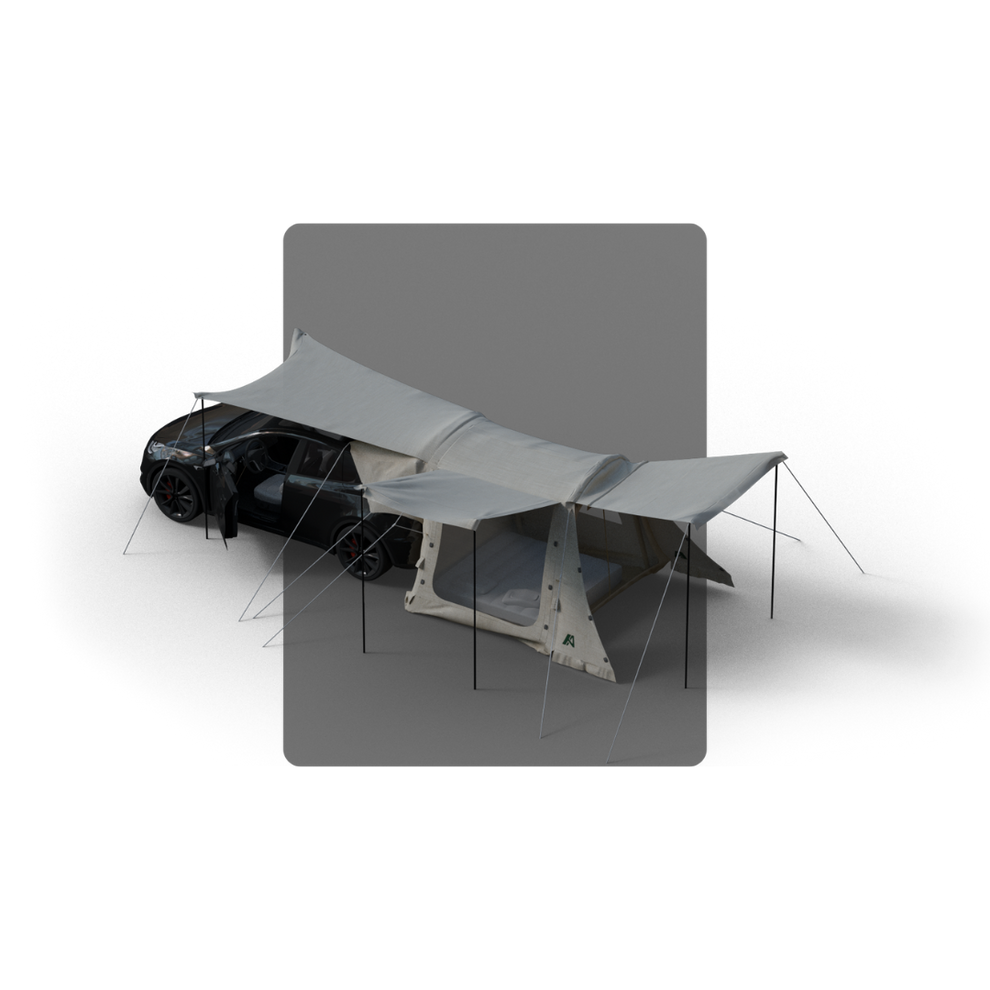
Outdoor Gear Spotlight: TENTSLA X1 Tesla Camping Tent
Don't sleep dangerously on the highway. Pull over, deploy the TENTSLA X1, and turn your Tesla into a luxury outdoor basecamp. Compatible with Model Y, Model 3, and Model X, the X1 seamlessly attaches to your open tailgate, utilizing the EV's climate control to heat or cool the expanded living space.
| Air-Frame Technology | Fast inflatable structure completely replaces fiberglass poles; setup takes less than 5 minutes with the included pump. |
| Outer Shell Material | Rugged 420D Oxford Fabric with Silver Coating for ultimate UV protection and heat insulation. |
| Inner Fabric | Breathable 210D Oxford Fabric ensuring optimal ventilation without condensation buildup. |
| Weather Resistance | Heavy-duty waterproof construction designed to withstand severe outdoor elements and heavy rain. |
| Hardware Integration | Aviation-grade aluminum support poles for awnings and heavy-duty steel tent pegs for structural grounding. |
Outdoor Expert's Advice: Maximize your EV's true potential. Stop looking for driving shortcuts and start enjoying the destination. Explore the Premium Tesla Camping Tent today, upgrade your comfort with a dedicated Tesla Camping Air Mattress, and discover our full line of Tesla Tent Accessories to complete your setup.
Expert Recommendation: The Safe Way to Sleep in Your EV
From our experience engineering outdoor integration systems for the Tesla ecosystem, the conclusion is absolute: sleeping while your Tesla is in Drive is a criminal liability and a severe risk to public safety. However, sleeping in your Tesla while it is parked is an unparalleled luxury.
If you are embarking on cross-country travel, we recommend planning your stops. Instead of pushing through fatigue, locate a scenic campground or safe overnight parking zone. Engage Camp Mode, unroll your custom mattress, and deploy a Popular Tesla Camping Tent like the TENTSLA X1. By expanding the rear hatch, you integrate the precise temperature control of the Tesla HVAC system directly into a spacious, weather-resistant living area. You gain a massive annex for changing clothes, storing gear, or relaxing with friends. For commercial users traveling between job sites, or couples exploring national parks (yes, you absolutely can Sleep Two Adults in Tesla Model Y), this method transforms the vehicle from a mere transportation appliance into a mobile hotel room.
Frequently Asked Questions
Yes, it is strictly illegal in all 50 U.S. states and internationally to sleep while driving a Tesla. Law enforcement categorizes this as reckless driving, and in many jurisdictions, it can lead to immediate license suspension, heavy fines, and even vehicle impoundment.
No. Tesla Autopilot and Full Self-Driving (FSD) are classified as SAE Level 2 Advanced Driver Assistance Systems (ADAS). They require a fully alert, licensed driver behind the wheel ready to take over steering or braking at any fraction of a second.
Tesla utilizes steering wheel torque sensors to detect hand resistance and a cabin camera mounted above the rearview mirror to track eye movement and head position. If the system detects inattentiveness or closed eyes, it issues escalating audio-visual warnings, eventually disabling Autopilot and safely bringing the vehicle to a halt with hazard lights on.
The legal and safe way to sleep in a Tesla is to park the vehicle in a designated rest area or campsite, shift into Park, and engage Camp Mode. This maintains climate control and airflow while parked. Enthusiasts often pair this with a custom mattress and an exterior extension like the TENTSLA X1 camping tent.
Authoritative References & Legal Standards
- National Highway Traffic Safety Administration (NHTSA): Automated Vehicles for Safety – Federal Guidelines on Driver Distraction and ADAS Supervision
- SAE International: Levels of Driving Automation (J3016) – Definitions for Level 2 Partial Driving Automation
- Insurance Institute for Highway Safety (IIHS): Safeguards for Partial Automation – Driver Monitoring Systems and Safety Protocols