

8 Best Rear Car Tents in 2026: Practical Picks for SUV, Hatchback and Tesla Camping
Nov 09, 2026

A rear car tent can turn an ordinary parking spot into a sheltered campsite, but not every product marketed as a car tent is suitable for sleeping, extended camping, or every vehicle. Some are little more than tailgate awnings. Others are full-size tents that connect to an SUV hatch and add a separate living area. A smaller group uses vehicle-specific connectors or inflatable frames to create a more integrated camping setup.
Our position is straightforward: buy according to how you actually camp, not the largest capacity number on the product listing. A compact rear hatch shelter is usually the smarter purchase for quick stops and warm-weather trips. Families who spend several nights at a campsite should consider a full SUV tent with a rainfly, proper ventilation, and enough floor space. Tesla owners have another consideration: the tent must work with the vehicle's rear access, sleeping arrangement, and climate-management routine.

Quick Answer: Which Rear Car Tent Is Best in 2026?
Best full-size SUV tent: Napier Sportz SUV Tent 82000. Choose it if you want a separate 9 x 9 ft camping room connected to your SUV.
Best budget full-size option: Napier Backroadz SUV Tent. Its 10 x 10 ft footprint and straightforward pole design offer strong practical value.
Best quick tailgate shelter: Napier Sportz Cove. It is a compact shade and privacy extension, not a replacement for a full sleeping tent.
Quick Summary: 8 Best Rear Car Tents at a Glance
| Product | Best for | Design type | Our verdict |
|---|---|---|---|
| TENTSLA X1 | Tesla Model 3, Model Y and Model X camping | Vehicle-specific inflatable camping tent | Best Tesla-integrated choice |
| Napier Sportz SUV Tent 82000 | Families and longer SUV trips | Full-size rear-connected tent | Best overall traditional SUV tent |
| Napier Backroadz SUV Tent 19100 | Value-focused SUV campers | Full-size pole tent | Best value for a roomy campsite |
| Napier Sportz SUV Tent 84000 | Families needing extra covered space | Large tent with screen room | Best for group camping |
| Napier Sportz Cove | Day trips, tailgating and quick stops | Compact hatch shelter | Best quick-deploy option |
| Kelty Caboose 4 | Flexible tailgate camping | Hybrid freestanding tent and vehicle awning | Best versatile hybrid |
| Napier Sportz Dome-To-Go 86000 | Hatchbacks and compact CUVs | Compact vehicle-connected shelter | Best small-vehicle category to investigate |
| JOYTUTUS 5–9 Person Dual-Room SUV Tent | Large groups and family basecamps | Multi-room rear-connected tent | Best budget-oriented large layout |
These are not eight interchangeable tents. Some create a full sleeping room, while others provide shade or a vehicle-specific extension. We have separated those use cases rather than pretending a small tailgate awning offers the same protection and space as a full SUV tent.
1. How We Evaluate the Best Rear Car Tents
A rear car tent needs to do more than attach to a vehicle. It should create a useful sheltered area without making access to the car awkward or turning every setup into a long assembly project. For this guide, we assess products by their intended use and published specifications, with particular attention to five practical factors.
- Vehicle compatibility: Does the design fit a liftgate, hatchback, CUV, SUV, minivan, or a specific Tesla configuration? Does the manufacturer identify the compatible vehicle types?
- Weather protection: Look for a rainfly, taped seams, storm flaps, suitable fabric coating, and a stable anchoring system. A water-resistant fabric description alone is not enough.
- Setup and pack-down: Pole count, inflatable beams, attachment straps, and packed dimensions all affect how convenient the tent is on a road trip.
- Usable space: Sleeping capacity is only one part of the equation. Headroom, floor dimensions, ventilation, gear storage, and door access matter just as much.
- Independent use: A tent that can stand alone after detaching from the car is useful when you want to drive away from the campsite during the day.
We distinguish between manufacturer-published specifications and independent performance testing. The dimensions, prices, and feature descriptions below should be checked against the current listing before purchase because product configurations and availability can change. We do not treat a marketing claim such as "universal fit" as proof that a tent will seal properly around every vehicle.
2. The 8 Best Rear Car Tents in 2026
1. Best for Tesla owners
TENTSLA X1 Tesla Camping Tent
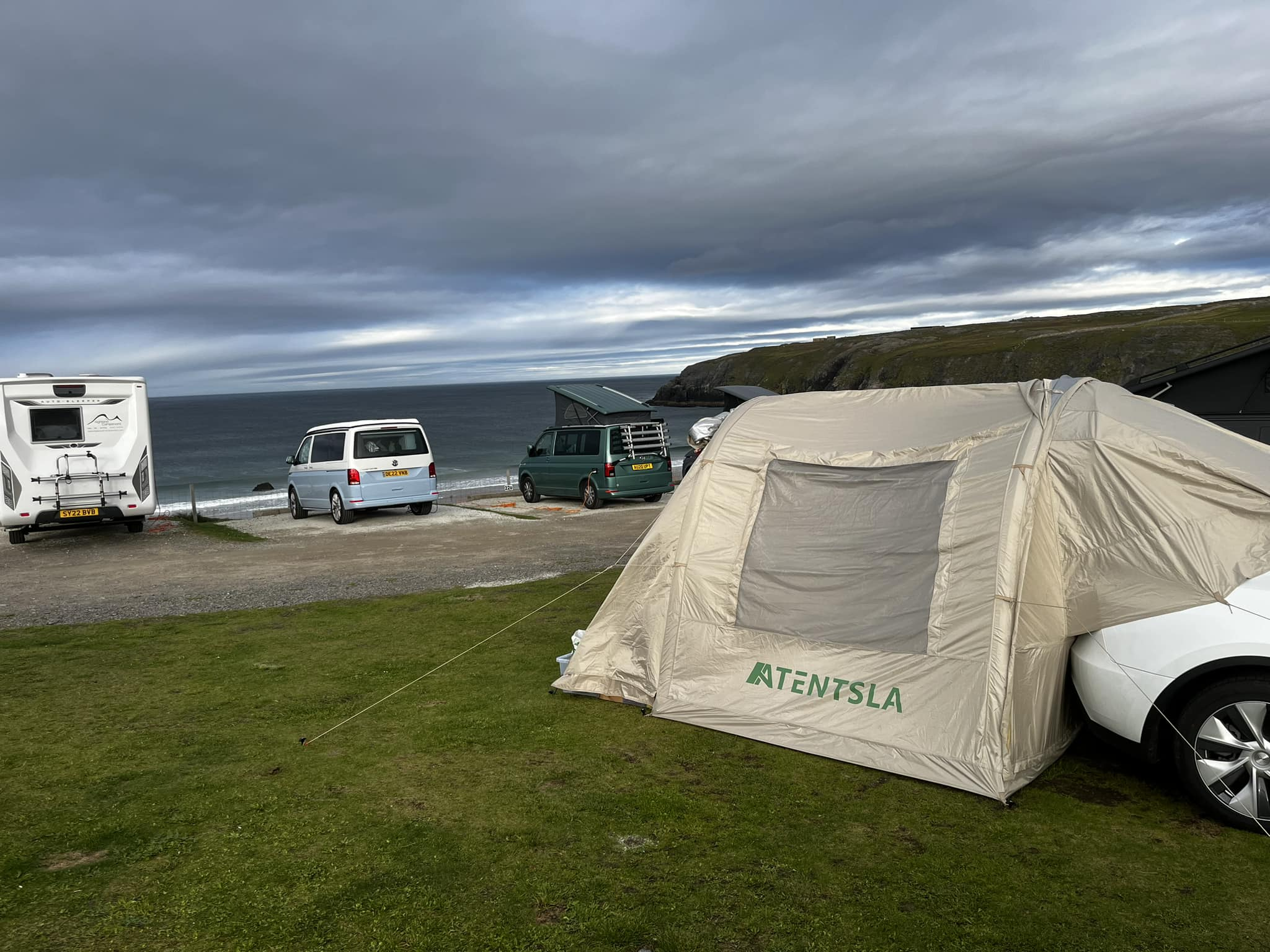
The TENTSLA X1 is the strongest choice in this list for Tesla owners who want a camping system designed around their vehicle rather than a generic tent sleeve. The current product configuration lists Tesla Model Y, including Juniper, and the brand also positions the X1 for Model 3 and Model X. Confirm the exact model-year and connector configuration before ordering.
Its key distinction is the inflatable air-frame installation. Instead of assembling a conventional tent frame from multiple long poles, users inflate the structure and secure the tent. The published product details also identify a Tesla trunk connector, a windshield connector, side and rear access, mosquito netting, and a weather-resistant design. The brand lists room for up to four people, although actual sleeping comfort depends on the selected bed arrangement and how much equipment you bring.
- Best for: Tesla owners who want an integrated vehicle camping setup.
- Standout features: Inflatable frame, vehicle-specific connectors, access points, mesh windows, and portable storage.
- Limitations: It is a specialized purchase rather than a universal rear hatch tent. Compatibility and setup configuration need checking before purchase.
- Our verdict: The best match for Tesla-focused camping, especially when a vehicle-specific connection is more important than buying the largest freestanding shelter.
At the listed price of $649, it costs more than basic tailgate shelters. That premium makes sense when you will use the vehicle-specific system regularly. For an occasional beach shade stop, it is more equipment than you need.
2. Best overall traditional SUV tent
Napier Sportz SUV Tent 82000
The Napier Sportz 82000 is a better choice for buyers who want a conventional full-size camping room attached to an SUV or minivan. Its 9 x 9 ft floor area and reported 7.25 ft center height give campers room to move around, organize equipment, and use the vehicle cargo area as part of the campsite.
The design uses a vehicle sleeve, a full rainfly with taped seams, storm flaps, mesh windows, and multiple doors. It can also be detached from the vehicle and used as a traditional ground tent. That last feature is more valuable than it first appears: if you need to drive to a trailhead or town, you do not necessarily have to dismantle the entire campsite.
- Best for: Families, road trips, and multi-night SUV camping.
- Standout features: 9 x 9 ft floor, 5-person stated capacity, ventilation, rainfly, and standalone use.
- Limitations: A pole-based tent still takes more setup effort than a compact hatch shelter, and its 37 lb published weight is not especially light.
- Our verdict: A strong all-round choice when you want a real camping room rather than a simple tailgate cover.
3. Best value full-size SUV tent
Napier Backroadz SUV Tent 19100
The Backroadz is a sensible purchase for buyers who want a roomy tent without paying for a larger screen-room configuration. Its published specification includes a 10 x 10 ft footprint, 88-inch center height, capacity for up to five people, and a universal vehicle sleeve for CUVs, SUVs, and minivans.
It uses a relatively straightforward pole structure, a full rainfly with taped seams, storm flaps, and mesh windows. The listed waterproof coating is 1500 mm PU. That specification should be considered alongside the rainfly and seam construction rather than treated as a guarantee of performance in every storm.
- Best for: Budget-conscious families who still want a large floor area.
- Standout features: 10 x 10 ft floor, simple pole layout, vehicle access, and rainfly.
- Limitations: No dedicated screen room or included awning, and the one-door layout is less flexible than some larger models.
- Our verdict: A practical value pick for normal three-season camping. Spend more only if you genuinely need the additional room or features.
4. Best for family groups and extra living space
Napier Sportz SUV Tent 84000 with Screen Room
If you regularly camp with children, friends, or a large amount of equipment, a screen room can be more useful than simply adding another sleeping place. The Sportz 84000 combines a 10 x 10 ft main tent with an attached 7 x 6 ft floorless screen room. The additional covered area is useful for muddy footwear, chairs, outdoor meals, and gear that should not occupy the sleeping space.
The published specification lists a capacity of up to six people, more than seven feet of headroom, mesh windows, ceiling vents, and a full rainfly with taped seams. It also includes an awning option and can be detached from the vehicle to function as a traditional tent.
- Best for: Family camping and longer stays where covered communal space matters.
- Standout features: Main sleeping area plus screen room, multiple doors, ventilation, and rainfly.
- Limitations: Larger packed size, more poles, and more setup work. It is excessive for solo travelers and quick overnight stops.
- Our verdict: Worth the extra bulk when the screen room will be used every trip. Otherwise, the smaller 82000 is the more rational buy.
5. Best quick-deploy rear hatch shelter
Napier Sportz Cove
The Sportz Cove is not a full SUV sleeping tent, and buyers should not confuse it with one. It is a compact shelter that connects to the vehicle's liftgate and extends the covered area by approximately two feet. Its main advantage is speed: the manufacturer describes a one-pole setup that can be completed in under five minutes.
It has two size options, a mesh door window, a storm flap, and a stated 2000 mm PU coating. At approximately eight pounds, it is easier to store in a vehicle than a large family tent.
- Best for: Tailgating, beach stops, short breaks, changing, and warm-weather shade.
- Standout features: Compact pack size, fast setup, mesh ventilation, and two vehicle-size options.
- Limitations: The short awning extension does not provide the enclosed floor space of a full SUV tent.
- Our verdict: A good accessory for frequent day trips, but not the right purchase if your priority is sleeping several people outdoors.
6. Best versatile hybrid shelter
Kelty Caboose 4
The Kelty Caboose 4 takes a different approach. It is a freestanding four-person shelter with an extended awning that can connect to an open vehicle hatch. When detached, the extended section can function as a vestibule. This hybrid layout gives it more flexibility than a shelter that depends entirely on the car for support.
Published specifications include a 21 lb packed weight, fiberglass poles, a 68D polyester floor and fly with a 1500 mm rating, and a peak height listed around 78 inches in the specification details. Its semi-universal vehicle attachment is useful, but it should not be interpreted as a guaranteed fit for every hatch shape.
- Best for: Campers who want a freestanding tent with a vehicle-connected extension.
- Standout features: Hybrid layout, detachable vehicle connection, vestibule function, and compact packed dimensions.
- Limitations: Semi-universal fit requires checking, and the open mesh-oriented construction is not the first choice for cold or exposed conditions.
- Our verdict: A smart option for flexible campsite use, especially if you sometimes want to leave the tent standing while the car is away.
7. Best compact-vehicle category to investigate
Napier Sportz Dome-To-Go 86000
Owners of hatchbacks and smaller crossovers should not automatically buy a large SUV tent. A full-size tent can be awkward around a low rear opening, a short hatch, or a compact parking footprint. Napier lists the Sportz Dome-To-Go as a separate hatchback and small-CUV camping product category, making it worth investigating for drivers who need a smaller vehicle-specific solution.
Before buying, confirm current availability, vehicle fit, and the exact dimensions for your model. Do not assume that a tent designed for a compact crossover will automatically fit a sedan hatchback or a vehicle with a different rear-door geometry.
- Best for: Compact hatchback and small-CUV owners looking for a smaller vehicle camping setup.
- Standout feature: A product category designed around smaller vehicle formats.
- Limitations: Check current model details and fitment carefully; published specifications and stock may vary by retailer.
- Our verdict: Worth shortlisting if a large 9 x 9 or 10 x 10 ft SUV tent is simply too much tent for your vehicle.
8. Best budget-oriented multi-room layout
JOYTUTUS 5–9 Person Dual-Room SUV Tent
For buyers who want a large family layout without moving into premium pricing, the JOYTUTUS dual-room SUV tent is a model worth comparing. Retail listings describe a multi-room configuration intended to create separate areas for sleeping, storage, or family use. Some versions are listed with a screen porch or rainfly, so confirm the exact package and model rather than assuming every listing includes the same accessories.
The advantage of this type of design is separation: children, adults, and equipment do not all need to occupy the same open floor area. The disadvantage is that a larger budget-oriented tent still needs careful inspection of seams, attachment points, ventilation, and replacement-part support.
- Best for: Larger families and group campers who prioritize floor plan and price.
- Standout features: Multi-room layout and a vehicle-connected camping area.
- Limitations: Confirm the exact version, dimensions, waterproof details, and after-sales support before purchase.
- Our verdict: Consider it when space is the main requirement, but do not choose it on advertised capacity alone.
3. Rear Car Tent Comparison: Which Design Fits Your Trip?
| Product | Space and layout | Setup approach | Weather-related features | Best buying reason |
|---|---|---|---|---|
| TENTSLA X1 | Vehicle-specific camping space; product listing states up to four people | Inflatable frame and vehicle connectors | Weather-resistant fabric, mesh windows | Integrated Tesla camping |
| Napier Sportz 82000 | 9 x 9 ft; stated five-person capacity | Pole hub and vehicle sleeve | 2000 mm PU coating, taped rainfly seams | Balanced family SUV camping |
| Napier Backroadz 19100 | 10 x 10 ft; stated five-person capacity | Two main shock-corded poles plus rainfly pole | 1500 mm PU coating, taped rainfly seams | Large floor area at lower cost |
| Napier Sportz 84000 | 10 x 10 ft plus 7 x 6 ft screen room | Multi-pole setup | 2000 mm PU coating, taped rainfly seams | Extra covered family space |
| Napier Sportz Cove | Two-person shelter; approximately 2 ft awning extension | One-pole setup | 2000 mm PU coating and storm flap | Fast shade and privacy |
| Kelty Caboose 4 | Four-person freestanding shelter with vestibule | Quick-Corners and vehicle awning connection | 1500 mm floor/fly specification and guy lines | Freestanding flexibility |
| Napier Sportz Dome-To-Go | Compact-vehicle format | Vehicle-specific compact tent design | Check current model specification | Smaller hatchback or CUV use |
| JOYTUTUS dual-room SUV tent | Large multi-room layout | Pole-based vehicle connection | Depends on exact model package | Large group layout at a budget-oriented price |
The most important distinction is not the advertised person count. It is whether the product creates the kind of space you need. A two-person hatch shelter is excellent for shade and short stops. It is a poor substitute for a family tent. Likewise, a large tent may be comfortable at a campground but inconvenient for a quick overnight road-trip stop.
4. Rear Hatch Tent vs. SUV Tent vs. Tailgate Awning: What Is the Difference?
Retailers often use the terms rear car tent, SUV tent, tailgate tent, hatchback tent, and car awning interchangeably. That makes shopping harder than it needs to be. The attachment method and usable floor area are more important than the label.
Rear hatch tents
A rear hatch tent typically connects to an open hatch or liftgate using a fabric sleeve, straps, or a vehicle-specific connector. It extends the usable sheltered area behind the vehicle. Some are designed mainly for shade and privacy; others create an enclosed sleeping space.
Full-size SUV tents
A full-size SUV tent usually has its own frame and floor area, with a vehicle sleeve that connects to the rear cargo opening. This arrangement gives you a larger living space and keeps equipment accessible from the vehicle. It is the better option for families and multi-night stays, but it also takes more room to pitch and pack.
Tailgate awnings and compact shelters
A tailgate awning is primarily a roof or canopy extension. It is useful for cooking away from direct sun, changing clothes, or sitting under cover. Unless the design includes suitable walls, mesh, and an enclosed sleeping area, it should not be treated as a full camping tent.
Vehicle-specific inflatable tents
An inflatable design replaces or reduces the number of conventional frame poles with air beams. It can simplify setup and packing, but it still needs correct inflation pressure, secure anchoring, and inspection for punctures or leaks. The vehicle connector is just as important as the inflatable frame itself.
5. How to Choose the Best Rear Car Tent
1. Confirm the rear hatch dimensions and attachment method
This is the first buying check, not the last. Measure the width and height of the rear opening, the distance from the ground to the hatch edge, and the available clearance around the vehicle. Check whether the tent uses an elastic sleeve, adjustable straps, a tailgate connector, or a model-specific fitting.
A universal sleeve can accommodate many vehicle shapes, but it cannot guarantee a perfect seal on every rear door. Vehicles with split tailgates, barn doors, unusual spoilers, roof accessories, or sharply curved bodywork may need special attention. If you drive a Tesla, compare the product's supported model and year against your vehicle rather than relying on a generic "SUV compatible" claim.
2. Decide whether you will sleep inside the car or in the tent
These are two different camping arrangements. Some people sleep on a mattress inside the vehicle and use the rear tent as a sheltered changing room or living space. Others sleep in the tent and use the vehicle for storage. Your choice affects the amount of floor space, access, and connector clearance you need.
If you plan to sleep inside the vehicle, check the mattress dimensions and seat-folding arrangement before ordering. Our guide to which Tesla models you can sleep in helps explain the vehicle-side considerations.
3. Do not judge waterproofing by one number
Hydrostatic-head ratings are useful, but they do not tell the whole story. A tent with a high fabric rating can still leak through poorly protected seams, doors, vents, or an inadequately fitted vehicle sleeve. Check whether the rainfly has taped seams, whether windows have storm flaps, and whether the floor is designed to keep ground moisture out.
For frequent wet-weather camping, prioritize a full rainfly, protected openings, secure guy lines, and a design that can be tensioned properly. For occasional summer use, a lighter shelter may be adequate. Do not pay for heavy-weather features if you will never use them, but do not expect a basic awning to protect you through prolonged rain.
4. Check ventilation and condensation management
Condensation is a common source of discomfort in vehicle camping. Warm, moist air from breathing and damp equipment can collect on cooler tent surfaces. Mesh windows, roof vents, and the ability to create cross-flow ventilation are practical features, not decorative extras.
For Tesla and other electric-vehicle owners, consider how the vehicle cabin and tent share air and access. Do not assume that running cabin climate control eliminates the need for ventilation in the tent area.
5. Consider setup time and packed weight honestly
If you move campsites every day, a complicated tent will become frustrating. An inflatable or compact one-pole design may be worth paying more for. If you stay in one campground for several nights, a heavier tent with more floor space may be a better trade-off.
Look at the complete packed system: tent, poles or pump, rainfly, stakes, guy lines, and storage bag. A product can appear light in its main specification while the full accessory kit takes up considerably more room.
6. Check warranty, replacement parts, and return conditions
Poles, connectors, zippers, and inflatable beams are the components most likely to create a repair problem over time. Ask whether replacement parts are available and whether the warranty covers frame or air-beam defects. For a vehicle-specific tent, also confirm how returns work if the connector does not fit your car.
6. Choosing a Rear Car Tent for a Tesla Model 3, Model Y, or Model X
Tesla owners should not shop exactly like owners of conventional SUVs. The vehicle's rear opening, glass and hatch arrangement, interior sleeping dimensions, power use, and climate settings all affect the camping setup. A generic rear car tent may work, but a model-specific connection can make the overall arrangement cleaner.
Model Y: prioritize usable rear space and fitment
The Model Y is a natural candidate for vehicle camping because of its rear cargo area and folding-seat layout. However, the tent must still match the vehicle's rear opening and the way you plan to sleep. Review the Tesla Model Y tent dimensions guide before choosing a product, especially if you intend to combine an interior mattress with an attached tent.
For more detail on the features that separate a vehicle-specific tent from an ordinary camping shelter, read the Model Y camping tent feature guide.
Model 3: be careful with generic SUV tent assumptions
A Model 3 is not a conventional tall SUV. Its rear opening, available cargo space, and vehicle proportions mean that a large universal SUV tent may not be the most practical option. Look for an explicitly supported configuration and check how the tent seals around the vehicle. Our guide to Tesla Model 3 camping tents is a useful starting point.
Model X: confirm the door and connector arrangement
Do not assume that a tent designed around a standard liftgate will work identically with every rear-door configuration. Confirm the intended connection points and whether the tent allows the access you need. A vehicle-specific system can be valuable when the rear opening differs from a conventional SUV.
Plan the climate and battery routine
Tesla Camp Mode can maintain cabin temperature and power selected vehicle outlets while parked, but it does not make every campsite setup automatically safe or energy-independent. Check the vehicle's current manual for operating requirements and limitations, monitor battery state of charge, and plan access to charging if you are camping away from services.
Our practical guide to using Model Y Camp Mode explains the setup considerations. You can also review Tesla Camp Mode battery consumption before planning an overnight stay.
7. TENTSLA X1: When a Vehicle-Specific Inflatable Tent Is Worth the Upgrade
For Tesla drivers, the TENTSLA X1 deserves a closer look because it is designed as a dedicated Tesla camping system rather than a generic tailgate canopy. Its published construction details include 210D Oxford inner fabric, 420D Oxford outer and floor fabric, aluminum support poles, steel tent pegs, and silver-coated fabric for UV protection and heat insulation.
The inflatable air-frame system is the main convenience feature. Instead of assembling a conventional frame from a collection of long poles, the user inflates the structure, secures the tent, and completes the setup with the included connectors and anchoring components. This is particularly appealing when you are moving between campsites or setting up after a long drive.
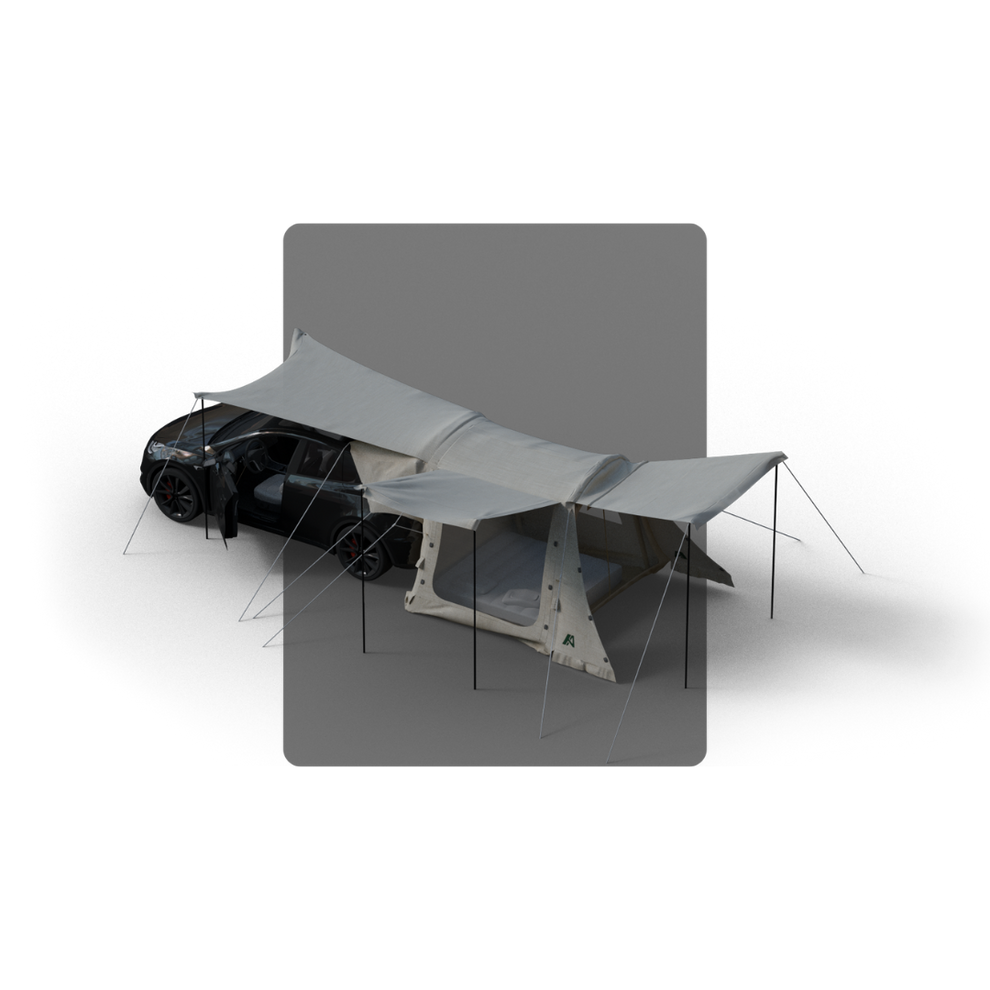
TENTSLA X1 Tesla Camping Tent
$649
Designed for Tesla Model 3, Model Y, and Model X configurations, the TENTSLA X1 combines an inflatable frame with vehicle connectors, weather-resistant Oxford fabric, and a portable storage system. The product listing identifies rear and side access, mosquito netting, and a setup designed for Tesla camping.
Its value is in the integrated system: tent, connectors, frame approach, and vehicle compatibility. It is not simply a low-cost awning with a Tesla logo.
Explore the TENTSLA X1When is the TENTSLA X1 worth buying?
- You own a supported Tesla model and want a vehicle-specific camping connection.
- You camp regularly and value a faster setup routine.
- You want a more integrated arrangement than a universal tailgate sleeve.
- You will use the tent often enough to justify a higher initial purchase price.
When should you choose a simpler tent instead?
If you only need shade for a few hours, a compact tailgate shelter is more economical. If you want a large family sleeping room that can also stand independently, a traditional SUV tent may offer more useful floor area for the money. The X1 is best evaluated as a Tesla camping system, not as a direct substitute for every large family SUV tent.
For a broader overview of vehicle camping equipment, browse TENTSLA camping accessories and the Tesla camping mattress collection. The right mattress and tent combination should be planned together rather than purchased as unrelated accessories.
8. Pros and Cons of Rear Car Tents
| Advantages | Limitations |
|---|---|
| Extends sheltered living space without requiring a separate trailer. | Vehicle compatibility can be more complicated than universal-fit marketing suggests. |
| Keeps clothing, food, and equipment accessible from the cargo area. | The vehicle may need to remain parked in a specific position for the tent to work. |
| Can reduce the need to unpack and repack the vehicle every night. | Some models take considerable time to assemble and secure. |
| Many full-size models provide room for sleeping, storage, and changing. | Large tents add packed weight and consume cargo space. |
| Vehicle-specific designs can provide a more integrated camping arrangement. | Specialized systems may cost more and be less transferable to another vehicle. |
| Compact hatch shelters are useful for day trips and short breaks. | A shade awning should not be mistaken for an enclosed weatherproof sleeping tent. |
From our experience evaluating camping equipment specifications, the biggest advantage is convenience: your vehicle becomes part of the campsite. The biggest limitation is dependence on fitment and parking position. If you frequently camp on uneven or exposed ground, a freestanding tent may be more forgiving than a design that relies on the rear hatch.
9. Common Mistakes When Buying a Rear Car Tent
Mistake 1: Buying by advertised capacity alone
A stated five-person capacity does not mean five adults will sleep comfortably with luggage. Compare the floor dimensions, usable width, headroom, and sleeping layout. For a family, the real question is whether everyone has enough room to sleep and move without blocking the vehicle entrance.
Mistake 2: Assuming universal fit means perfect fit
Universal usually means adjustable across a range of vehicles, not custom-sealed to every hatch. A poor sleeve fit can allow wind, insects, and rain to enter. Check the supported vehicle categories and ask the seller about unusual rear-door designs.
Mistake 3: Confusing a tailgate awning with a sleeping tent
A canopy is useful for shade, but it may not have a floor, full walls, or enough weather protection for overnight use. If you intend to sleep outside the vehicle, buy an enclosed design built for that purpose.
Mistake 4: Ignoring ventilation
Mesh windows and vents are essential for comfort. A sealed-looking tent is not automatically a better tent. Airflow helps manage condensation and keeps the sleeping area more comfortable in warm conditions.
Mistake 5: Forgetting the campsite footprint
A 10 x 10 ft tent plus guy lines needs more room than its floor dimensions suggest. Before buying, consider where you normally camp and whether the tent can be pitched without blocking a neighboring site, walkway, or vehicle access lane.
Mistake 6: Buying an expensive tent for occasional use
Premium materials and specialized connectors can be worthwhile, but only if you use them. If you camp twice a year and mostly need a sun shelter, a compact model is likely the better purchase.
10. Cost-Benefit Analysis: Is a Premium Rear Car Tent Worth It?
Rear car tents cover a wide price range because they solve different problems. A compact tailgate shelter is a relatively inexpensive way to add shade. A full-size SUV tent costs more because it includes a larger frame, more fabric, a floor, a rainfly, and a more substantial vehicle connection. A specialized inflatable system adds vehicle-specific engineering and a different setup method.
| Budget approach | What you generally get | Who should buy it | Our advice |
|---|---|---|---|
| Basic tailgate shelter | Shade, privacy, mesh door or simple rear cover | Day trippers and occasional users | Best entry point if overnight enclosure is not required. |
| Mid-range full SUV tent | Separate floor area, poles, vehicle sleeve, rainfly | Regular car campers and families | Best value for multi-night camping. |
| Large multi-room SUV tent | Extra covered space, screen room, more doors and poles | Families and group campers | Worth it when the extra room will be used. |
| Premium vehicle-specific system | Dedicated connectors, specialized frame, vehicle-oriented design | Frequent owners of supported vehicles | Pay more for fit and convenience, not for the assumption that expensive always means better. |
For commercial users such as outdoor tour operators, rental fleets, or organized event providers, durability and replacement-part availability should carry more weight than the lowest purchase price. A tent that is difficult to repair or takes too long to set up can create recurring labor and replacement costs.
For personal use, calculate cost per trip. A $649 system used regularly over several years may deliver better value than a cheaper product that is awkward to fit and rarely leaves the storage bag. But if you camp infrequently, a simpler shelter will usually be the more rational purchase.
11. Our Final Recommendations: Which Rear Car Tent Should You Buy?
We would narrow the decision to four practical scenarios rather than recommend one tent to every buyer.
- For Tesla owners: Choose the TENTSLA X1 if you want a vehicle-specific inflatable camping setup and your exact vehicle configuration is supported. The premium is justified by integration and convenience, not by a promise of better camping in every situation.
- For families with an SUV: Start with the Napier Sportz 82000. It offers a strong balance of floor space, ventilation, rain protection, and vehicle access.
- For buyers watching the budget: Compare the Napier Backroadz 19100 before paying for a larger multi-room system. Its 10 x 10 ft footprint already provides substantial space.
- For day trips and quick stops: The Napier Sportz Cove is the more sensible purchase. It is compact, quick to deploy, and does not pretend to be a full family tent.
Do not buy a rear car tent simply because it is marketed as universal, waterproof, or suitable for several people. Confirm the attachment system, inspect the weather protection details, and decide whether you need a sleeping room or a shaded extension. Those three decisions will eliminate most unsuitable options before you spend money.
TENTSLA focuses on vehicle-oriented camping equipment for Tesla owners. Its X1 system is most compelling for drivers who want a dedicated camping setup rather than a generic shelter. For more ideas on building a complete vehicle camping arrangement, explore the TENTSLA outdoor camping lifestyle guide.
12. Frequently Asked Questions About the Best Rear Car Tents
1. What is the best rear car tent in 2026?
The best choice depends on the vehicle and camping style. For Tesla owners seeking a vehicle-specific inflatable system, the TENTSLA X1 is a strong option. For traditional SUV camping, the Napier Sportz 82000 is a balanced full-size tent. For quick shade and short stops, the Napier Sportz Cove is more practical.
2. Can you sleep inside a car with a rear tent attached?
Yes, many campers sleep on a mattress inside the vehicle and use the attached tent as extra sheltered space. Others sleep in the tent itself. Check that the tent connection leaves the required rear access open and that your mattress and sleeping arrangement fit the vehicle.
3. Do rear car tents fit every SUV?
No. Universal sleeves are adjustable, but rear hatch dimensions and shapes vary. Check vehicle compatibility, hatch height, opening width, attachment straps, and the manufacturer's fitting guidance before buying.
4. Are rear car tents waterproof?
Some provide substantial rain protection through coated fabrics, taped seams, rainflies, and storm flaps. Others are designed mainly for shade and light weather. Check the complete construction rather than relying on the word waterproof or a single hydrostatic-head rating.
5. Is an inflatable rear car tent better than a pole tent?
An inflatable tent can simplify frame assembly and reduce the number of conventional poles, which is useful for frequent setup and pack-down. A pole tent may be less expensive and easier to repair with replacement poles. Choose based on setup frequency, packed size, repair support, and vehicle compatibility.
6. Can I use a rear car tent with a Tesla Model Y?
Yes, but you should select a tent that explicitly supports the Model Y or has a compatible adjustable connector. Confirm the model year, rear hatch dimensions, and whether the tent allows the access you need. Vehicle-specific systems such as the TENTSLA X1 are designed around supported Tesla configurations.
7. Is a tailgate awning enough for overnight camping?
Usually not if you need an enclosed sleeping area. A tailgate awning is best for shade, cooking cover, changing, and short stops. For overnight sleeping outside the vehicle, choose a full tent with suitable walls, floor, ventilation, and weather protection.
8. What size rear car tent should I buy for a family?
Start with the number of people, sleeping arrangement, and gear volume rather than the stated capacity alone. A 9 x 9 ft or 10 x 10 ft tent can offer useful family space, while a screen room adds a separate area for equipment and sitting. Check actual floor dimensions and usable headroom before ordering.
9. How do I prevent condensation in a rear car tent?
Use mesh windows and roof vents to create airflow, avoid bringing wet clothing into the sleeping area when possible, and keep bedding away from damp tent walls. Follow the vehicle manufacturer's guidance for climate settings and do not assume cabin climate control replaces tent ventilation.
10. Is a premium Tesla camping tent worth the price?
It can be worth the price if you own a supported Tesla, camp regularly, and value vehicle-specific connectors and a faster setup process. If you only need occasional shade or a basic sleeping shelter, a simpler universal tent may offer better value.
References
- Napier Outdoors — Sportz Cove product specifications. Manufacturer details on size options, setup, vehicle connection, weight, and weather features.
- Kelty — Caboose 4 official product information. Manufacturer specifications for the hybrid tailgate tent, materials, packed weight, and freestanding configuration.
- Tesla — Model Y Owner's Manual. Official guidance on Camp Mode, climate controls, and vehicle operation while parked.