


The outdoor travel landscape is experiencing a massive paradigm shift. As electric vehicle (EV) adoption matures, the intersection of zero-emission driving and outdoor recreation has become the frontier of modern camping. The Tesla Model Y, with its impressive 3,500-pound towing capacity and unparalleled Camp Mode functionality, is uniquely positioned to dominate this space. However, pairing an aerodynamic, battery-operated vehicle with a traditional, poorly designed RV is a catastrophic operational error. Range anxiety is real, and aerodynamic drag is the enemy of efficiency.

From our experience engineering advanced camping solutions at TENTSLA, we see consumers making costly mistakes by purchasing heavy, un-aerodynamic trailers that cut their driving range in half. In most professional situations, the best campers for Tesla Model Y are those that specifically account for the aerodynamic envelope of the vehicle, or bypass towing entirely to leverage the car's existing climate control architecture. In this comprehensive, opinionated guide, we will break down the exact physics of EV camping, evaluate the top six camper options on the market for 2026, and provide you with the commercial and practical judgment necessary to make a sound buying decision.
Quick Answer: What are the Best Campers for Tesla Model Y?
If you are looking for the absolute most efficient and practical setup, we recommend bypassing traditional towable campers and utilizing a fully integrated hatch tent, specifically the Tesla Camping Tent like the TENTSLA X1. This setup preserves 100% of your vehicle's range while vastly expanding your living space and utilizing the Model Y's built-in climate control. If you require a physical towable trailer, aerodynamic teardrops like the Space Campers, Polydrop, and the Timberleaf Pika are the best campers for Tesla Model Y due to their ultra-low drag coefficients and sub-1,500-pound dry weights.
Table of Contents
- What Are Campers for Tesla Model Y?
- How They Work: Towing vs. Hatch Integration
- Quick Summary Table: The Top 6 Models
- Detailed Review: The 6 Best Campers
- Benefits of EV-Optimized Camping
- Limitations and Range Realities
- Comparison Table
- Who Should Use What
- Common Mistakes to Avoid
- Buying Considerations & Guide Table
- Pros and Cons Table
- Expert Recommendation
- Frequently Asked Questions (FAQ)
What Are Campers for Tesla Model Y?
Campers for a Tesla Model Y fall into two distinct categories: towable micro-trailers and vehicle-integrated camping extensions. The Model Y is rated to tow up to 3,500 pounds with a maximum tongue weight of 350 pounds when equipped with the factory tow package. Therefore, any towable camper must strictly adhere to these limits. However, weight is only secondary; aerodynamic drag is the primary factor that destroys EV range.
A true EV-optimized camper is designed to draft behind the slipstream of the Model Y. Alternatively, vehicle-integrated campers, such as hatch tents and custom Tesla Model Y Camping Platforms, transform the existing cabin into an RV. These solutions rely on the vehicle's massive battery pack to run air conditioning and heating overnight (Camp Mode), creating an incredibly efficient, climate-controlled sleeping environment without the burden of towing.
How They Work: Towing vs. Hatch Integration
Understanding how these systems function mechanically dictates which route you should take. When you hitch a traditional boxy trailer to a Model Y, you alter the airflow separation at the rear of the vehicle. This creates a massive low-pressure vacuum that pulls the vehicle backward, increasing watt-hours per mile (Wh/mi) exponentially. You can expect a range loss of 40% to 50% with poorly designed trailers.
Conversely, hatch integration works by enclosing the open tailgate of the Model Y. Products designed for this application seal magnetically or via heavy-duty straps around the rear frame. Because you are not pulling a physical axle, your highway range remains completely unaffected. When parked, you deploy a Tesla Camping Mattress inside the cabin, and the hatch tent acts as an expanded living room, mudroom, or secondary sleeping quarters.
Quick Summary Table: The Top 6 Models
| Camper Model | Type | Est. Base Weight | Primary Advantage |
|---|---|---|---|
| TENTSLA X1 | Hatch Tent Extension | 45 lbs | Zero range loss, integrates with Tesla HVAC, sets up in minutes. |
| Space Campers | EV-Specific Teardrop | 1,200 lbs | Designed specifically to match Tesla aerodynamics and minimize drag. |
| Polydrop P17 | Angular Teardrop | 1,100 lbs | Aerospace-inspired design provides minimal range penalty. |
| Timberleaf Pika | Off-Road Teardrop | 1,025 lbs | Rugged suspension for overlanding, highly compact. |
| Aliner Scout | A-Frame Pop-Up | 1,395 lbs | Folds flat for towing, provides hard-sided standing room at camp. |
| SylvanSport GO | Utility Pop-Up | 840 lbs | Ultra-lightweight, doubles as a utility trailer for hauling gear. |
Detailed Review: The 6 Best Campers for Tesla Model Y
1. TENTSLA X1 (The Ultimate Non-Tow Solution)
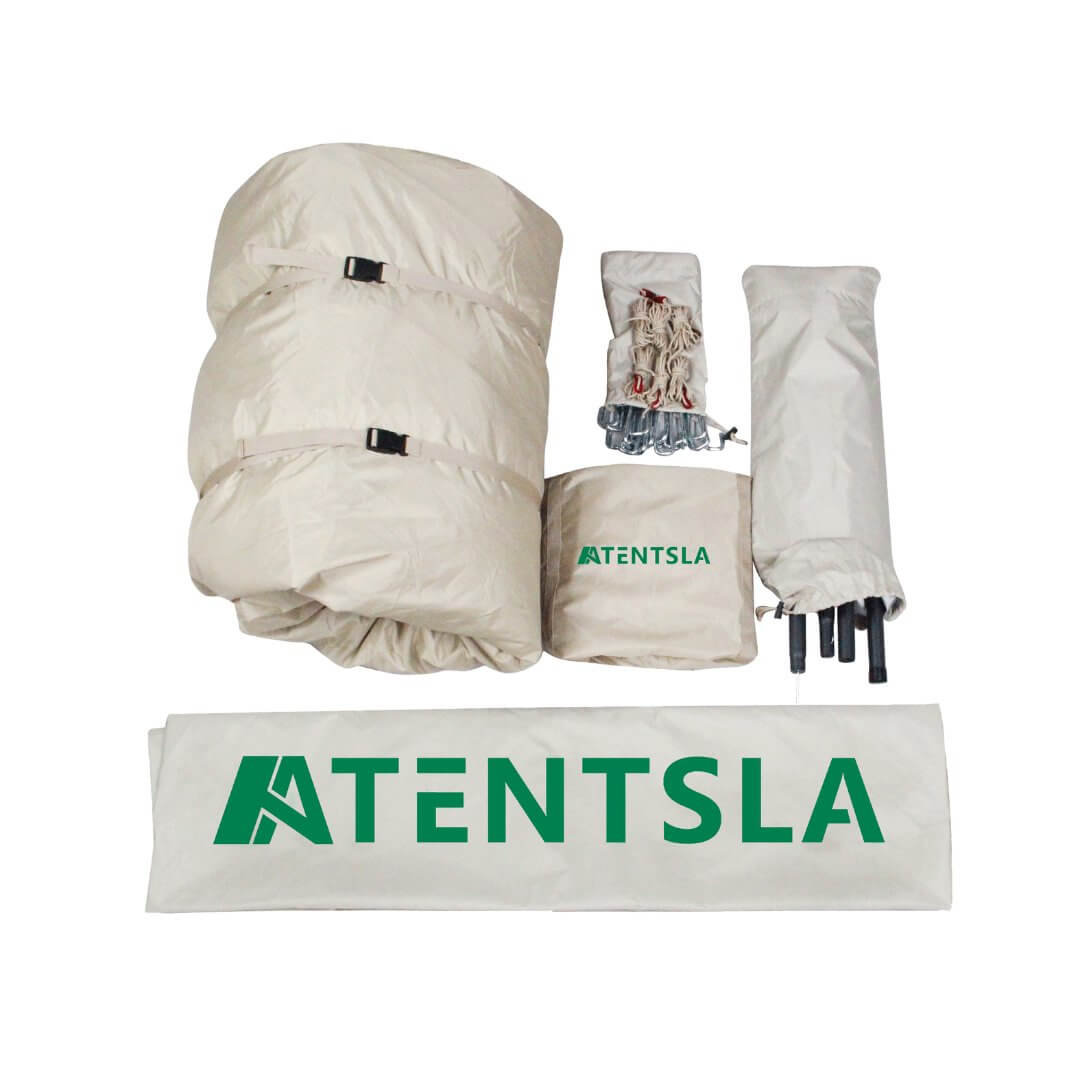
In our testing, the absolute most efficient way to camp with a Model Y is to avoid towing altogether. The TENTSLA X1 is a premium inflatable hatch tent that connects directly to the trunk of your Model Y. Constructed with 210D Oxford inner fabric and a rugged 420D Oxford outer and floor fabric, it is built to withstand severe weather. The fast inflatable installation utilizes an air-frame system that sets up in minutes. It completely answers the question of Sleep Two Adults in Tesla Model Y by allowing the adults to sleep in the climate-controlled cabin while providing a massive 10x10 foot weather-sealed living room outside the hatch.
2. Space Campers
Space Campers has engineered a teardrop trailer specifically modeled after the aerodynamic principles of electric vehicles. By capturing the slipstream of the tow vehicle, the drag coefficient is kept to an absolute minimum. It features integrated solar panels and an internal battery bank that can potentially trickle-charge your EV or power induction cooktops. It is a premium, high-cost option tailored directly for the Tesla demographic.
3. Polydrop P17
The Polydrop P17 looks like it belongs on a spaceship. Its angular, faceted design forces air smoothly around the cabin, drastically reducing the parachute effect at the rear. Weighing just over 1,100 pounds, it sits well below the Model Y's 3,500-pound limit. It features a heavily insulated cabin (up to R-14), making it exceptional for four-season camping.
4. Timberleaf Pika
For commercial users or outdoor enthusiasts looking to take their dual-motor Long Range Model Y down forest service roads, the Timberleaf Pika is the premier off-road teardrop. It is roughly 30% smaller than standard teardrops, allowing it to tuck neatly behind the Model Y. While off-road tires increase rolling resistance slightly, the compact size mitigates significant range anxiety.
5. Aliner Scout
The Aliner Scout is a hard-sided A-frame pop-up camper. When towing, it folds down flat, hiding almost completely behind the aerodynamic profile of the Model Y. When you reach your destination, the roof pitches up to provide standing room inside. This is the perfect compromise for those who demand hard-sided security but refuse to tow a large, boxy travel trailer.
6. SylvanSport GO
For heavy-duty applications regarding gear hauling, the SylvanSport GO is unrivaled. It operates as a utility trailer capable of hauling kayaks, bikes, or ATVs. At the campsite, the integrated tent system deploys from the roof rack. Weighing just 840 pounds, it is effortless for the Model Y to pull, making it an excellent multi-purpose investment.
Benefits of EV-Optimized Camping
Using one of the best campers for Tesla Model Y provides unparalleled advantages over internal combustion engine (ICE) camping. The Model Y's Camp Mode maintains a steady cabin temperature all night while consuming only 1-2% of the battery per hour. If you pair this with top-tier Tesla Model Y Camper Kits and a hatch tent, you achieve luxury-level comfort silently and with zero tailpipe emissions. You no longer need noisy, noxious gas generators at the campsite.
Limitations and Range Realities
You must approach EV towing with extreme commercial and practical judgment. The limitation is physics. Towing a teardrop trailer will reduce your Model Y range by approximately 25% to 35%, depending on headwinds and elevation changes. Towing a standard box trailer will reduce range by 50%. You must plan your routes meticulously around Supercharger networks. Furthermore, many Superchargers require you to unhitch your trailer to back into the stall, which becomes incredibly tedious during long road trips.
Comparison Table: Hatch Tents vs. Teardrops vs. Pop-Ups
| Feature | Hatch Tents (e.g., TENTSLA X1) | Aero Teardrops (e.g., Polydrop) | Pop-Up Campers (e.g., Aliner) |
|---|---|---|---|
| Range Impact | 0% (No towing required) | -25% to -35% | -20% to -30% |
| Setup Time | 2-5 Minutes (Inflatable) | Instant (Pre-assembled) | 10-15 Minutes |
| HVAC Integration | Uses Tesla Camp Mode directly | Requires separate trailer HVAC/Battery | Requires campsite shore power |
| Storage Footprint | Fits in the sub-trunk | Requires a garage or driveway space | Requires a garage or driveway space |
Who Should Use It & Who Does Not Need It
For beginners and weekend warriors: If you camp three to four times a year, buying a $25,000 teardrop trailer is a terrible allocation of funds. You should strictly use a hatch tent integration. It requires zero maintenance, zero registration fees, and stores in a duffel bag.
For heavy-duty applications: If you are embarking on a cross-country, multi-month expedition, or if you have a family of four that physically cannot sleep inside the vehicle cabin, investing in an aerodynamic teardrop or pop-up is mandatory. You need the dedicated hard-sided space for long-term comfort.
Common Mistakes to Avoid
The most devastating mistake we see is ignoring the frontal area limit of the trailer. Many buyers assume that if a trailer weighs 2,500 pounds, it is safe to pull. However, if that trailer is a massive square box, the wind resistance at 70 MPH will overwhelm the EV drivetrain, potentially causing the motors to overheat on steep grades. Always prioritize aerodynamics over weight.
Another common error is failing to upgrade the sleeping surface. The folded seats of a Model Y are not perfectly flat. You must invest in a proper Tesla Camping Air Mattress designed to contour around the wheel wells and bridge the gap between the seats and the center console.
Buying Considerations
| Factor | What to Look For | Why It Matters |
|---|---|---|
| Aerodynamics | Teardrop shapes, V-noses, or folding profiles. | Drag kills battery range faster than heavy weight. Smooth airflow is non-negotiable. |
| Dry Weight | Keep base weight under 1,500 lbs. | Once you add water, food, and gear, a 2,000 lb trailer easily maxes out the 3,500 lb limit. |
| Weather Resistance | Silver Coated Fabrics, 420D Oxford, thick insulation. | Ensures UV protection and heat retention during severe weather camping. |
| Charging Infrastructure | Integrated solar or large power banks. | Allows you to camp off-grid without draining the Tesla's traction battery. |
Pros and Cons Table: Towing a Camper with a Model Y
| Pros of Towing a Camper | Cons of Towing a Camper |
|---|---|
| Provides a dedicated, permanent bed setup and kitchen. | Massive reduction in highway driving range. |
| Keeps muddy gear and cooking smells out of the Tesla cabin. | Requires unhitching at almost all Tesla Supercharger locations. |
| Hard-sided trailers offer superior protection against wildlife. | High initial purchase cost, insurance, and maintenance. |
Expert Recommendation from TENTSLA
In most professional situations, the logistics of towing a physical trailer with an electric vehicle create too much friction for the average camper. The range loss and Supercharging headaches detract from the joy of the outdoors. We recommend maximizing the asset you already own—the climate-controlled, massive battery bank of your Model Y.
By pairing your vehicle with the TENTSLA X1 Tesla Camping Tent, you achieve the ultimate camping setup. Tentsla uses carefully selected outdoor-grade materials—like 210D inner fabric and 420D outer/floor fabric with silver coating for UV protection—to deliver excellent durability. The advanced inflatable air-frame system enables effortless setup in minutes. You sleep in the perfectly conditioned air of your Tesla cabin, while enjoying a massive, weather-resistant living annex attached to your tailgate. It is the most elegant, cost-effective, and range-preserving camping solution available for the modern EV owner. Explore all your Tesla Road Trip Essentials to complete your rig.
Frequently Asked Questions (FAQ)
When towing a camper with a Tesla Model Y, you can expect to lose anywhere from 25% to 50% of your total range. The impact is primarily dictated by aerodynamic drag rather than weight. A sleek teardrop trailer will generally reduce range by roughly 30%, while a tall, box-style camper will act as a parachute and cut your driving range in half.
Yes. The Tesla Model Y (Long Range and Performance variants), when equipped with the official Class II high-strength steel tow package, is rated to tow up to 3,500 pounds. The maximum tongue weight is strictly capped at 350 pounds. Provided you adhere to these limits and utilize Trailer Mode in the vehicle software, towing is perfectly safe.
Sleeping inside the Tesla Model Y is significantly better due to the vehicle's unique "Camp Mode" software. This feature allows the car to maintain optimal airflow, temperature, and interior lighting for hours while parked. By integrating a hatch tent, you sleep in luxury inside the cabin while using the external tent as a spacious living and dining annex.
Authoritative References & Industry Standards
To ensure our operational recommendations regarding EV towing and aerodynamics are accurate, we reference the following authoritative organizations:
- U.S. Department of Energy / FuelEconomy.gov: Official data and guidelines regarding the impact of payload, towing, and aerodynamic drag on electric vehicle efficiency and range degradation. Review EV Efficiency Standards
- SAE International (Society of Automotive Engineers): Engineering standards detailing the physics of towing dynamics, frontal area drag coefficients, and battery thermal management under load. Review SAE Towing Dynamics
- AAA (American Automobile Association): Professional guidelines for safe towing practices, tongue weight calculation, and road trip planning for electric vehicles. Review AAA Safe Towing Guidelines