


The romanticized vision of the American road trip—pulling your car over anywhere, rolling down the windows, and sleeping under the stars—is largely a modern myth. Over the past decade, municipalities across the country have aggressively cracked down on vehicle habitation. If you are asking, "Where can I legally sleep in my car in the US?", you must abandon the assumption that public parking lots and city streets are free campgrounds. They are not. Relying on outdated advice from internet forums will inevitably result in a midnight knock on your window from law enforcement, a trespassing citation, or worse.

From our experience engineering advanced vehicular camping solutions at TENTSLA, navigating the jurisdictional maze of federal, state, and local ordinances requires precision. You cannot simply guess your way through a cross-country trip. Whether you are driving a traditional internal combustion engine (ICE) vehicle or maximizing the Outdoor Tesla Lifestyle, you must apply commercial and practical judgment to your overnight parking strategy. In this definitive guide, we strip away the gray areas and provide a clear, actionable roadmap on where you can legally sleep in your vehicle, how to leverage federal lands, and how modern electric vehicles are completely changing the rules of engagement.
Quick Answer: Where Can I Legally Sleep?
The safest and most reliable locations to legally sleep in my car in the US are Federal Public Lands managed by the Bureau of Land Management (BLM) and the United States Forest Service (USFS). These areas allow "dispersed camping" for up to 14 days completely free of charge. Highway rest stops are governed by state law; some allow overnight sleeping (e.g., Texas, Nevada), while others strictly prohibit it (e.g., Florida, Colorado). Big-box retail lots like Walmart and Cracker Barrel have drastically reduced overnight parking allowances due to local city ordinances and must be verified on a store-by-store basis. Commercial truck stops (Loves, Pilot) generally permit overnight parking for paying customers, though space is highly competitive.
Table of Contents
- Direct Answer: The Legal Landscape
- What It Is: Dispersed Camping vs. Vehicle Habitation
- How It Works: Navigating Jurisdictions
- Benefits of Vehicle Camping
- Limitations and Hidden Risks
- Who Should Use This Setup
- Who Does Not Need It
- Common Mistakes to Avoid
- Buying Considerations for Vehicle Sleepers
- Expert Recommendation
- Summary and Comparison Tables
- Frequently Asked Questions
Direct Answer: The Legal Landscape
Finding locations to legally sleep in my car in the US requires understanding that there is no universal federal law granting you the right to sleep in a vehicle on public streets. The legality is dictated entirely by a patchwork of local municipal codes. In urban centers, sleeping in your car is routinely classified under "illegal vehicle habitation" or "camping within city limits." Consequently, the only environments where you possess a guaranteed, legal right to sleep in your vehicle are designated campsites, private property (with explicit owner permission), and specific classifications of federal public land.
What It Is: Dispersed Camping vs. Vehicle Habitation
In the context of the law, you must differentiate between "dispersed camping" and "vehicle habitation." Dispersed camping is a federally recognized recreational activity that takes place outside of designated campgrounds on BLM or USFS land. It is perfectly legal. Vehicle habitation, however, is a municipal term used by cities to target individuals living out of their cars on urban streets or commercial lots. When you pull into a Walmart parking lot to sleep, you are technically engaging in vehicle habitation, which is only legal if the store manager grants permission and there is no overriding local city ordinance banning it.
How It Works: Navigating Jurisdictions
In most professional situations, seasoned road trippers rely on a tiered system to find legal overnight parking:
- Tier 1: BLM and National Forest Land. You can drive down dirt roads on these federal lands and pull over to sleep. The rule is typically a 14-day limit within a 28-day period. You must pack out all waste.
- Tier 2: Interstate Rest Areas. State Departments of Transportation regulate these. You must check state laws. For instance, you can sleep for up to 24 hours in a Texas rest area, but if you attempt the same in Tennessee, you risk a citation.
- Tier 3: Commercial Truck Stops. Facilities like Pilot Flying J, Love's, and TA generally welcome overnight parkers because they want you to buy fuel and food. You must park in the designated auto sections, never in the commercial big-rig slots.
- Tier 4: Retail Lots (Walmart, Cracker Barrel, Cabela's). You must call the store manager ahead of time. Even if corporate policy allows it, local city ordinances often supersede corporate policy, resulting in private security forcing you to leave.
Benefits of Vehicle Camping
The primary benefit of car camping is the massive reduction in travel overhead. Bypassing a $150-per-night hotel room allows you to reallocate capital toward actual experiences. Furthermore, it offers unparalleled logistical flexibility. You are not bound by hotel check-in times or rigid itineraries.
For electric vehicle owners, the benefits are exponentially higher. Using a Tesla Model Y Camp Mode Guide allows you to sleep in a climate-controlled cabin (70 degrees all night) without violating the anti-idling laws that plague internal combustion engine (ICE) vehicles. Because an EV produces no exhaust and makes no noise, you can legally and comfortably sleep in designated areas where running a gas engine would result in an immediate fine.
Limitations and Hidden Risks
We must use commercial and practical judgment: sleeping in your car has severe limitations. The most pressing is security. In poorly lit urban environments, a stationary vehicle with a sleeping occupant is a vulnerable target. Secondly, thermal management in a traditional gas-powered car is dangerous. You cannot safely run a gas engine all night for heat or AC due to carbon monoxide risks and anti-idling laws. If you are sleeping in an ICE vehicle, you are entirely at the mercy of the ambient outdoor temperature. Finally, hygiene logistics—finding legal, clean restrooms and showers—requires constant daily planning.
Who Should Use This Setup
We recommend vehicle camping for cross-country road trippers, outdoor photographers seeking sunrise access to national parks, and digital nomads operating on lean budgets. It is specifically advantageous for Tesla and EV owners who have invested in Tesla Road Trip Essentials. If you have a vehicle capable of safely managing overnight climate control, car camping transitions from an endurance test to a legitimate luxury experience.
Who Does Not Need It
If you require absolute certainty, a private bathroom, and zero logistical stress, you should not be sleeping in your car. Furthermore, if you are driving a compact sedan with seats that do not fold completely flat, attempting to sleep in the driver's seat will result in severe musculoskeletal pain and a dangerous lack of REM sleep. Do not attempt multi-day car camping without a flat sleeping surface.
Common Mistakes to Avoid
The most catastrophic mistake beginners make is ignoring "No Overnight Parking" signage. Municipalities actively enforce these zones, and towing companies aggressively patrol them. If you see the sign, leave. Another profound error is creating a "footprint" in a stealth or commercial location. When sleeping at a rest stop or truck stop, do not put out lawn chairs, deploy awnings, or cook outside your vehicle. You are there to rest, not to set up a campground.
For EV owners, a common error is failing to monitor Tesla Camping Mode Battery Drain. Ensure you park with at least a 20% battery buffer to accommodate overnight HVAC usage and the drive to the next charging station.
Buying Considerations for Vehicle Sleepers
To safely and legally sleep in my car in the US, you must invest in proper gear. Privacy is paramount; custom-fit blackout window shades prevent outside observers from looking in and block intrusive parking lot lights. You must also prioritize spinal support. An uneven cargo floor will ruin your trip. Invest in a proper Tesla Camping Air Mattress or an equivalent high-density memory foam pad contoured to your specific vehicle.
If you plan to utilize BLM land or designated campsites where deploying external gear is legal, extending your living space is a massive quality-of-life upgrade. Integrating a vehicle-attached tent allows you to stand up, change clothes, and store gear outside the sleeping cabin.
Expert Recommendation
From our experience, attempting to stealth-camp in urban retail lots is a game of diminishing returns. The stress of waiting for a security guard to knock on your window ruins your sleep architecture. We unequivocally recommend planning your routes around BLM land, USFS land, and verified commercial truck stops. If you own an EV, you possess the ultimate camping machine. To fully leverage this capability on public lands, deploying a Premium Tesla Camping Tent transforms your vehicle from a cramped metal box into a multi-room, climate-controlled backcountry basecamp.
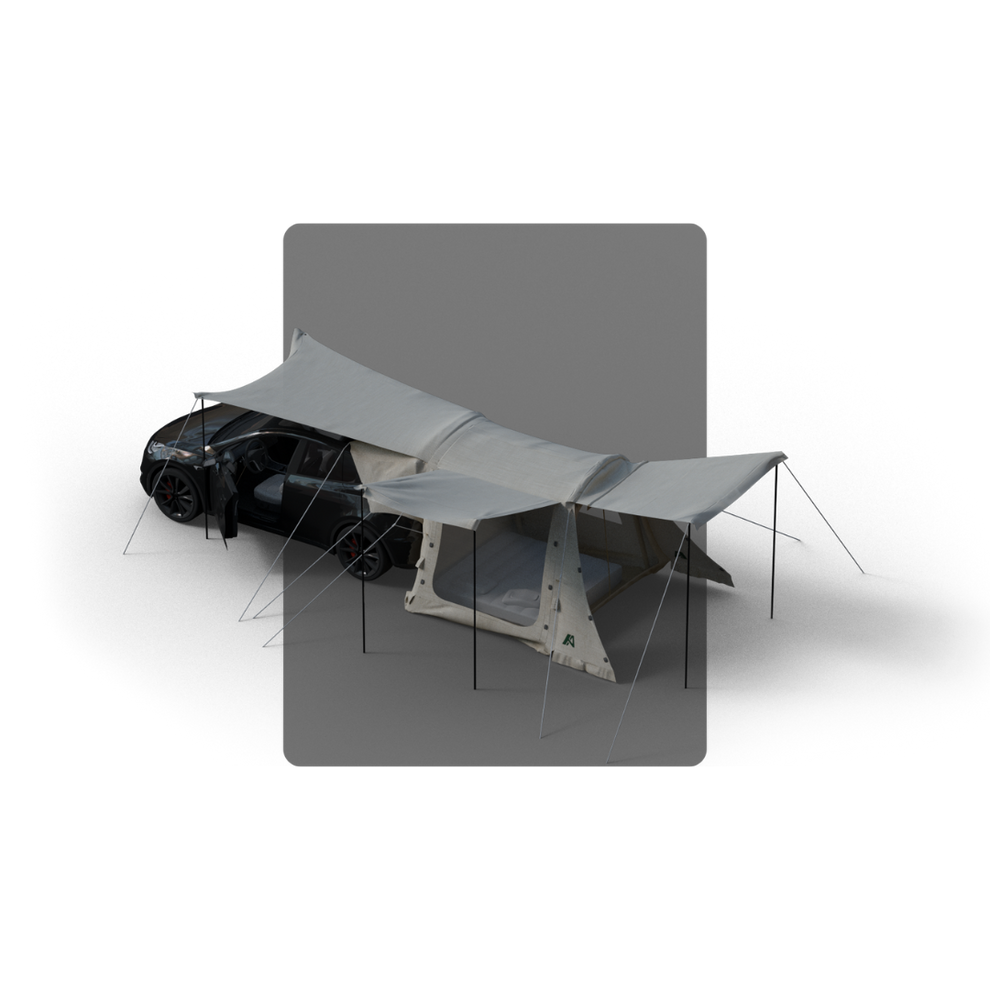
TENTSLA X1 Tesla Camping Tent
Engineered specifically for the Tesla Model 3, Model Y, and Model X, the TENTSLA X1 allows you to legally and comfortably expand your footprint on BLM and National Forest lands. It seamlessly integrates with your EV's climate control system.
- Premium Weather-Resistant Construction: Built with 210D inner fabric and 420D Oxford outer fabric to withstand harsh backcountry conditions.
- Fast Inflatable Installation: Advanced inflatable air-frame system enables effortless setup in just a few minutes, entirely bypassing traditional fiberglass poles.
- UV Protection & Heat Insulation: Silver-coated fabric reflects harsh sun, maintaining a comfortable interior environment.
- Perfect Seal: Custom-tailored tailgate sleeve prevents bugs and weather from entering your vehicle cabin while the hatch remains open.
Summary and Comparison Tables
| Location Type | Legality for Overnight Sleeping | Primary Caveat |
|---|---|---|
| BLM / National Forests | 100% Legal (Dispersed Camping) | 14-day limit; no amenities provided. |
| Interstate Rest Areas | Varies strictly by State | Some states allow 8-24 hours; others ban it entirely. |
| Commercial Truck Stops | Generally Permitted | Must park in designated auto spots, never truck lanes. |
| Retail Lots (Walmart, etc.) | Manager Discretion / City Laws | City ordinances often override store policies. |
| City Streets / Urban Areas | Largely Illegal (Habitation bans) | High risk of police interaction and towing. |
| Feature | Traditional Gas Vehicle (ICE) | Electric Vehicle (e.g., Tesla) |
|---|---|---|
| Climate Control | None (Illegal/Dangerous to idle overnight) | Constant HVAC via Camp Mode |
| Noise / Stealth | Loud if engine runs; draws attention | Silent operation; ultimate stealth |
| Carbon Monoxide Risk | High if exhaust is blocked | Zero risk |
| Power Availability | Limited to small 12V batteries | Massive high-voltage battery pack |
| Pros (Advantages) | Cons (Limitations) |
|---|---|
| Completely legal and free of charge. | Zero amenities (no bathrooms, water, or trash cans). |
| Allows deployment of vehicle-attached tents and gear. | Often requires navigating unpaved, high-clearance dirt roads. |
| High privacy and isolation from urban noise. | Cellular service is frequently unavailable. |
| Beautiful, natural environments for morning wake-ups. | Requires strict "Leave No Trace" waste management. |
Frequently Asked Questions
Is it illegal to sleep in your car at a Walmart?
It depends entirely on local ordinances. While Walmart corporate policy historically allowed overnight parking for RVs and travelers, thousands of local city councils have passed laws banning overnight vehicle habitation in commercial lots. If a city ordinance exists, the store manager cannot legally grant you permission to stay. Always look for signage and ask management.
How can I find legal dispersed camping on BLM land?
The most reliable method is to use official interactive maps provided by the Bureau of Land Management or dedicated overlanding apps (like iOverlander or Campendium). These tools verify land ownership boundaries. When on BLM land, you must ensure you are not blocking roadways, parking within 200 feet of a water source, or violating localized fire restrictions.
Is it safe to use Camp Mode in a Tesla while sleeping in a closed garage?
From an emissions standpoint, yes. Because a Tesla does not have a combustion engine, it produces zero carbon monoxide. You can safely run the HVAC system via Camp Mode in an enclosed space without the risk of asphyxiation associated with gas-powered vehicles. For a deeper dive into EV safety, read our guide on Tesla Model Y Sleeping Safety.
Authoritative Industry References
To ensure our legal and operational advice is completely accurate, we base our jurisdictional guidelines on data from the following federal and state authorities:
- Bureau of Land Management (BLM) - Federal guidelines, maps, and regulations governing free dispersed camping and 14-day stay limits on public lands.
- United States Forest Service (USFS) - Official rules regarding motorized vehicle access, off-road parking, and overnight sleeping protocols within National Forests.
- Federal Highway Administration (FHWA) - Department of Transportation documentation detailing the state-by-state variance in Interstate Rest Area regulations and commercial parking restrictions.