


If you are still pitching a traditional nylon dome tent in the dirt next to your $50,000 electric vehicle, you are fundamentally underutilizing your machine. The modern electric vehicle is no longer just a method of transportation; it is a rolling, high-capacity climate-controlled power bank. With the rise of EV-specific overlanding, a massive shift has occurred in how we approach the outdoors, and at the center of this revolution is the Tesla AC camping tent.

From our experience as industry practitioners at TENTSLA, the market is currently flooded with generic, poorly fitted SUV tailgate tents that falsely claim to be EV-compatible. Most of these products fail miserably at retaining the one thing that makes Tesla camping superior: the vehicle's climate control. When you engage "Camp Mode" on a Model Y, Model 3, or Model X, you want that crisp air conditioning or vital heating to flow directly into your living space without leaking into the surrounding wilderness.
In this comprehensive guide, we will break down exactly what a true Tesla AC camping tent is, how the physics of vehicle-to-tent climate control work, and whether investing in a premium setup is actually worth your money. We are taking a definitive position: if you want to experience the true Outdoor Tesla Lifestyle, a purpose-built, seamlessly sealed tailgate tent is the only logical choice.
Quick Answer: What is a Tesla AC Camping Tent?
A Tesla AC camping tent is a specialized outdoor shelter engineered to connect seamlessly to the open rear trunk of a Tesla vehicle (such as the Model Y, 3, or X). Unlike traditional ground tents, it utilizes a custom-fitted, weather-tight sleeve that seals against the vehicle's body.
By keeping the tailgate open and activating the vehicle's built-in "Camp Mode," the car's HVAC system pushes continuous air conditioning or heating directly into the tent. This creates a massive, climate-controlled living and sleeping area, allowing you to camp comfortably in extreme summer heat or freezing winter conditions without the need for noisy generators or dangerous portable heaters.
Table of Contents
- How It Works: The Engineering of Camp Mode
- Quick Summary Table: Specifications
- The Unmatched Benefits
- Limitations to Consider
- Pros and Cons Table
- Who Should Use It & Who Does Not Need It
- Comparison Table: AC Tent vs Rooftop vs Ground
- Common Mistakes Avoid
- Buying Considerations & Material Science
- Buying Guide Table
- Expert Recommendation
- Frequently Asked Questions
How It Works: The Engineering of Camp Mode
Understanding a Tesla AC camping tent requires understanding the software and hardware integration of the vehicle itself. Tesla's Camp Mode is a software feature that maintains cabin temperature, powers the USB and 12V outlets, and disables the vehicle's interior security alarms while the car is parked.
When you attach a Premium Tesla Camping Tent like the Tentsla X1, you are essentially expanding the cabin's total cubic volume. The tent features an elasticized, heavily engineered connection sleeve. You back the vehicle into the tent, stretch the sleeve over the rear bumper and roofline, and secure it with a series of heavy-duty straps and magnets. This creates an airtight seal.
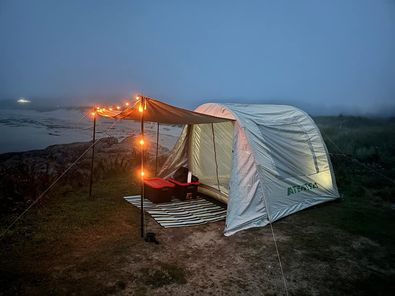
Once sealed, the vehicle's blower motors push conditioned air out of the dashboard vents and rear console vents. The air circulates over the folded rear seats (where you typically place a Tesla Camping Air Mattress) and floods into the attached tent. Because a premium tent utilizes high-denier fabrics and silver-coated insulation, it traps this conditioned air efficiently, preventing the vehicle's compressor from overworking.
Quick Summary Table: TENTSLA X1 Specifications
To demonstrate what a professional-grade setup looks like, here are the architectural specifications of the industry-leading model.
| Material / Component | Application & Purpose |
|---|---|
| 210D Oxford Fabric | Inner Fabric: Lightweight, highly breathable to prevent condensation buildup while maintaining the climate. |
| 420D Oxford Fabric | Outer Fabric & Floor: Extreme durability, puncture resistance against rocks, and heavy hydrostatic head waterproofing. |
| Aluminum | Support Poles: Aerospace-grade strength to withstand high winds without snapping or permanently bending. |
| Steel | Tent Pegs: Heavy-duty ground anchoring for unyielding stability in varied terrain. |
| Silver Coated Fabric | UV Protection & Heat Insulation: Reflects solar radiation to keep the AC running efficiently during summer days. |
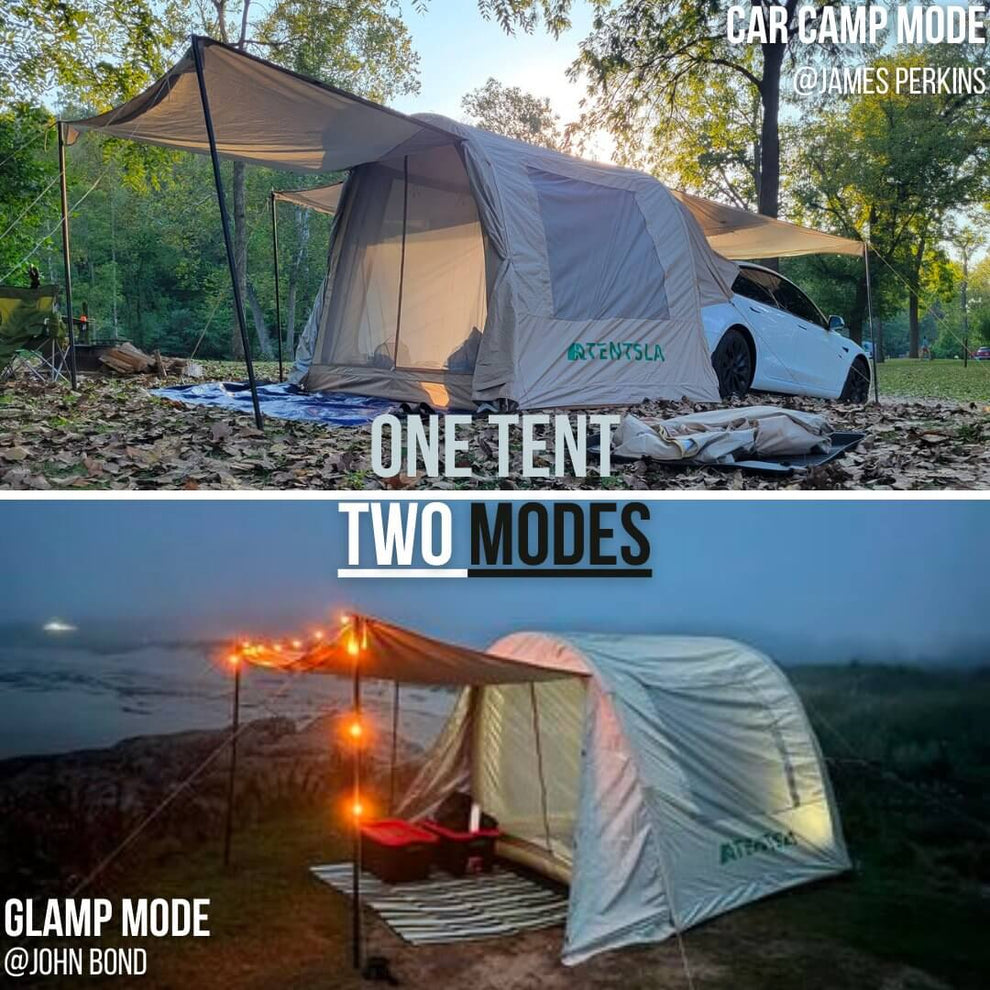
TENTSLA X1 Tesla camping Tent for Tesla Model 3, Model Y, and Model X
Premium Weather-Resistant Construction designed for optimal climate retention.
The Unmatched Benefits
In most professional situations, the goal of overlanding is to maximize comfort without sacrificing mobility. The Tesla AC camping tent offers benefits that entirely disrupt traditional camping paradigms.
Absolute Climate Control: The primary benefit is undeniable. Whether you are camping in the sweltering heat of the Mojave Desert or the freezing elevations of the Rockies, your living space remains a constant 70°F (21°C). This makes summer camping with children or pets infinitely safer and more enjoyable.
Massive Space Expansion: A Tesla Model Y is spacious, but it is not a living room. By attaching the tent, you separate your sleeping quarters (inside the car on a flat mattress) from your living/changing/dining quarters (inside the tent). This allows early risers to sit in the tent and drink coffee without waking those still sleeping in the vehicle.
Seamless Power Integration: With the tent sealed to the car, you have direct, bug-free access to the vehicle's infotainment system, charging ports, and interior lighting. You can power laptops, run induction cooktops, and keep your gear fully charged using your Tesla Road Trip Essentials.
Limitations to Consider
We believe in commercial and practical judgment. This setup is not magic; it is bound by the laws of thermodynamics and battery chemistry.
Battery Consumption: Running the AC or heater will drain your high-voltage battery. In our testing, Camp Mode consumes roughly 1% to 2% of the battery per hour, depending on the temperature differential. Over a 10-hour night, expect to lose 10-20% of your range. You must calculate this into your trip to ensure you have enough range to reach a Supercharger the next day.
Footprint Requirements: A connected tent requires a larger, flatter campsite. You need enough room to park the vehicle and extend the tent outward by at least 8 to 10 feet. This limits your ability to "stealth camp" in standard parking spaces.
Pros and Cons Table
| Pros (Why it's worth it) | Cons (The trade-offs) |
|---|---|
| Unparalleled comfort with active AC and heating. | Relies entirely on the vehicle's battery state of charge. |
| Secure, off-the-ground sleeping inside the locked vehicle. | Requires driving the car to a level, spacious campsite. |
| Stand-up headroom in the tent extension. | Cannot easily drive away without detaching the tent sleeve. |
| Protection from mosquitos while keeping the trunk open. | Higher initial investment compared to a basic nylon dome tent. |
Who Should Use It & Who Does Not Need It
For commercial users and digital nomads: If you work remotely and live out of your EV for extended periods, this is a non-negotiable upgrade. The ability to sit upright in an air-conditioned tent while on a Zoom call in the middle of a national park is the pinnacle of the modern outdoor lifestyle.
For family campers: Families transitioning from traditional car camping will find this setup revolutionary. Keeping children and pets safe from extreme temperatures makes trips drastically less stressful.
Who does not need it: If you are a hardcore backpacker who hikes 10 miles away from your parked car, or if you strictly engage in urban "stealth" car camping where deploying a large tent is illegal or impractical, this product is not for you. In those scenarios, a simple internal window shade kit is sufficient.
Comparison Table: AC Tent vs. Rooftop vs. Ground
| Feature | Tesla AC Tailgate Tent (TENTSLA) | Rooftop Tent (RTT) | Traditional Ground Tent |
|---|---|---|---|
| Climate Control | Yes (Direct from vehicle HVAC) | No (Ambient temperature only) | No (Ambient temperature only) |
| Aerodynamic Impact | Zero (Stored in sub-trunk while driving) | High (Reduces EV range by 10-15%) | Zero (Stored in trunk) |
| Living Space | Massive (Car + Tent combined) | Limited (Sleeping only) | Variable (Disconnected from car) |
| Pet Friendliness | Excellent (Ground-level access) | Poor (Requires lifting dogs up ladders) | Good (Ground level, but no AC) |
Common Mistakes to Avoid
In our experience, users who have a negative first time with their setup usually commit one of these three common mistakes:
1. Buying a Generic SUV Tent: A generic tent uses a loose bungee cord to wrap around the car. It will leak your expensive AC into the woods, overwork the Tesla's compressor, and let bugs in. You must buy a tent explicitly tailored to the aerodynamics of the Tesla, which is why we consider the Tentsla X1 the Best Tent for Tesla Model Y.
2. Ignoring the Battery Buffer: Never arrive at a remote campsite with 15% battery expecting to run Camp Mode all night. Always plan to arrive with at least 30-40% charge if you want to use heavy climate control and still drive out the next morning.
3. Failing to Turn Off Auto-Wipers/Lights: When sleeping in the car, shifting your weight can sometimes trigger vehicle sensors. Ensure your screen is in Camp Mode, which appropriately manages screen brightness, exterior lighting, and prevents the wipers from triggering if morning dew settles on the windshield.
Buying Considerations & Material Science
When you are ready to make a purchasing decision, you must evaluate the engineering of the tent materials. A Tesla AC camping tent acts as an insulation barrier; therefore, material density matters.
Look for Oxford fabric. Denier (D) is the unit of measurement that dictates the thickness of the individual threads. A standard cheap tent uses 150D or lower. For heavy-duty applications, you must demand at least 210D for the inner walls to maintain breathability, and 420D for the outer fly and floor. The 420D floor ensures that dog claws, camping chairs, and sharp rocks will not puncture the waterproof membrane.
Additionally, the integration of Silver Coated Fabric is crucial for daylight efficiency. Silver coating reflects UV rays and solar radiation. If your tent lacks this coating, the sun will turn the tent into a greenhouse, forcing the Tesla's AC to run at maximum RPMs to compensate, which rapidly drains your battery.
Buying Guide Table
| What to Look For | Why it Matters for a Tesla | The TENTSLA Standard |
|---|---|---|
| Custom Tailgate Seal | Prevents conditioned air from escaping; stops carbon dioxide pooling under the car from entering. | Precision-engineered sleeve for Model 3/Y/X. |
| Hydrostatic Head Rating | Determines water resistance. Weak tents leak during heavy storms, soaking your car's interior. | High-grade 420D Oxford handles torrential downpours. |
| Freestanding Capability | Allows you to detach the car and drive to the store while leaving the tent pitched at the site. | Fully freestanding with structural aluminum poles. |
Expert Recommendation
From our experience at TENTSLA: The convergence of EV technology and outdoor recreation is not a passing trend; it is the new standard. Attempting to force legacy camping gear to work with an advanced vehicle creates friction and ruins the experience.
We emphatically recommend upgrading your outdoor setup to a purpose-built Tesla AC camping tent. The return on investment is immediate: you gain a mobile, climate-controlled hotel room that allows you to camp comfortably 365 days a year. When evaluating the market, the TENTSLA X1 stands alone. With its 420D Oxford fabric, aerospace-grade aluminum poles, and flawless tailgate seal, it is the only product we trust to maximize the potential of Tesla's Camp Mode. Do not compromise your vehicle's efficiency with inferior generic knock-offs; invest in the gear that matches the engineering of your car. Explore our full line of Tesla Tent Accessories to complete your ultimate overlanding rig.
Frequently Asked Questions
Does a Tesla AC camping tent drain the battery quickly?
Can I use any SUV tent on my Tesla?
Is it safe to leave the Tesla trunk open all night?
Authoritative References & Industry Standards
To ensure our readers have access to the highest standards of outdoor ethics and EV operation, we reference the following authoritative organizations:
- Tesla Official Owners Manual - Defining the exact software parameters, safety protocols, and battery management strategies for utilizing Camp Mode.
- Leave No Trace Center for Outdoor Ethics - The definitive standard for minimizing campsite footprint, protecting wildlife, and engaging in responsible vehicle-based overlanding.
- U.S. Department of Energy (DOE) - Providing foundational data on electric vehicle efficiency, HVAC energy consumption, and high-voltage battery operation in extreme weather conditions.