


The Tentsla Origin Story: Our story is one born from the rugged wilderness of Victoria, Australia, where the raw beauty of nature is as breathtaking as it is unforgiving. It was mid-July, and the chill of the Australian winter enveloped the landscape. Four friends, united by wanderlust and the thrill of adventure, set out in their Tesla to immerse themselves in the serenity of a national park, with spirits high and hearts full of excitement. As night descended, so did the temperature, and the group faced the ultimate outdoor trial. Two of us sought shelter in a traditional camping tent, while the others remained in the car. The stark contrast between the biting cold outside and the retained warmth inside the Tesla was an eye-opener. Those in the tent battled the cold, a night so frigid it was etched into our memories, while those in the car embraced the comfort of their futuristic haven.
This profound experience in the freezing Australian outback led directly to the birth of Tentsla. However, surviving that night also forced us to confront a vital engineering question that every single electric vehicle adventurer must eventually answer: exactly how much battery does Tesla's Camping Mode drain per hour?
From our extensive experience engineering premium outdoor gear tailored specifically for electric vehicles, we know that relying on guesswork in the wilderness is undeniably dangerous. If you do not know precisely how much battery does Tesla's Camping Mode drain per hour, you risk waking up to a highly depleted vehicle that physically cannot make it to the nearest Supercharger. We recommend approaching your overland power management with strict mathematical precision. You cannot simply assume your car will behave the same in a snowstorm as it does on a mild autumn evening.

In this comprehensive, highly opinionated guide, we strip away the marketing fluff and break down the raw thermodynamics of the climate control system. We will analyze real-world consumption data across wildly varying climates to provide the definitive answer to how much battery does Tesla's Camping Mode drain per hour.
Summary: Expected Battery Drain Under Various Conditions
| Ambient Weather Condition | Average Temperature | Hourly Battery Drain | 8-Hour Overnight Drain |
|---|---|---|---|
| Mild / Ideal | 60°F - 70°F (15°C - 21°C) | ~1% per hour | 8% - 10% |
| Hot / Summer | 80°F - 95°F+ (26°C - 35°C+) | 1.5% - 2% per hour | 12% - 16% |
| Cold / Winter (Heat Pump) | 20°F - 32°F (-6°C - 0°C) | 2% - 2.5% per hour | 16% - 20% |
| Extreme Cold (PTC Heater) | Below 10°F (-12°C) | ~3% per hour | 24%+ |
Table of Contents
- 1. The Core Engineering: How Camp Mode Works
- 2. Mild Weather Consumption (60°F to 75°F)
- 3. Cold Weather Consumption (Below 32°F)
- 4. Hot Weather Consumption (Above 85°F)
- 5. Five Factors That Accelerate Power Loss
- 6. Tentsla's Proven Strategies to Minimize Drain
- 7. The 20% Rule and Off-Grid Planning
- 8. Frequently Asked Questions (FAQs)
- 9. Authoritative References

1. The Core Engineering: How Camp Mode Works
When examining how much battery does Tesla's Camping Mode drain per hour, we must first dispel a widespread consumer myth. The car does not simply "stay awake" in its normal, driving operational state. Camp Mode is a highly specialized, low-power software state engineered specifically to optimize energy distribution while you sleep. It automatically disables the security alarm, deactivates the walk-away door locks, and keeps the low-voltage subsystem active to continuously power the USB charging ports, the center entertainment display, and the interior ambient lighting. Most critically, it commands the high-voltage battery to bypass sleep mode in order to maintain a strictly regulated cabin temperature.
From an engineering perspective, the hardware variable that most heavily alters the equation of how much battery does Tesla's Camping Mode drain per hour is the type of climate control system installed in your specific chassis. Older vehicles (pre-2021 Model 3s and early Model S/X units) utilizing resistive PTC heaters will inherently consume significantly more power. Resistive heating essentially forces electrical current through a resistor to generate raw heat—a massively inefficient process. Conversely, newer models equipped with the proprietary Octovalve heat pump system function differently. Heat pumps move existing ambient thermal energy into the cabin rather than creating it from scratch, which drastically reduces power consumption.
2. Mild Weather Consumption (60°F to 75°F)
In temperate, mild climates, your vehicle barely has to exert any effort. When the outside ambient temperature closely mirrors your desired internal cabin temperature (e.g., it is 65°F outside and you set the climate to 68°F), the HVAC compressor and heater core sit completely idle. The system only utilizes minimal power to run the circulation fans on low speed, cycling fresh air through the HEPA filter.
Under these ideal, near-perfect conditions, when clients ask us how much battery does Tesla's Camping Mode drain per hour, we confidently state it is roughly 1%. This translates to a negligible 8% to 10% total capacity loss over a standard eight-hour sleep cycle. Many new owners vastly overestimate how much battery does Tesla's Camping Mode drain per hour in normal conditions, leading to unnecessary anxiety. In mild weather, your vehicle is essentially just operating as a highly efficient, oversized air purifier.
3. Cold Weather Consumption (Below 32°F)
This is precisely where our origin story in the freezing Australian winter becomes highly relevant. When ambient temperatures plummet below freezing, thermodynamics turn aggressively against you. The glass roof of your vehicle offers virtually zero thermal insulation. If you are sleeping in sub-zero conditions and demanding a toasty 72°F cabin, the heating system is forced to run continuously at maximum capacity to combat the relentless thermal bridging.
In these extreme, frigid scenarios, the amount of battery does Tesla's Camping Mode drain per hour leaps to 2% to 3%. Over an eight-hour night, you could easily burn through 16% to 24% of your total battery pack. If you are driving an older Model 3 with a PTC heater through a blizzard, that number can climb even higher. It is an absolute necessity to factor this massive energy penalty into your route planning before driving deep into a snowy national park.
4. Hot Weather Consumption (Above 85°F)
While cold weather drains the battery through aggressive heating, desert camping presents its own unique set of challenges. To accurately predict how much battery does Tesla's Camping Mode drain per hour in the summer heat, you must account for solar load. Even if the sun has set, a vehicle parked on sun-baked asphalt will radiate heat throughout the night. The air conditioning compressor must run frequently to pull humidity and heat out of the cabin.
We typically see hot weather consumption hover around 1.5% to 2% per hour. The AC compressor is generally more electrically efficient than a resistive heater, but it still demands a steady flow of kilowatts. If you park in direct sunlight for an afternoon nap without deploying proper reflective window shades, the system will work overtime, rapidly depleting your reserves.
5. Five Factors That Accelerate Power Loss
The climate system is not the only culprit. Several user-controlled variables can severely impact your energy reserves. If you want to optimize your setup, you must monitor these five factors:
- Sentry Mode Interference: Leaving Sentry Mode active while sleeping inside the car is a critical mistake. The cameras and FSD computer will remain active, capturing your every movement inside the vehicle. By eliminating this unnecessary power draw, you lower how much battery does Tesla's Camping Mode drain per hour by up to 30%.
- Center Display Usage: Streaming Netflix or playing intensive arcade games on the center console while the climate control is running will pull significant wattage. Turn off the screen using the "Screen Clean Mode" or simply let it sleep to conserve power.
- Charging External Devices: Plugging two laptops, a drone battery, and multiple smartphones into the 12V and USB-C ports draws power directly from your high-voltage pack via the DC-DC converter.
- Uninsulated Glass: The panoramic glass roof is a thermal nightmare. It lets heat escape in the winter and bakes you in the summer.
- Excessive Fan Speeds: Manually overriding the automatic climate control to force the fans to blow at maximum speed (Level 10) uses substantially more electricity than letting the system regulate itself on a lower setting.
6. Tentsla's Proven Strategies to Minimize Drain
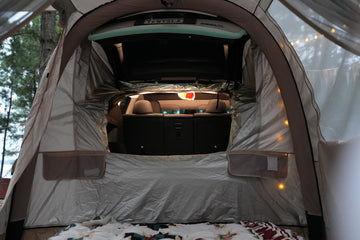
We adamantly recommend a holistic, gear-focused approach to your Tesla Camping Setup. Relying entirely on the car's HVAC hardware to keep you comfortable is inefficient and risky. By utilizing premium, purpose-built gear, you can let your body heat do the work, allowing you to lower the cabin temperature settings drastically in the winter.
The foundation of any efficient setup is proper insulation from the cold trunk floor. We highly recommend integrating a proper Tesla Camping Mattress into your loadout. A high-R-value sleeping pad acts as a thermal barrier between you and the uninsulated sub-trunk. For maximum comfort and thermal retention, upgrading to a Self Inflating Camping Mattress ensures you stay warm without forcing the car's heater to run constantly. If you prefer an exact, laser-cut fit for your specific vehicle dimensions, the Tesla Trunk Mattress provides edge-to-edge insulation.
Furthermore, do not waste your vehicle's 12V battery trying to inflate massive air mattresses with cheap, inefficient pumps. Use a dedicated Portable Air Pump for Tent setups to save your car's electrical reserves for what matters most: driving home safely the next day.
7. The 20% Rule and Off-Grid Planning
Tesla engineers built a hardcoded safety net into the software. When the high-voltage battery reaches exactly 20% State of Charge (SoC), Camp Mode will automatically disable itself. The climate control will shut off, and the vehicle will aggressively attempt to preserve the remaining 20% so you can drive to a charger. You cannot bypass this limit.
Ultimately, understanding how much battery does Tesla's Camping Mode drain per hour allows you to calculate your necessary arrival buffer. We recommend arriving at any off-grid campsite with an absolute minimum of 50% battery. If you assume a 15% overnight drain, plus the 20% unusable floor, you are left with a mere 15% to drive back to civilization. When asked what average battery does Tesla's Camping Mode drain per hour, we point to the 1-2% baseline, but we always advise planning for a worst-case 3% scenario.
8. Frequently Asked Questions (FAQs)
No. Tesla's battery management system (BMS) is highly advanced. Using Camp Mode simply draws a low, continuous current, which is actually far less stressful on the lithium-ion cells than the massive, instantaneous amp draw required for rapid highway acceleration. It causes zero undue degradation.
Technically, no. Activating Camp Mode intentionally disables Sentry Mode to prevent the interior motion sensors from constantly triggering the alarm while you toss and turn in your sleep. If you want exterior security cameras recording, you must use "Keep Climate On" instead of Camp Mode, but this will consume significantly more battery.
The single biggest variable affecting how much battery does Tesla's Camping Mode drain per hour is ambient temperature. If a sudden cold front moved in, the heater likely consumed more power than you anticipated, causing the battery to hit the mandatory 20% shutoff threshold, which instantly deactivated the system.
Yes. By eliminating these power draws, you lower how much battery does Tesla's Camping Mode drain per hour by up to 30% in mild climates. The massive infotainment screen, especially if streaming high-definition video over cellular data, is a notable energy consumer. Knowing exactly how much battery does Tesla's Camping Mode drain per hour ensures a safe, stress-free adventure when you manage these secondary systems correctly.
9. Authoritative References & Further Reading
To further understand the engineering behind electric vehicle efficiency, thermal management, and safety protocols, we highly recommend consulting the following authoritative sources:
- Tesla Official Owners Manual - Direct manufacturer specifications regarding Camp Mode activation, limitations, and the 20% battery preservation floor.
- U.S. Department of Energy: EV Technology - Technical breakdowns of how modern heat pumps and battery management systems operate under extreme environmental stress.
- AAA Electric Vehicle Climate Study - Independent, rigorous laboratory testing detailing exactly how sub-zero temperatures drastically reduce lithium-ion battery capacity and increase HVAC energy consumption.
- EPA Electric Vehicle Guide - Governmental insights into EV efficiency metrics and the environmental impact of idling an electric vehicle versus a traditional internal combustion engine.
- Tesla Camping Community Forum - A massive repository of real-world, peer-reviewed data from thousands of owners testing off-grid electrical consumption.